World
Venezuela quakes: Thousands of survivors seek food, shelter

Tens of thousands of people desperately sought food and shelter in Venezuela on Tuesday after the two earthquakes killed nearly 2,000, but rescue teams managed to pull a 3-year-old boy alive from the rubble six days after the shocks.
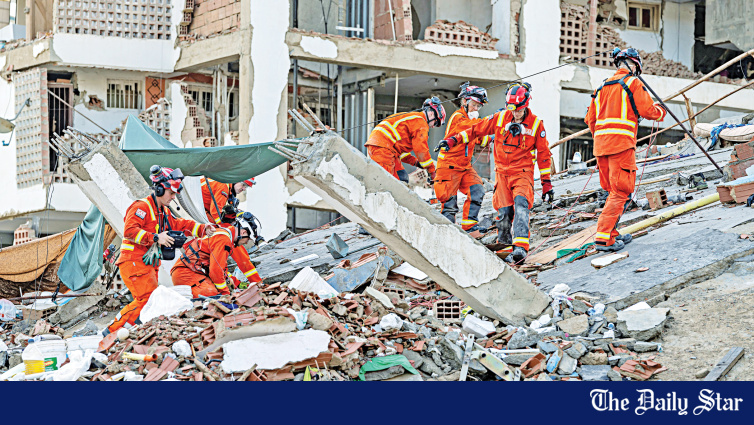
Last week’s 7.2 and 7.5 magnitude shocks — one of the worst earthquake disasters in Latin American history — collapsed whole residential complexes, left tens of thousands unaccounted for and prompted frantic search-and-rescue operations for survivors trapped in the ruins.
Hopes were fading fast for more rescues, but nearly a week after the quakes, a Jordanian civil defense team dug the three-year-old boy from the wreckage of a house in Caracas.
Video footage online showed rescue workers cheering with joy on discovering the child, whose vital signs were good, the Jordanian civil defense said in a statement.
The critical 72-hour window during which survivors were still likely to be found closed on Saturday evening.
Six days after the shocks, the UN refugee agency said “food shortages are widespread, basic services have broken down and connectivity has been largely severed” in the port city of La Guaira — the worst hit area north of the capital Caracas.
“They give out supplies here, but sometimes people nearly kill each other for food…it’s like a cockfight,” said Daniela Armas, 18, a vendor in La Guaira who was injured falling from a motorbike during the quakes.
In a daily update, Venezuela’s National Assembly President Jorge Rodriguez said deaths had risen to 1,943, with more than 10,500 injured after one of Latin America’s worst earthquake disasters.
He said nearly 6,500 people had been rescued from the rubble in La Guaira, but that number was likely closer to 20,000 including those who escaped or were helped out by family.
Many Venezuelans have not hidden their anger at the government’s slow response to the disaster in a country already struggling with decades of economic crisis that has weakened infrastructure and health services.
The UN agency said it needed some $14.85 million to scale up aid and temporary shelter for 30,000 people over six months.
The quakes likely damaged or destroyed 58,870 buildings, according to a preliminary assessment of satellite data published by Nasa.
With thousands in need of help, World Health Organization spokesman Christian Lindmeier said health services in Venezuela were overstretched and under “extreme pressure.”
“There’s an increased risk now of outbreaks of vaccine-preventable diseases” such as measles and diphtheria, due to low pre-earthquake vaccination coverage, he said.
As international rescue teams from the US, Mexico and dozens of other countries scrambled with trained dogs and heavy equipment to dig out survivors, Venezuelans began burying the dead they could find.
Others were frantically searching by hand for missing loved ones in the rubble, but also in hospitals and morgues.
“It’s harder not knowing because you ask yourself, ‘What do I do? Where do I look for her?” said Rosanna Luna, looking for her sister Soraida in the wreckage of her home.