World
Vance: Iran invited UN nuclear inspectors back into country, in ‘major milestone’

Iran has agreed to invite International Atomic Energy Agency inspectors back into the country, US Vice President JD Vance said Monday after the first round of US-Iran peace talks in Switzerland, where he said “very good progress” was made on resolving the crisis in Lebanon.
“The Iranians have agreed to invite IAEA inspectors back into their country,” Vance told reporters at the Burgenstock resort. He called Iran’s invitation to UN nuclear inspectors “a major milestone for the American people and the first step in permanently denuclearizing or permanently ending a nuclear weapons program in Iran.”
“We laid a very good foundation for a successful final deal,” Vance said. “The final deal is the house… We haven’t built the house, but we’ve laid a successful foundation to get to a good place for the American people.”
The IAEA has accused Iran of obstructing inspections and failing to give a full account of its highly enriched uranium stockpile after the material was apparently buried in US strikes on key Iranian nuclear sites during last June’s 12-day Israel-Iran war.
Vance’s comments came after Iran’s Foreign Ministry spokesman Esmaeil Baghaei said that outside of an unspecified “brief discussion,” the talks in Switzerland had not touched on Iran’s nuclear program.
“One of the points raised by the American delegation was the presentation of its positions regarding the nuclear issue,” Baghaei said. “A very brief discussion took place regarding the nuclear issue, but there was no discussion of details, and it cannot be said that negotiations on the nuclear issue have begun.”
While Iran, whose leaders are sworn to destroy Israel, denies seeking nuclear arms, it has amassed uranium enriched to levels with no peaceful application.
Israel and the US launched a bombing campaign on Iran on February 28 in a bid to destabilize its regime and destroy its ballistic missile and nuclear programs, but the fighting entered a truce on April 8 with none of those goals achieved.
Vance: Washington wants to restrict Iran’s unfrozen funds to purchasing US produce
Speaking at Burgenstock, Vance indicated the US is seeking to restrict the use of unfrozen Iranian assets to purchasing produce from US farmers for the “benefit” of the Iranian people, rather than terrorism.
According to Vance, the scheme was worked out by US President Donald Trump’s son-in-law and unofficial adviser Jared Kushner along with Qatari mediators, and would see Iranian funds unfrozen as part of a peace deal only after approval from Doha and Washington.
The initiative would be mutually beneficial to Washington and Tehran, since “if Iranian assets are ever unfrozen, they’re going to go to make American farmers richer and to feed the Iranian people,” Vance said. Public concerns about unfreezing Iranian assets were sparked by “misreporting” on the issue, he added.
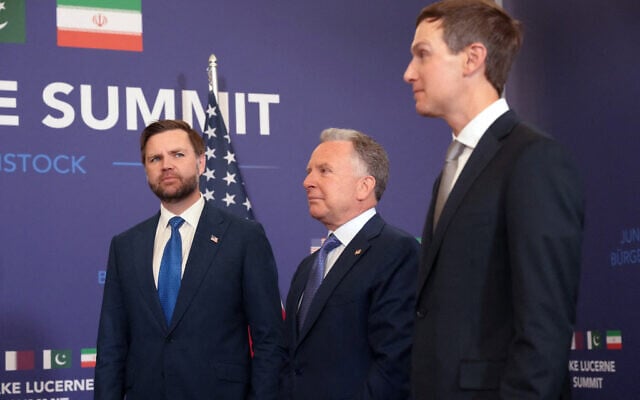
Vance also said the US was in “constant contact” with Israel and other regional partners throughout the negotiations with Iran.
“We’re constantly trying to keep our regional friends updated about this. This is not a deal that the United States is imposing on the region. This is a deal that the region has desperately asked the United States to put in place,” he claimed.
Trump seeks to “lay the foundation, see if we can get to a permanent peace. If we can’t, the president of the United States still has a lot of options to accomplish America’s security objectives,” Vance said. “But he has certainly committed us to this pathway for now, and we’re going to keep on working and seeing what we can accomplish.”
‘Very good progress’ on Lebanon ‘de-confliction,’ says Vance
Along with IAEA inspections, the negotiations in Switzerland also secured agreement on “a mechanism for keeping the Strait of Hormuz open,” and made “very good progress” on a “deconfliction mechanism” for the Israel-Hezbollah conflict in Lebanon, Vance said.
“We wanted to make sure that we had the proper coordination set up so that if there is shooting, if Hezbollah fires at Israel or if Israel responds, if there are other conflicts that arise in the region, we’re actually talking to each other and figuring out how to stop the shooting,” he said.
He says the goal of the mechanism is to allow for direct communication when incidents occur between Israel, Lebanon, Hezbollah, and other regional partners, falsely claiming that “there really hasn’t been a mechanism to have those discussions until basically [yesterday,] when we set that up.”
In fact, a nearly identical deconfliction mechanism was set up during the Biden administration as part of the November 2024 ceasefire it brokered in Lebanon.
That panel included representatives from Israel, the Lebanese government, the US, the UN and France, and remains in place to date, albeit with limited effectiveness.
One apparent difference between the deconfliction mechanism described by Vance and the one that already exists is that the vice president says Hezbollah will be part of the conversation.
“Sometimes a junior guy (in Hezbollah) fires a drone that didn’t have approval from the high command. Of course, Israel has to respond to that, but we could have a more peaceful situation if Israel responds in the context of the conversation that is ongoing between Hezbollah, Lebanon, Israel and other partners in the region,” Vance said.
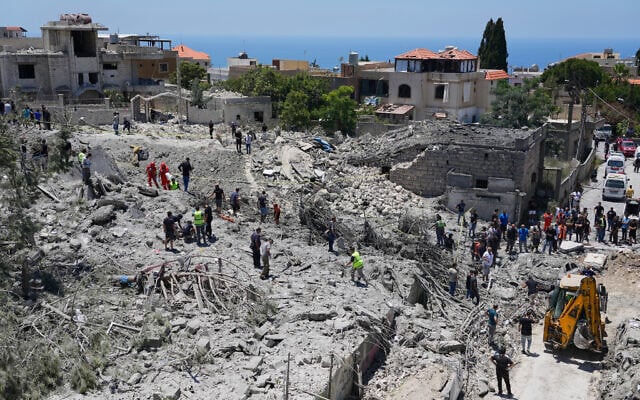
Washington believes it “can get to a place where Lebanon’s territorial integrity and sovereignty is protected, Israel’s security is protected, and that’s going to require some coordination with the Lebanese armed forces, and also it’s going to require the Iranians to rein in Hezbollah,” Vance said.
He noted Iranian negotiators had threatened to walk out after US President Donald Trump threatened to “hit Iran very hard again” if it did not rein in its “highly paid PROXIES in Lebanon from causing trouble.”
The vice president defended Trump’s comments.
“What we told the Iranians yesterday is when you guys engage in what us millennials might call ‘trash talk,’ you can’t expect the president of the United States not to respond and not to correct the record,” Vance said.
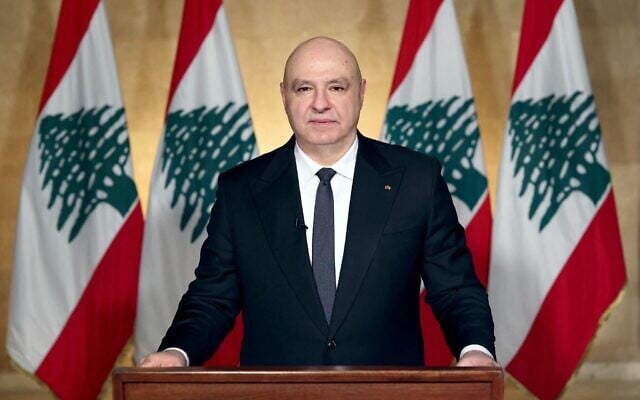
Meanwhile, Lebanese President Joseph Aoun’s office said he received a call from Vance, Kushner and Qatari Prime Minister Sheikh Mohammed bin Abdulrahman Al Thani on Monday about the Lebanon ceasefire and “de-confliction cell.”
They discussed “the issue of consolidating the ceasefire in Lebanon, stopping the Israeli military escalation, and steps that should be taken in this regard, including the possibility of forming a cell for this purpose,” the Lebanese presidency said.
Under last week’s US-Iran memorandum of understanding, which forms the basis for the Burgenstock talks, hostilities are to cease across the region, including in Lebanon.
Israel, which is not a party to either the MOU or the talks, has vowed to stay in Lebanon, and Israeli officials have voiced criticism of the MOU. Meanwhile, the White House has expressed unprecedented criticism of Israel over its operations in Lebanon.
Technical talks to continue throughout the week
The negotiations, which secured an agreement on a roadmap to reach a final deal within 60 days, were expected to devolve into lower-level technical talks throughout the week.
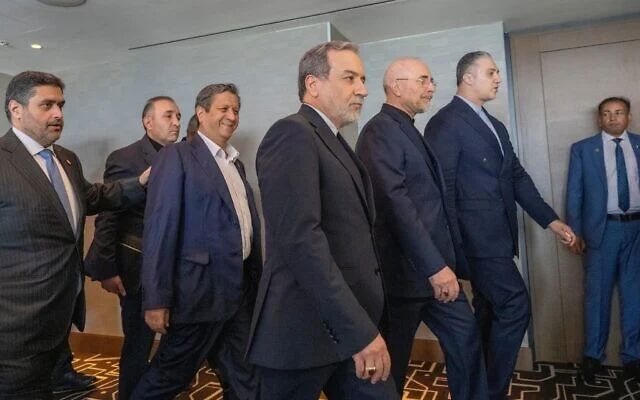
Iran’s high-level negotiating team had already left Switzerland for Tehran by the time Vance spoke on Monday, after 18 hours of “intensive” talks, Iranian state media said.
The Iranian delegation, led by parliament speaker Mohammad Bagher Galibaf, left behind a team of experts led by Deputy Foreign Minister Kazem Gharib Abadi for the technical talks, according to Iran’s semi-official Tasnim news agency.
An official involved in the talks told The Times of Israel that the high-level delegations from the US, Qatar and Pakistan were still at Burgenstock, but were also expected to leave shortly and leave behind experts for the technical talks.