World
US Military Launches 'Self-Defence' Strikes On Iran After Trump Vows Response To Apache Crash Near Strait Of Hormuz

Tehran: US Central Command (CENTCOM) has announced military action against Iran on Tuesday, hours after President Donald Trump claimed that a US Apache helicopter was downed by Iran. Taking to Truth Social, Trump also emphasised that the US must respond to the attack on it’s “highly sophisticated” helicopter. The announcement followed reports of a US Army Apache helicopter going down off the coast of Oman near the Strait of Hormuz and later, an American Navy drone boat rescued the 2 crew members.
Initially, there was no word on the reason behind the crash and an investigation was launched to find the cause. According to CENTCOM, American forces began operations at 5 pm local time on Tuesday. The command stated that strikes were carried out “at the Commander in Chief’s direction”. CENTCOM framed the action as self-defence, stating, “The mission is a proportional response to unjustified Iranian aggression.”
Crash And Conflicting Accounts
Following the launch of strikes, CENTCOM, in a post on X, said, “U.S. Central Command (CENTCOM) forces began launching self-defense strikes against Iran at 5 p.m. ET today at the Commander in Chief’s direction, in response to yesterday’s downing of a U.S. Army Apache helicopter. The mission is a proportional response to unjustified Iranian aggression.”
Earlier, US President Donald Trump blamed Iran for the downing of the US military helicopter. “The Iranians shot down one of our highly sophisticated Apache Helicopters while patrolling over the Strait of Hormuz,” he posted on Truth Social, adding that he had been briefed by the military. Trump said, “There were two pilots involved, both are safe and uninjured. Nevertheless, the United States must, of necessity, respond to this attack.”
A US official, speaking to the Associated Press on condition of anonymity, stated that the helicopter went down after colliding with an Iranian drone. However, it was not clear whether the collision was deliberate, and the official statements noted that the crash remained under investigation. Another US official stressed that the current indications pointed to an Iranian drone being responsible.
Soldiers Rescued With No Life-Threatening Injuries
CENTCOM reported that the 2 crew members were recovered within about 2 hours of the incident and were in stable condition, adding that their AH-64 Apache was patrolling regional waters when it went down.
Spokesperson Captain Tim Hawkins stated that a Task Force 59 unmanned surface vessel located and rescued the soldiers. He called it a first for US forces, saying that the task force began deploying the drone boats in theatre in late March. It is also confirmed that both soldiers were receiving medical care and their injuries were not serious or life-threatening.
Iranian response
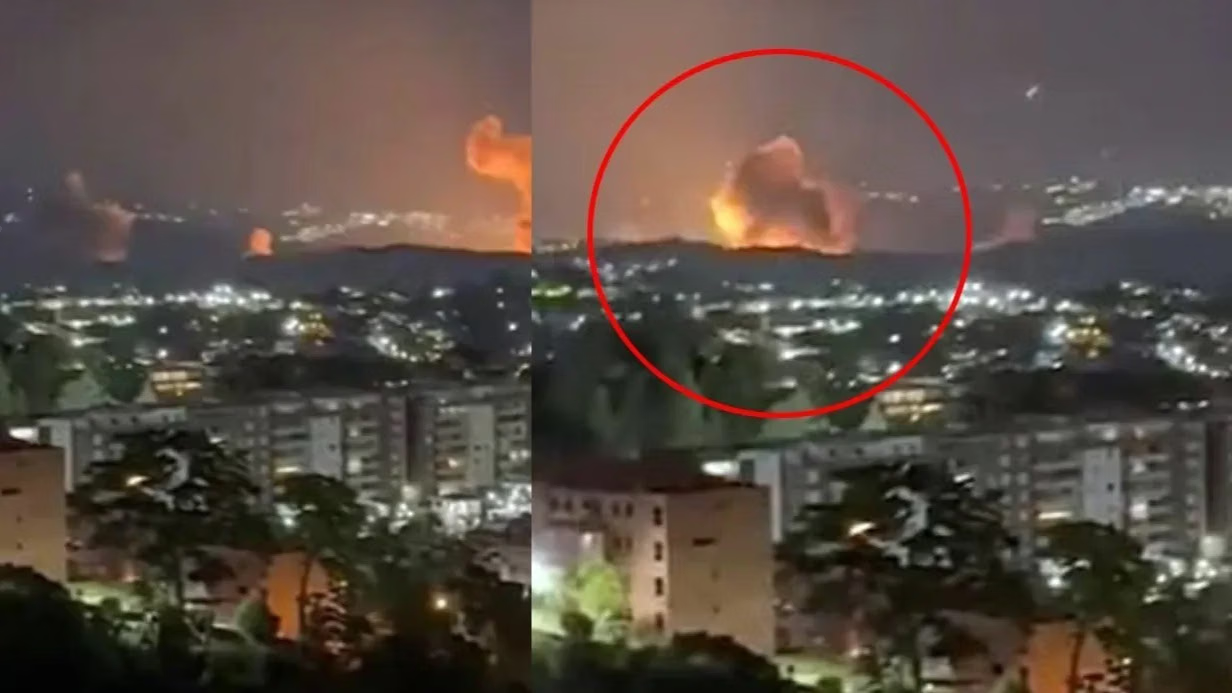
Iranian state broadcaster, Islamic Republic of Iran Broadcasting (IRIB) reported on X that multiple explosions were heard in Sirik and Qeshm Island in the Strait of Hormuz, about 80 km from Minab. The outlet added that “the US has claimed responsibility for this military aggression”. The tweet from IRIB confirmed the attack, after CENTCOM claimed that it had begun “self-defense strikes” in response to an Apache helicopter incident.
It also defied rumours of destruction after US strikes, saying, “Contrary to rumors, no impacts have been reported in Tehran, Minab, or Bandar Abbas.”
Earlier, Iranian Foreign Minister Abbas Araghchi posted on X that foreign forces near Iran face inherent risks, saying, “Foreign forces in proximity to our territory are at constant risk on account of their own human errors, plain accidents, or potentially being caught in crossfire. To reduce risk, best solution is for them to leave. We prefer language of diplomacy but speak other languages too.” However, he did not address Iran’s role in the US helicopter incident.
Iranian media, including the semi-official Mehr News Agency, reported that no claim of responsibility had been made by Iran. The Islamic Revolutionary Guard Corps (IRGC) had not issued a statement at the time of reporting.
Strait Of Hormuz Crisis Deepens
Following the fresh strikes, the crisis deepens at the Strait of Hormuz, which carries about one-fifth of the world’s oil supply. Trump had earlier stressed that he intended to restore traffic through the waterway as part of negotiations with Iran. Speaking on Tuesday, he told reporters, “We’re in the final throes of what will be a very, very good deal that will not allow in any way, shape or form nuclear weapons. The strait will open up right away. It’ll open up immediately upon signing, which could be in two or three days,” adding it could be done “in one hour, if you want to know the truth”.
Asked about obstacles, Donald Trump said, “I don’t think there are any sticking points. I think we’re very close to having a very, very good, strong, powerful deal,” and that an agreement would be “actually stronger than doing the bombing.” He has repeatedly suggested a deal is close since a ceasefire was agreed, though no agreement has materialised so far.
He also told NBC’s ‘Meet the Press’ on Sunday that he did not view US troops in the region as being in danger. “We have the best offense anyone’s ever seen. So I don’t consider it a danger,” he said, adding he did not plan to withdraw them because they may still be needed.