World
US launches 2nd night of strikes against Iran, as Israel said bracing for war to restart

The United States launched fresh strikes on Iran late Wednesday and into early Thursday morning after striking Iranian targets a day earlier in response to attacks on commercial shipping in the Strait of Hormuz, as the Israeli defense establishment was reportedly keeping a close eye on the rising tensions amid concerns the fighting could quickly escalate and draw Israel back in.
The US was also reportedly returning its refueling planes to the region, after they were removed during the ceasefire that began in early April. Some of the planes, whose presence is a potential signal of the war restarting, were previously parked at Ben Gurion Airport.
According to Channel 12 news, Prime Minister Benjamin Netanyahu and Defense Minister Israel Katz were holding a security consultation Wednesday evening, a day after the US and Iran resumed attacks.
Tehran fired on ships in the Strait of Hormuz, prompting the US to hit Iranian targets overnight Tuesday-Wednesday and Iran to retaliate against US targets in the Gulf. Iranian state media reported that eight members of the Iranian navy and air force were killed in US attacks on southern parts of the country, in Bandar Abbas and Bushehr.
On Wednesday, following those strikes, lead mediator Pakistan urged restraint. But both the US and Iran used bellicose rhetoric, with Iran threatening to close the strait and US President Donald Trump first declaring that the memorandum of understanding between the countries was “over,” then sending mixed signals over whether, or how much, fighting would continue.
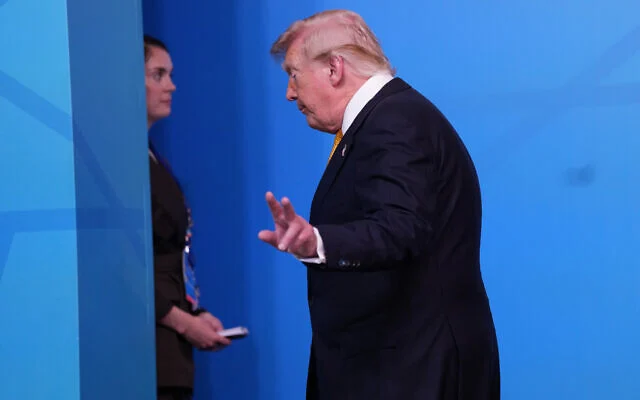
“I don’t think it’s going to start again. I think it’s going to go very quickly. They hit a couple of ships, and so we hit them much harder,” Trump said Wednesday during a press conference at the conclusion of a NATO summit in Ankara.
“Anything that happens is going to be over very quickly, and we’ll only make it safer — including for oil,” Trump stressed, adding that the US has managed to get significant amounts of oil out of the Strait of Hormuz since the MoU was reached last month.
“We’re not looking for long term,” Trump stressed. He then said, paradoxically, “I’m not sure I want to make a deal. Let’s just finish the job.”
In Truth Social posts accompanying images he shared of US strikes in Iran, which he called “retribution for yesterday’s bombing of ships by Iran,” Trump warned, “If it happens again, it will get much worse!”
US Vice President JD Vance also said that the US would “knock the hell out of” Iran if it kept firing at ships.
““The basic deal that we cut was we’ll lift our blockade if you stop shooting at ships — but if you shoot at ships, we are going to punch back, and we’re going to punch back harder than ever before,” he said at an event, according to CNN.
While the most recent exchange of fire has remained confined to the Gulf and has not spilled over into Israel, Jerusalem is preparing for multiple scenarios, given concerns that the situation could deteriorate rapidly, Channel 12 reported.
The IDF has reportedly raised its level of readiness across the board, maintaining both defensive and offensive preparations. The military was said to have operational plans ready, fighter jets armed and on standby, and target banks prepared based on updated intelligence.
The report added that the IDF is maintaining close coordination with US Central Command to ensure Israel is prepared for any sudden escalation and was not caught by surprise. The escalation with Iran is likely being seen as a welcome development in Israel, which was not a party to the US-Iran talks, has been wary of them, and has sought to further weaken Tehran’s military and regime.
US strikes Hormuz targets again, said to bring refuelers back
The US military announced Wednesday evening that it conducted a fresh wave of strikes against Iranian military targets in the Strait of Hormuz, which continued into early Thursday morning local time.
The second night of US strikes against Iran would be greater in number than the ones carried out a day earlier, a US official told Reuters, speaking on condition of anonymity.
“At the direction of the Commander in Chief, US Central Command forces have started conducting additional strikes against Iran to further degrade their ability to threaten freedom of navigation in the Strait of Hormuz,” CENTCOM posted on X.
“The United States is holding Iran accountable for recent unjustified aggression against commercial shipping and civilian crews freely navigating a vital international waterway,” it added.
This is in retribution for yesterday’s bombing of ships by Iran. If it happens again, it will get much worse!
( TS: Jul 8 2026, 5:35 PM ET ) pic.twitter.com/cEp1lp4VWN
— Commentary Donald J. Trump Truth Social Posts On X (@TrumpTruthOnX) July 8, 2026
The Kan public broadcaster meanwhile reported that the US has begun returning military refueling planes to the Middle East, after they had been evacuated from the region to Europe in recent weeks upon the signing of the MoU.
PM: Canceled Hegseth visit ‘could mean something’
Also on Wednesday, Prime Minister Benjamin Netanyahu confirmed that US Defense Secretary Pete Hegseth canceled a planned visit to Israel after being “called back” to Washington. The premier suggested that the cancellation could be a positive development for Israel amid escalating US-Iran tensions.
Asked about the visit during a lengthy Hebrew-language podcast interview with Israeli journalist and former right-wing Knesset member Sharon Gal, Netanyahu said Hegseth “was called back” to the White House from the NATO summit in Turkey.
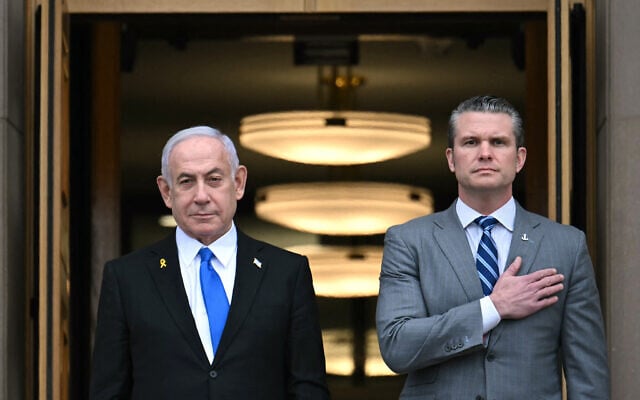
However, Hegseth was still with Trump in Turkey on Wednesday evening in Turkey, and had not in fact returned to Washington. Netanyahu did not specify the purpose of the planned visit or the reason for its cancellation, but told the interviewer he did not take it as a bad sign.
“Why do you think it disappoints me? Maybe it means something else?” he said when Gal asked if he was disappointed by the cancellation.
“I can’t tell you,” he added when pressed on what he meant, saying only that “there are a few possibilities here.”
Mediators warn against escalation
Qatar and Pakistan, which mediated the MoU between the US and Iran, both urged against the strikes ramping up. Iran’s Foreign Minister Abbas Araghchi made a call on Wednesday to the prime minister of Qatar, during which they called for avoiding escalation.
“The two parties underscored the importance of using diplomatic means to resolve regional issues and emphasized the need to maintain contact and coordination to avoid an escalation of tensions in the region,” an Iranian foreign ministry statement said of Araghchi’s call with Qatar’s Mohammed bin Abdulrahman Al Thani.
Araghchi also responded to Trump’s comments previewing additional US strikes.
“Addressing the civilized and courageous nation of Iran with derogatory language does not diminish its greatness,” Araghchi posted on X. “Iranians are known for their civility, culture, and strong moral values. We do not answer vulgarity with vulgarity, but with action: fearlessly and with great valor.”
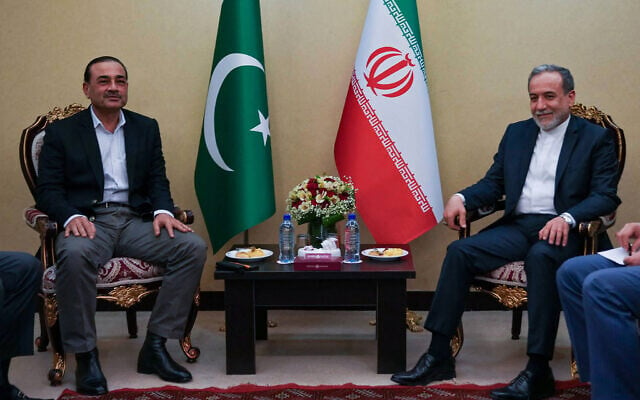
In addition, Pakistan urged the United States and Iran to exercise restraint and uphold the MoU.
“Pakistan urges all sides to uphold their respective commitments under the Islamabad Memorandum of Understanding,” the foreign office said in a statement, which also called on “all parties to exercise restraint.”
Iran threatens to close Strait of Hormuz again
Iran, however, issued a warning that it would not back down from its insistence that it manage the flow of traffic through the Strait of Hormuz, an Iranian security source told state media. Iran closed the strait, a vital artery for the flow of oil and gas, at the start of the war, upending the global economy
“The memorandum of understanding signed on this matter clearly states that Iran will reopen the strait in accordance with its own arrangements. Therefore, Iran will not permit the establishment of any new route outside the framework of its own arrangements,” the source told Iran’s Press TV.
The source said Iran would close the Strait of Hormuz in response to any renewed attacks against the country. But Vance warned against Iran shutting down the strait again, threatening more strikes.
“I’m obviously not going to tell you exactly what’s going to happen tonight, but the president has said to them very simply, the Strait of Hormuz is going to be open. That means oil and gas is going to flow to the American people,” he said. “If they try to close it down, there’s going to be response from the American military. It’s that simple.”