World
Ukraine faces risk of tougher EU loan terms to get aid payouts

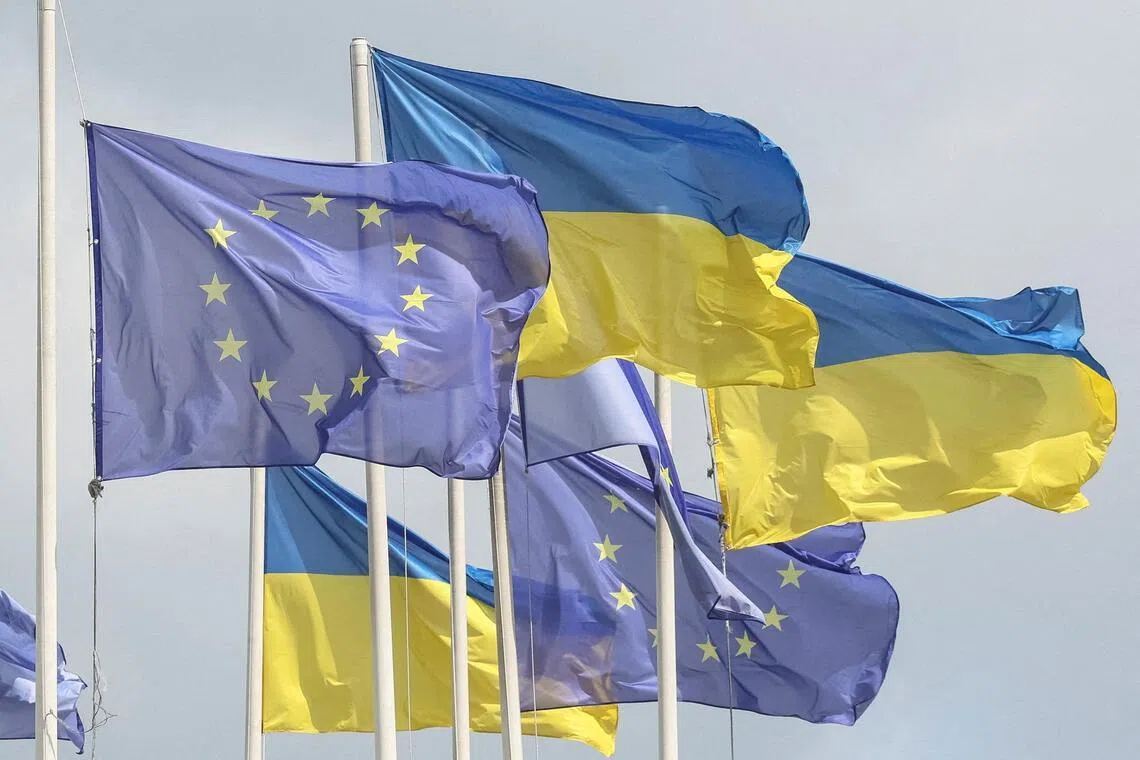
BRUSSELS – The European Union is considering imposing stricter conditions on its €90 billion (S$134.52 billion) loan to Ukraine, making some of the payouts dependent on the introduction of an unpopular tax change for businesses, according to people familiar with the matter.
The plan being discussed by the European Commission, the EU’s executive arm, would affect €8.4 billion in so-called macro-financial assistance expected to be granted in 2026 under the programme, which is essential to keeping Kyiv in the fight against Russia’s full-scale invasion.
The push coincides with Ukraine’s efforts to persuade its other major donor, the International Monetary Fund, to at least delay imposing the same requirement to unlock more aid under a separate loan programme worth more than US$8 billion (S$10.21 billion), the people said.
They asked to remain anonymous because the talks are private.
The discussion has zoomed in on changes to a preferential tax regime currently applying to some Ukrainian companies.
Initially designed for self-employed entrepreneurs and small businesses, it allows firms to pay a minimum rate of 5 per cent of revenue.
The change would add more than 40 billion hryvnia (S$1.16 billion) annually to the budget, according to the Finance Ministry’s estimates.
The Finance Ministry and Ukraine’s major donors have argued that the arrangement is a drain on the wartime budget, distorts competition and helps maintain a large shadow economy.
The proposal would require the authorities in Kyiv to impose a 20 per cent value-added tax on those companies currently operating under the preferential system, whose annual revenue exceeds 4 million hryvnia, the people said.
The EU aid potentially affected by the new condition accounts for just a fraction of the entire two-year package, which is made up of about €60 billion in defence support with the rest split between macro-financial assistance and the so-called Ukraine Facility package, which provides funds for general budget spending.
The European Commission spokepersons said the commission was “working tirelessly” to finalise the memorandum of understanding that would underpin the conditions for the funding for Ukraine, but declined to provide details.
The EU’s executive always coordinates its “reform agenda with the IMF, and this is the case also now,” according to the spokesperson.
The aim was to conclude the talks “as soon as possible with an ambitious reform agenda to strengthen Ukraine’s economy” and speed up its integration with the EU, the spokesperson said.
But the push is likely to raise tensions inside the Ukrainian society as the proposed measures are extremely unpopular.
A standoff between Parliament and President Volodymyr Zelensky is also making them difficult to implement.
Ukraine has long pushed for the EU to approve payouts from the aid package, which faced months of obstruction from Hungarian Prime Minister Viktor Orban.
His defeat in a parliamentary election earlier in April opened the way for the money to start being released before the end of this quarter.
While the new conditions won’t affect the key defence assistance, they are still likely to run into difficulties.
Parliament openly defied Mr Zelensky earlier in 2026 in refusing to change the tax arrangement including expanding the categories of foreign parcels subject to VAT, another of the requirements being pushed by the IMF.
The president’s office, meanwhile, blamed the Finance Ministry for being too pliant toward the IMF.
Further IMF disbursements depend on this and other fiscal-tightening measures that Kyiv agreed to implement to curb the size of the shadow economy.
However, it has already missed a March deadline to amend the legislation. It now has until June, when the next IMF review is due, to do so.
The Washington-based lender has so far disbursed US$1.5 billion under the current program.
The next tranche of about US$700 million remains in question.
With Parliament in a stalemate to pass the tax changes, Ukrainian officials and the IMF discussed a possible delay to the implementation of VAT measures for self-employed entrepreneurs by about a year during the lender’s Spring meeting earlier in April, the people said.
The IMF is still insisting, however, that Parliament passes VAT tightening on parcels by June, they said.
The Finance Ministry said on April 27 it would soon submit the relevant Bill to Parliament.
Still, the prospects for the amendments to pass are looking slim, one of the people said.
The Finance Ministry in Kyiv and the IMF both declined to comment.
Even if Ukraine manages to buy some time now, it will eventually have to reform its tax system to bring it in line with EU rules during accession talks.
This would include getting rid of some exemption.
For now, Kyiv’s international donors could consider other measures to generate revenue or curb informal economy, one of the people said. BLOOMBERG