World
Two Clocks, Two Egos, and the Gods Who Are Never Late

Sophocles put it in four words the Chorus never had to repeat: “Pride breeds the tyrant.” Twenty-five centuries later, two men who believe themselves the smartest people ever to occupy their offices are proving the old Greeks right in real time, on two different continents, on two different election clocks — and both are running out of road.
Start with the arithmetic of vanity. Donald Trump has called his own brainpower “off the charts” so many times it has become a campaign liturgy, the sequel to his 2018 boast of being a “very stable genius.” Genius, in Trump’s flowery language, apparently means picking a fight with the Strait of Hormuz in an election year. But a strait does not care about approval ratings. It does not care about campaign schedules. It does not care about the fragile ego of a man who needs a war to look like triumph. And triumph is exactly what he needs before 3 November, when American voters go to the polls in the most consequential midterms of his second term.
The generic ballot has Democrats up roughly four points, a durable lead that has held since spring and represents a six-point swing since he took office. The House, by most forecasts, is his to lose. The Senate map still favors Republicans on paper. But “on paper” is where Pyrrhus won, too. After his costly victory over the Romans, he remarked, “One more such victory and we are undone.” We remember how that campaign ended for him — a victory so expensive it wrecked the very army that won it.
The sentence he actually got was delivered ten days before his second inauguration: an unconditional discharge. No fine. No probation. No cell. Just a permanent line on the record that no amount of golfing at Mar-a-Lago will ever erase. He dodged the cage. He did not dodge the ledger. History has a way of returning to unfinished ledgers, and Trump is spending the run-up to the midterms as if he knows it.
READ: Israeli opposition would secure Knesset majority over Netanyahu bloc, poll shows
He has already asked President Isaac Herzog for that pardon, and Trump — ever the generous co-conspirator in mutual survival — has publicly lobbied for it too, calling Netanyahu “a Great Hero” who deserves immediate clemency. Two men, each unable to save himself, each reaching for the other’s hand like drowning swimmers who mistake each other for a life raft. Neither one is buoyant.
The polling tells its own quiet joke. Netanyahu’s Likud still edges out Naftali Bennett’s list in most seat projections. The opposition bloc as a whole outpolls the coalition, 58 seats to 52, with neither side within reach of the 61-seat majority that would let Netanyahu govern. Without that magic number of 61, he cannot contrive a scheme to pardon himself. Bennett, once his own protégé, now polls as more trustworthy than his old boss on almost every leadership metric. The apprentice waits at the courthouse door while the king rehearses his innocence for cameras he no longer fully controls.
When the Strait of Hormuz seized up, Russian grain ships kept sailing out of Astrakhan anyway, feeding Iran’s third-largest wheat-import relationship almost without interruption, because the Caspian Sea answers to no American carrier group.
Further out, in the waters off Malaysia, Iran runs a second, darker supply line: a shadow fleet of tankers that cut their transponders, meet at sea for ship-to-ship transfers, and deliver crude to Chinese “teapot” refineries at a discount of eight to ten dollars a barrel below Brent. Sanctions have turned into a money-printing scheme.
READ: Poll: 40 % of non-religious US Jews accuse Israel of genocide in Gaza
And on land, the steel answers both: a 10,400-kilometer rail corridor running from Xi’an and Yiwu through Xinjiang, Kazakhstan, and Turkmenistan to the Aprin dry port outside Tehran, cutting a thirty-to-forty-day sea voyage down to roughly fourteen. None of it, on its own, feeds ninety million people. Together, it is a hedge against exactly the kind of chokepoint war Trump has been threatening to obliterate the Persian civilization, and Iran sits inside China’s Belt and Road Initiative closely enough that Beijing has every incentive to keep the wire from ever reaching the fuse. Civilizational patience is not a metaphor in Tehran. It is an infrastructure with three separate spines.
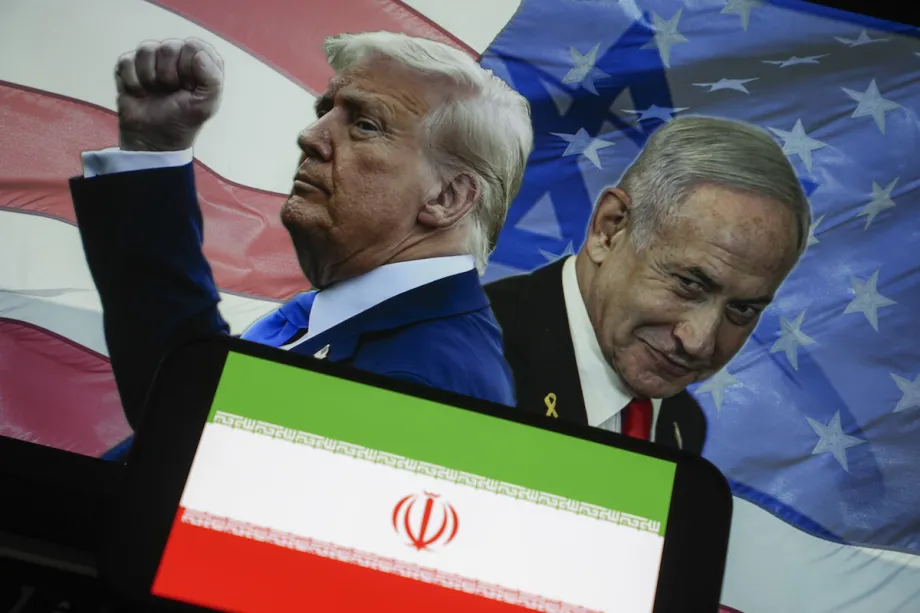
Here, then, is the poetic justice neither man saw coming, because hubris never sees the whole disease. Trump needed a short, glorious war to save a shrinking base and got a stalemate with a country that has survived Mongols, Ottomans, and forty years of American sanctions. Netanyahu needed Trump’s protection to escape a courtroom his own hand-picked witnesses built. Trump needed Netanyahu’s war to look like strength instead of desperation. Both men, so certain of their own singular genius, are now hostages to each other’s timing, praying that Miriam Adelson’s checkbook and AIPAC’s phone tree can do what neither the Israeli electorate nor an American jury seems inclined to do for free.
The Greeks had a word for the moment right before the fall, and it wasn’t a kind one. They called it ate — a kind of blind, reckless delusion that takes over once pride has gone too far. It shows up right after hubris, the way a hangover follows a wild night: not really a punishment, just what happens next. Gravity is doing what gravity always does to men who have forgotten they can fall.
OPINION: Iran is China’s indispensable partner, but Beijing will never fight its war