World
Trump’s claims that China stole voters’ data unlikely to derail September summit

PHILADELPHIA – US President Donald Trump’s allegations that China acquired information on millions of American voters and attempted to meddle in the 2020 election are unlikely to upend the carefully tended US-China relationship, US analysts say.
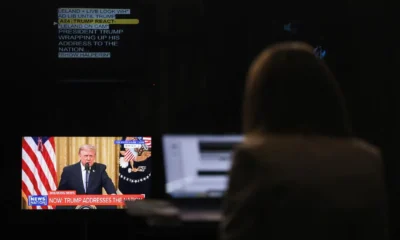
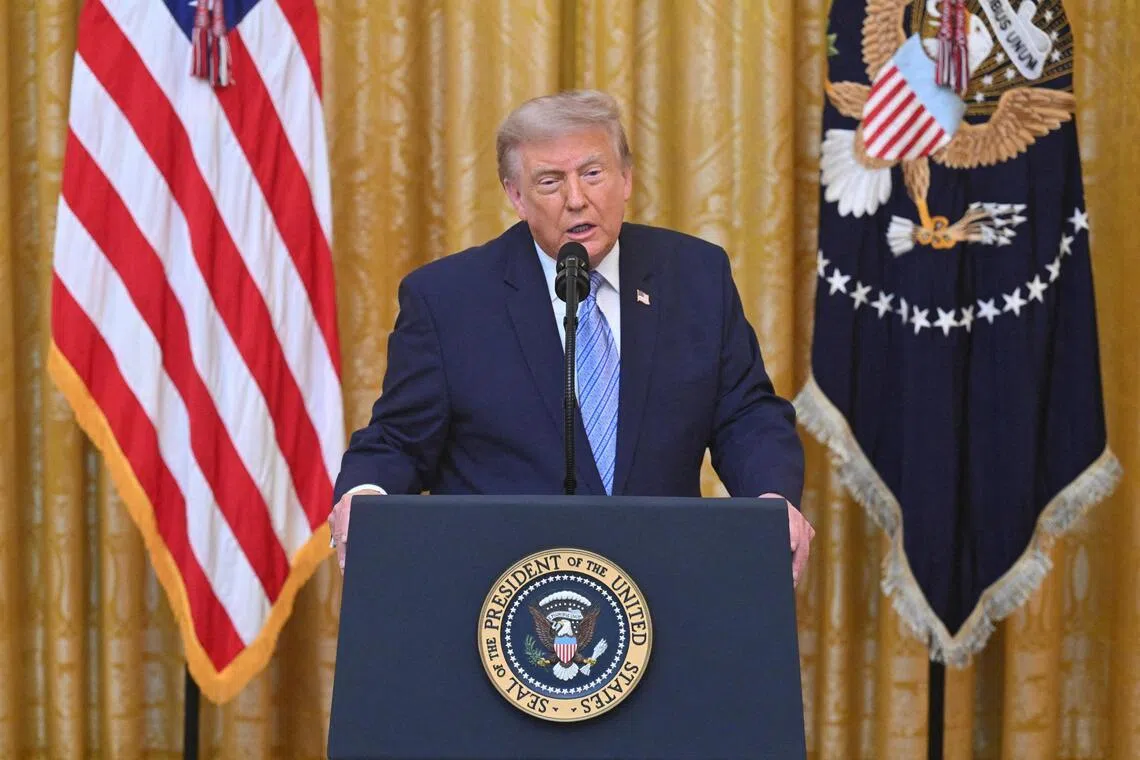
In a July 16 primetime speech that prominent American TV networks refused to broadcast live, Trump said the records show China acquired 220 million US voter files, beginning in the 2020 election cycle.
It was “the largest compromise of election data in history,” he said.
China’s targeting of the election was “buried by rogue bureaucrats” and kept out of daily presidential briefings provided to him, he said.
Analysts told The Straits Times that Trump’s claims did not appear to be borne out and China was likely to brush them off.
Indeed, numerous previous probes – including by courts and Trump’s own Justice and Homeland Security departments – had found no evidence of voting-machine tampering, foreign interference or widespread fraud in the 2020 election when Trump was defeated.
Newly declassified intelligence documents on the White House website shed some light on a dissenting view that Beijing’s efforts at influence “probably included overt messaging, nascent online covert influence capabilities” as well as diplomatic and economic leverage. But key sections remained redacted, a New York Times report said, making it difficult to assess if and how successfully China carried out the attempts.
“As I understand it, the White House released nothing that backed up the claim,” Dennis Wilder, a professor at Georgetown and Texas A&M universities and a former senior director for East Asia at the National Security Council told The Straits Times.
During the Obama administration, Wilder was senior editor of the President’s Daily Brief from 2009 to 2015 and served as CIA’s deputy assistant director for East Asia and the Pacific from 2015 to 2016.
While China does have a record of attempting to influence US politics, Wilder said, it has tended to centre on local elections, particularly in areas with large ethnic Chinese populations.
“The intelligence record does not show large Chinese campaigns to influence US national elections,” he said.
What China does is to influence operations in social media, such as TikTok, to influence American views particularly on the Sino-US relationship and attitudes toward its human rights record, he said.
Democratic Senator Mark Warner from Virginia, a member of the Senate Intelligence Committee dismissed Trump’s claims outright. “The fact is our intelligence agencies unanimously agreed that China did not even try to change a single vote in the 2020 election,” he wrote on X.
The Chinese embassy in Washington DC said China “has never and will never interfere in the presidential elections of the US.”
Although Trump’s allegations are not trivial, they are not seen as creating friction ahead of Chinese President Xi Jinping’s visit to the White House in September.
“The Chinese are utterly pragmatic. They won’t like it but I doubt they will take it seriously,” said Wilder.
“Xi has much bigger fish to fry with the US, especially on Taiwan. As long as Trump continues to deny Taiwan arms before the trip, they can ignore a lot,” he said, referring to Beijing’s keenness for the Trump administration to pursue a restrained relationship with the self-ruled island that China considers its own.
The Chinese appear to be relatively calm so far and attribute this to Trump’s political need to boost the Republican Party’s popularity ahead of the midterm elections and push electoral reforms under the SAVE America Act, said Yun Sun, an expert on US-China relations and director of the China Program at the Stimson Center.
“We will have to see how it will further ferment,” she said.
“If this is just one shot at China, in the effort to push through the SAVE America Act, Beijing is unlikely to let it disrupt the state visit. But if the speech is followed by real punitive actions against China, that will make the bilateral relations more uncertain.”
Election interference allegations strike at the most politically sensitive fault line in US-China relations, said Han Shen Lin, the China Managing Director for The Asia Group, a strategic advisory firm.
Whether backed by new intelligence or not, they reinforce Washington’s bipartisan narrative that strategic competition with China extends beyond trade and technology into democratic institutions, he noted.
Such accusations certainly raise the political cost of engagement but are unlikely to derail a summit since both sides see strategic value, he also said.
“I do expect a tougher public tone paired with pragmatic diplomacy behind closed doors, which reflects today’s dual-track US-China relationship,” Han said.
In other allegations, Trump also said his administration had found 278,000 non-citizens listed as voters and that voting machines and counting systems were vulnerable to hacking.
With his Republican Party at risk of losing its congressional majority in Nov 3 midterm elections, he framed the claims as reasons that his party’s lawmakers must pass voting reforms.
Some parts of the stalled legislation known as the SAVE America Act – such as requiring photo identification and proof of citizenship to vote – are popular with Republicans. But the Bill would also end universal mail-in voting, an issue with those from rural red states where constituents use mail ballots.
Will this spark a domestic crisis?
Most US analysts did not see Trump’s claims setting off a crisis domestically.
John Fortier, an expert on the US election system and a senior fellow at the American Enterprise Institute, said it would take a long time to pore through the trove of documents shared by the White House as evidence for its allegations.
But his preliminary assessment was that the US election system was not at risk.
“Our voting machines are not connected to the internet and we have moved to a system where most of them have a paper ballot backup. These things provide a lot of security,” he said.
“And while it’s not a good thing if a foreign entity is trying to collect data on Americans, many of these records are available to political parties and other groups. So I’m not surprised that foreign actors were able to acquire some of that,” he said.
He did not deny the possibility of non-citizens voting but estimated the number could be in the tens of thousands, much smaller than the number projected by Trump.
Trump’s address also laid bare the deep fissures between the president and the press. He lashed out at the media, arguing that NBC and ABC should lose their broadcast licences for not airing his speech live on their networks.
Major TV networks declined to broadcast the event out of concerns that Trump may make false claims about election and it would be irresponsible to air them.
“It’s a really bad idea for US news networks not to carry a presidential address,” said Joseph Morris, a professor of political science at the Mercyhurst University in Erie, Pennsylvania.
“The US is still struggling with unusually high levels of political polarisation and when some networks choose to cover at least some of the address while others act as though it wasn’t even happening, well, it is just one more contribution to political polarisation,” he said.
Having said this, news organisations decide what is newsworthy, he added. “A strong argument can be made that nothing that Trump said or might have said about election interference in 2020 was, in any way, newsworthy.”
If Trump’s address was intended to pressure lawmakers into supporting the Save America Act, it was hamstrung by his low job approval ratings.
Going public can be a good strategy for presidents who are locked in battles with Congress, Morris said.
“If, however, the president’s approval rating is well below 40 per cent, they have to ask themselves, ‘who is going to listen to me?’ ”
The more worrisome aspect to him was a possibility that Trump was using the allegations as a way to strategise for the scenario if the Republicans lost the midterms, as polls indicate.
“His rhetoric in recent months suggests he’s aware of this and that he’s looking for any opportunity to claim election interference, cheating, or fraud should 2026 not go his way. In this way, tonight’s address may be understood as an effort to prime the population so more people will be receptive to his claims,” Morris said.
But Trump’s message would mostly fall on deaf ears, he predicted.
“Outside of his base, there aren’t many Americans who are listening to evidence about the deep state and 2020 election interference and taking it seriously.
“On this issue, the messenger matters, and Donald Trump has proven himself to be an untrustworthy messenger to at least 60 per cent of the population.”