World
Trump: US to hit Iran ‘VERY HARD’ tonight, may take Kharg Island, despite ongoing talks

US President Donald Trump announced on Thursday that the US would launch new airstrikes on Iran overnight for what would be the third night in a row and would take Iran’s oil infrastructure hub Kharg Island — though he later questioned whether his citizens could “stomach” such a maneuver.
His comments came despite reports that efforts to finalize an agreement between Washington and Iran were going well. A diplomatic source told CNN that talks were still on track after two nights of US strikes on Iran and retaliatory missile and drone fire from Iran on Bahrain, Kuwait, and Jordan. The attacks came after an Iranian drone downed a US helicopter near the Strait of Hormuz on Monday.
In a post on Truth Social on Thursday, Trump declared that the US would be “hitting Iran… VERY HARD TONIGHT.”
“At some point in the not too distant future, we will be taking Kharg Island, and other oil infrastructure points, and assume total control of their oil and gas markets, much like we have with Venezuela, which is working out brilliantly for both Venezuela and the United States of America,” Trump wrote.
But in a later interview with Fox News, Trump questioned whether Americans would support the capture of Kharg Island.
“We are talking to them and all, but you know, look, my preference has always been – take Kharg Island… my preference would be that. I don’t know that America has the stomach for it,” he said in an interview on Fox News. “I think they’d like to see us come home.”
Iran is “dying to make a deal” and “is being decimated,” Trump claimed. “They’re really in submission,” he added. “They just don’t know it yet.”
It was not clear whether the threat was genuine or if it was another tactic by the US president aimed at coaxing Iran to make concessions at the negotiating table. Trump has repeatedly made dire threats to Iran, only to later back off.
Asked by Fox if the US would start attacking power plants and bridges as he has previously threatened, he replied, “Yeah, but I’d rather not do it, because once you do that, the people suffer.”
Trump: “My preference has always been to take Kharg Island. I don’t know that America has the stomach for it, to be honest with it. You’d make a fortune.” pic.twitter.com/5ub1HK4WMH
— Aaron Rupar (@atrupar) June 11, 2026
Prime Minister Benjamin Netanyahu will convene top ministers and aides for a security discussion Wednesday evening, the office of one of the ministers told The Times of Israel.
Release of frozen Iranian funds still being ironed out
Earlier on Thursday, three Iranian sources and a European confirmed to Reuters that efforts to reach a preliminary deal had intensified, and that the US and Iran were exchanging messages on the details of a memorandum of understanding.
The sources noted, however, that some issues have to be discussed in detail, including a mechanism for the release of billions of dollars in frozen Iranian funds.
“Iran wants $6 billion to $12 billion of its frozen funds to be released to Tehran, while Washington wants to release funds in stages for humanitarian goods and rejects returning funds to Iran outright,” said one of the Iranian sources.
Another Iranian official said discussions continued over the amount of frozen assets to be released immediately, as well as a guaranteed timetable for the payment of the remaining $12 billion of the funds within a 60-day period.
A senior European official said, “Right now, talks are focusing very precisely on the technical details and the financial amount — in short, the level of liquidity available to Iran.”
A US source familiar with the matter also confirmed that messages were still being exchanged, and that a political understanding had been reached but that the mechanism around frozen funds was still being ironed out.
The White House and Iran’s Foreign Ministry did not immediately respond to a Reuters request for comment on this story.
The framework of an interim deal would center on a temporary easing of Iran’s grip on the Strait of Hormuz and phased access to the waterway, while also ending a US blockade on Iranian ports. Unresolved questions over Tehran’s nuclear enrichment capacity and its stockpile of highly enriched uranium, a key priority for Israel, which is not included in the negotiations, would be left for future talks.
The priority for Iran’s regime is not a comprehensive settlement but a framework that restores minimum breathing space for the establishment in Tehran by unlocking its frozen assets and halting the war, the Iranian sources said.
“This war, from a military standpoint, is a dead end. The Americans could not achieve their goals by attacking Iran. There has been progress in negotiations,” said one of the Iranian sources.
Trump has repeatedly said a deal is close, while also threatening to intensify bombing.
Qatar, Pakistan push for diplomacy
A diplomat speaking on condition of anonymity told AFP that Qatari negotiators departed Tehran on Thursday morning following talks with Iranian officials “that lasted into the early hours of this morning.”
The discussions were “conducted in coordination with the United States,” the diplomat added.
Separately, Pakistan’s Foreign Ministry said that the country’s interior minister had returned from a visit to Tehran in recent days, where he delivered a message from the prime minister to the Iranian leadership as part of the mediation efforts.
Calling for a “negotiated settlement,” ministry spokesman Tahir Andrabi acknowledged that it was “hard to be optimistic in the new exchange of hostilities,” but told journalists that Pakistan “remains engaged” in mediation efforts.
“Let’s not draw curtains on Pakistan’s mediation approach,” he urged.
“Pakistan remains deeply concerned at the situation in the region marked by recent escalation,” Andrabi said. “We are of the view that diplomacy and dialogue should be the guiding principles for achieving a negotiated settlement of all contentious issues.”
Iran calls ceasefire ‘practically meaningless’
Despite the efforts of Qatari and Pakistani mediators, tensions persisted on Thursday, with Iran’s Foreign Ministry declaring that the US had rendered the ceasefire that, in early April, halted the joint US-Israeli war with Iran “practically meaningless” through the US’s “illegal and criminal” airstrikes overnight.
Warning that the strikes were a “flagrant violation” of the ceasefire, the ministry added that “the responsibility for the extremely serious consequences of this criminal act lies with the leaders of the United States.”
Iran’s Islamic Revolutionary Guard Corps said following the US airstrikes that it had launched counterattacks on 18 US military targets at airbases in Kuwait and Bahrain, as well as the US Navy’s Fifth Fleet in Bahrain.
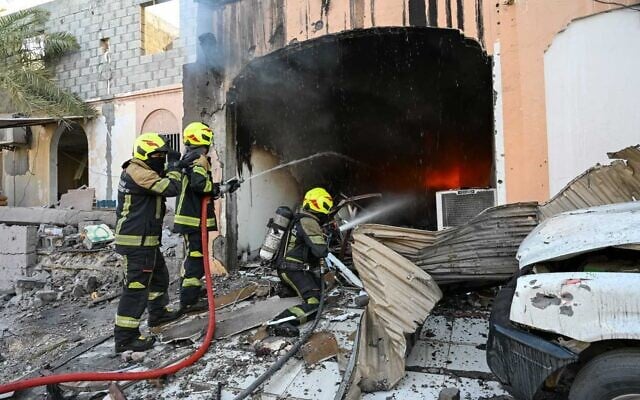
It later said it had also targeted the al-Azraq air base in Jordan for a second successive night, firing 12 ballistic missiles at the US base, although Jordan disputed this number, saying it had intercepted 20 missiles.
Bahrain’s Interior Ministry said an 11-year-old girl suffered minor injuries, and homes were damaged in the town of Hamad and the capital, Manama, after debris fell from Iranian drones that were intercepted and destroyed.
Kuwait briefly closed, then reopened, its airspace due to the attack.
Later on Thursday, the US military announced that it had disabled another tanker transporting Iranian crude oil in the Gulf of Oman, the third commercial ship hit this week after attempting to violate a US blockade.
In a statement, the US Central Command said it struck the Guinea-Bissau-flagged M/T Jalveer “as it attempted to transport oil from Iran through the Gulf of Oman.”
“A US aircraft fired two Hellfire missiles into the ship’s engine room after the crew repeatedly failed to comply with directions from US forces,” CENTCOM said.
U.S. forces disabled a third oil tanker this week in the Gulf of Oman after it allegedly violated the blockade on Iran by transporting Iranian oil.
The tanker, M/T Jalveer, was struck in its engine room after ignoring U.S. orders. pic.twitter.com/TgfEhHolfW
— Clash Report (@clashreport) June 11, 2026
It marked the third time this week that the US military has disabled ships in the area, after Palau-flagged vessels M/T Marivex and M/T Settebello were disabled on Monday and Tuesday.
“Marivex violated the blockade by attempting to sail to an Iranian port and Settebello attempted to transport Iranian oil,” according to CENTCOM.
CENTCOM said it has “disabled nine non-compliant vessels, redirected 135 ships that complied, and allowed 42 vessels supporting humanitarian aid to pass since initiating the blockade on April 13.”
The announcement came hours after Indian authorities confirmed the deaths of three Indian sailors in a previous US military strike to halt a tanker off Oman.
Indian Ports, Shipping and Waterways Minister Sarbananda Sonowal announced on X that three Indians missing after the prior American strike on the tanker Settebello had been killed.
CENTCOM had accused the Settebello of having “violated the ongoing blockade by attempting to transport oil from Iran,” and US forces fired into the ship’s engine room to stop it.
The leader of the International Maritime Organization, a United Nations agency, condemned the attack. India’s foreign ministry summoned a senior US diplomat to convey its “deepest concerns” over the attack and formally protest the strike, spokesperson Randhir Jaiswal said.
India’s embassy in Oman also reported a separate incident involving a tanker off Oman, but an Indian shipping official said all Indians aboard were safe.
Meanwhile, Iran’s new body overseeing the Strait of Hormuz claimed that it had implemented a complete closure order for the strategic waterway until further notice, after the IRGC announced the move overnight. Iran has largely blocked the strait since the beginning of the war.
“Due to the tensions caused by the aggression of the American forces in the region and the announcement made last night by the Iranian armed forces, the Strait of Hormuz will be closed until further notice,” the Persian Gulf Strait Authority said in a post on X.