World
Trump tries to downplay economic effects of the Iran war

Follow our live coverage here.
WASHINGTON – Facing pressure to address the economic fallout of his war in Iran, US President Donald Trump on May 4 sought to portray his policy wins for small businesses as evidence that he was succeeding in building up the economy.
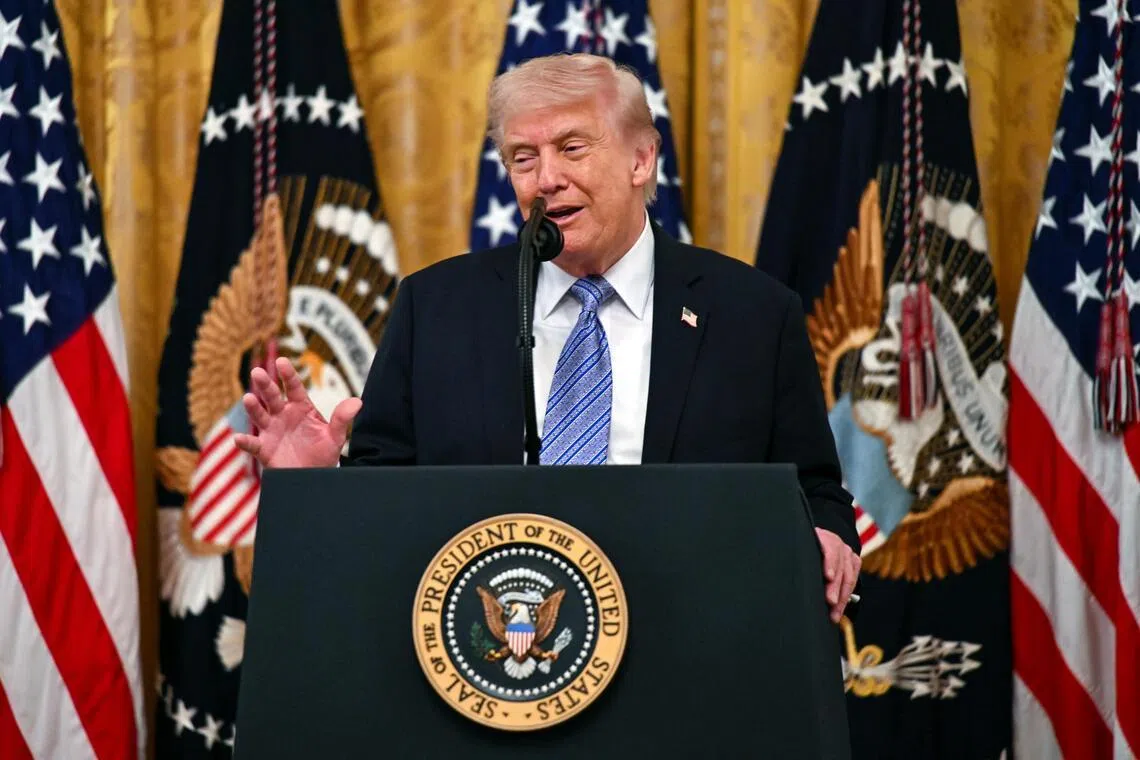
Speaking to business leaders from across the country at an event in the East Room of the White House, Mr Trump declared that slashing taxes and regulations had yielded “record business”, and that the economy was “roaring”. The White House described the Small Business Week event as highlighting “the extraordinary revival of Main Street under his ‘America First’ agenda”.
But looming over it all was a war abroad that Mr Trump had begun, and whose economic impact is compounding cost-of-living concerns among Americans, many of whom increasingly say their economic reality has worsened under his tenure.
Mr Trump’s comments on May 4 created a sharp contrast with the economic reality outside Washington, as rising energy prices hammer families and businesses alike.
With talks between the United States and Iran at a standstill, the price of Brent crude, the global benchmark for oil, reached about US$114 per barrel by the evening of May 4. The spike came at a moment of great uncertainty about the blockade in the Strait of Hormuz, a key thoroughfare for the world’s oil.
Mr Trump, who often focuses on economic indicators such as the stock market that have very little impact on the bottom line for most Americans, has brushed off the pain caused by his own policies with promises that it is temporary.
During the event on May 4, he sought to downplay the rising cost of energy, saying that it had been projected to rise much more, and that he saw it “going down very substantially” soon.
But for Americans, relief remained out of reach.
The average cost of a gallon of gas topped US$4.45 (S$5.70) nationwide, according to AAA, an increase of more than US$1 compared with in 2025. Soaring even higher was the cost of diesel, which shot above US$5.64 a gallon, or a roughly US$2 increase from this time in 2025. This increases the cost of transporting products, which is likely to result in higher prices for consumers.
Also at the event on May 4, Mr Trump offered a new defence of one of his most consequential policies, slashing the federal workforce, which resulted in the loss of hundreds of thousands of jobs. He boasted that private sector jobs had been created in their place, and suggested that federal workers were grateful to him for firing them.
“And I feel sorry for everyone, you know, it’s a hard thing to do,” he said. “Many of those people voted for me, but now they like me because they went out, they got private sector jobs that they like better and is paying them sometimes two or three times more money.”
With the midterm elections just months away, Mr Trump has struggled to hone an economic message, despite pleas from Republicans to focus on how his policies are improving the lives of everyday Americans and pledges from his aides that he would travel the country doing just that.
Mr Trump has faced accusations from some in his “America First” base that he is too focused on foreign policy and global conflicts and not enough on the kitchen-table issues that he campaigned on addressing, such as the cost of living and grocery and gas prices.
But delivering a focused message on the economy is not much in Mr Trump’s style.
During the more than one-hour speech on May 4, Mr Trump veered off into other topics, including criticising former President Joe Biden, boasting about passing cognitive tests and complaining about polls and media coverage. He also offered a lengthy account of how he had decided to renovate the reflecting pool at the National Mall.
The event featured other speakers who praised Mr Trump, including Mr Rick Harrison of the reality television show “Pawn Stars” and Energy Secretary Chris Wright, who praised his popularity in Venezuela after the United States removed its president.
On May 1, Mr Trump delivered another economic speech at The Villages in Florida, where he was billed to speak about how his tax and domestic policy legislation would help older Americans who may be relying on Social Security.
But for much of the roughly 1.5-hour speech, Mr Trump’s tax policies seemed to be an afterthought.
Standing in front of hundreds from a retirement community in a school gymnasium, Mr Trump criticised the staff of the event for not ensuring his microphone volume was loud enough. He launched into a xenophobic tirade against the Somali community in the United States, mocked a transgender weightlifter and brought Dr Phil McGraw, the talk show host, onstage to speak.
He blamed his predecessors for high prices and inflation, and once again dismissed the issue of affordability, which he has called a “hoax”.
“And the Democrats start screaming, ‘affordability, affordability’ – they’re the ones that caused the problem,” Mr Trump said.
Mr Trump did touch on his domestic policies, pledging to defend Social Security and Medicare. But he also acknowledged that those issues did not have his full attention. He assured the crowd of supporters that Dr Mehmet Oz, Mr Trump’s administrator of the Centers for Medicare and Medicaid Services, knew more about “Medicaid, Medicare, medical crap than any human being”.
Mr Trump said Dr Oz was telling him about the programs on the way to The Villages, making it “the most boring trip I’ve ever made”.
“I said, ‘You work out the details,’ but I did say, ‘Give them the max,’” Mr Trump said. “That’s all I care about.” NYTIMES