World
Trump says Saudi civilian nuclear pact is conditioned on normalization with Israel

US President Donald Trump said on Thursday that the agreement reached with Saudi Arabia for a civilian nuclear program would require Riyadh to normalize relations with Israel, prompting praise from the office of Prime Minister Benjamin Netanyahu.
In a post on Truth Social, Trump insisted there would be “no enrichment of material,” meaning the deal wouldn’t grant Saudi Arabia the right to enrich uranium on its soil.
The deal “pertains only to non-military use such as the ones that Iran and UAE (and others) already have, will be approved, but is totally subject to Saudi Arabia joining the very respected and successful Abraham Accords,” Trump wrote.
While former US president Joe Biden’s administration had conditioned nuclear cooperation with Saudi Arabia on the kingdom’s recognition of Israel, reports had suggested that Trump would not enforce this condition.
Trump’s post came after pro-Israel advocates — and reportedly Jerusalem itself — had expressed alarm over his administration’s decision to proceed with the civilian nuclear deal without conditioning it on Riyadh’s entry into the Abraham Accords.
The US Energy Department also made no mention of the Abraham Accords when announcing the nuclear agreement on Wednesday, indicating that this stipulation was not part of the documents signed by Washington and Riyadh.
Likewise, Trump’s insistence that Riyadh would not carry out nuclear enrichment appeared intended to counter a report in The Wall Street Journal claiming that the agreement could see US companies build a uranium enrichment facility in Saudi Arabia.
The Saudi Embassy in Washington did not immediately respond to a request for comment on Trump’s post. Saudi Arabia’s longstanding position has been that it would not sign the Abraham Accords without an agreement on a roadmap to Palestinian statehood, a nonstarter for Israel’s current government.
Despite there being no response from Saudi Arabia to Trump’s post, Netanyahu’s office said that normalization with Riyadh would be a “historic leap forward” for peace.
“The joint American and Israeli military action against the genocidal regime in Teheran [sic] and Israel’s crushing of Iran’s terror axis have created the possibility to expand the circle of peace,” declared the Prime Minister’s Office.
“As President Trump has said, Saudi Arabia’s joining of the Abraham Accords would be an historic leap forward for peace in the Middle East.”
“Peace through Strength,” the PMO concluded.
The United Arab Emirates and Bahrain signed the Abraham Accords during Trump’s first term in 2020, breaking a longstanding taboo to become the first Arab states to recognize Israel in a quarter century. Morocco and Sudan followed suit.
The Trump administration on Wednesday said the civil nuclear deal abides by nonproliferation agreements in the US Atomic Energy Act, which are among the world’s strongest.
However, a person familiar with the agreement said it doesn’t include the International Atomic Energy Agency’s Additional Protocol, which would allow for more monitoring, inspections and verification.
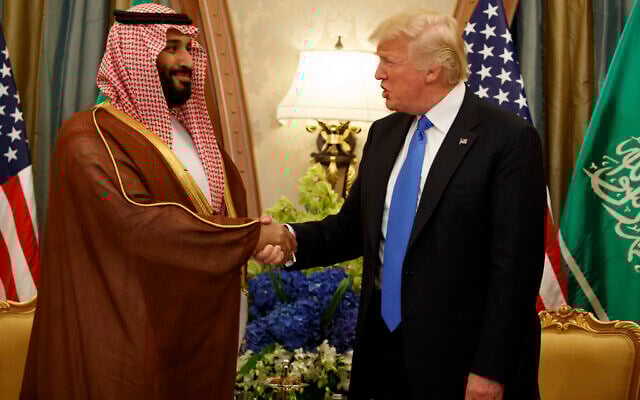
Saudi Arabia, the world’s top oil exporter, said the agreement supports efforts to diversify energy sources, and includes the “highest international standards” of nuclear safety, security and nonproliferation.
The deal would let Saudi Arabia enrich uranium and reprocess nuclear waste, both of which are potential pathways to a nuclear weapon. The UAE agreed to forgo both when it signed a similar deal with the US in 2009.
Concerns over a Gulf arms race
The deal is expected to last 30 years and involves US firms in developing the program. US lawmakers from both parties and Israeli officials have voiced deep concern over such a project due to fears Saudi Arabia could eventually convert it to develop nuclear weapons. It will be submitted to Congress for review, though it doesn’t appear likely the Republican-controlled legislature will block its implementation.
Policymakers have also long feared that if Iran produced a nuclear weapon, the move would set off an arms race across the Gulf.
US Energy Secretary Chris Wright dismissed concerns about proliferation, insisting the deal was in Washington’s economic and strategic interest.
“These agreements uphold the highest standards of nuclear safety and nonproliferation, while relying on the world’s best nuclear technology and scientists, designed right here in the United States,” he said.