World
Trump orders Netanyahu to stop attacking Iran’s gas, oil fields

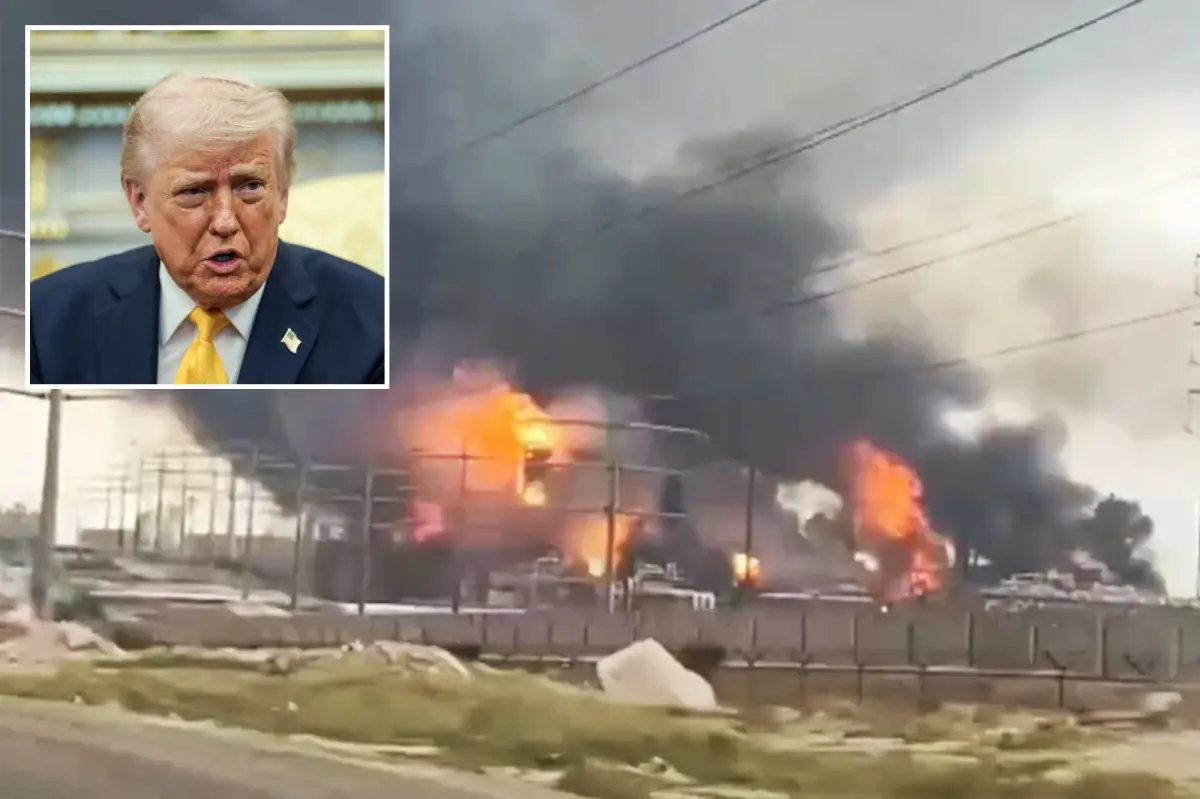
President Trump said Thursday he personally urged Israeli Prime Minister Benjamin Netanyahu to stop targeting Iran’s energy infrastructure — as the price of Brent crude oil briefly swelled to $119 a barrel.
“I told him, ‘Don’t do that.’ And he won’t do that,” Trump said in the Oval Office.
The comments came after Israel struck Iran’s South Pars natural gas field overnight — a major escalation that triggered retaliatory attacks by Tehran on energy sites across the region, including Qatar’s Ras Laffan Industrial City, the world’s largest liquefied natural gas facility.
South Pars is Iran’s portion of the world’s largest natural gas reserve, which it shares with US ally Qatar across the Persian Gulf.
“On occasion, he’ll do something,” Trump said of Netanyahu, “and if I don’t like it … we’re not doing that anymore.”
Hours later, Netanyahu confirmed he will listen to Trump.
“President Trump asked us to hold off on future attacks, and we’re holding off,” he said during a press conference in Jerusalem.
Still, the prime minister signaled Israel’s broader campaign remains aggressive — even as questions swirl about instability inside Iran’s leadership.
“I’m not sure who’s running Iran right now,” Netanyahu said, adding that the country’s new supreme leader “has not shown his face.”
“There’s a lot of tensions … it’s not a uniform position,” he said, describing what he called a murky internal power struggle.
He also rejected reporters’ questions that Israel pushed the US into the conflict.
“I misled no one and I didn’t have to convince President Trump,” Netanyahu said. “He understood that.”
Still, Israeli officials suggested their military strategy is focused on degrading threats rather than toppling the regime outright.
IDF spokesman Nadav Shoshani said Israel’s focus is squarely on military objectives.
“We’re more focused on military targets, on degrading threats — that’s the way we work,” Shoshani said. “Regime change is not something that you can predict … our goal is to degrade a military threat.”
Follow The Post’s coverage of the United States’ airstrikes on Iran:
Netanyahu also made clear that any regime change in Iran would have to come from within, rather than being imposed militarily — and warned against simply swapping one hardline ruler for another.
“You don’t want to replace one Ayatollah with another. You don’t want to replace Hitler with Himmler,” he said, referring to Nazi SS Chief Heinrich Himmler. “It’s up to the Iranian people to choose the moment and rise to the moment.”
Shoshani added that Israeli operations have thrown Iranian forces into “disarray,” disrupting coordination and weakening the regime over time, even if toppling it is not an explicit objective.
“Over the past 36 hours, we’ve targeted more than 200 targets across Iran,” he said, including senior personnel and infrastructure.
“We have great coordination with the US armed forces … maybe the best we’ve had in our history,” he added.
But Director of National Intelligence Tulsi Gabbard underscored an alleged difference in objectives between Washington and Jerusalem on Capitol Hill Thursday.
“The objectives that have been laid out by the president are different from the objectives that have been laid out by the Israeli government,” Gabbard told the House Select Committee on Intelligence Committee.
She emphasized that Israel has focused heavily on targeting Iran’s leadership.
“We can see through the operations that the Israeli government has been focused on disabling the Iranian leadership … beginning with the ayatollah,” she said.
By contrast, Gabbard said Trump’s goals are more narrowly defined.
“The president has stated that his objectives are to destroy Iran’s ballistic missile launching capability, their ballistic missile production capability, and their Navy … and mine-laying capability,” she said.
The continuing conflict has rattled global energy markets.
With the Strait of Hormuz effectively closed and key energy facilities under attack, investors fear the war has entered a dangerous new phase.
Oil prices surged above $119 per barrel Thursday, while the national average for gasoline climbed to $3.88 per gallon, according to AAA.
Trump and his team have sought to calm markets while signaling readiness to act.
“We will do whatever is necessary to keep the price down,” the president said.
Treasury Secretary Scott Bessent said the administration is weighing several options, including another release from the Strategic Petroleum Reserve.
“The US could unilaterally do another SPR release to keep the price down,” he told Fox Business.
Bessent also floated easing restrictions on Iranian oil already in transit.
“We may unsanction the Iranian oil that’s on the water. It’s about 140 million barrels,” he said.
Despite the rising tensions, Trump ruled out deploying US ground forces.
“I’m not putting troops” on the ground, he said during the Oval Office meeting with Japanese Prime Minister Sanae Takaichi.
Netanyahu, for his part, defended Israel’s campaign as necessary to prevent a far greater threat.
“If you think that the oil markets are in trouble today, think of Iran with nuclear weapons and the means to deliver them,” he said. “Then think of the blackmail that you would endure.”
He also urged the world to consider the consequences of a nuclear-armed Iran.
“Just imagine what they would do,” Netanyahu said.
European and allied leaders are increasingly alarmed.
France, the United Kingdom, Germany, Italy, the Netherlands and Japan jointly called for an “immediate comprehensive moratorium on attacks on civilian infrastructure, including oil and gas installations.”