World
Trump Cancels Iran Bombing Plans At Last Minute After High-Level Talks

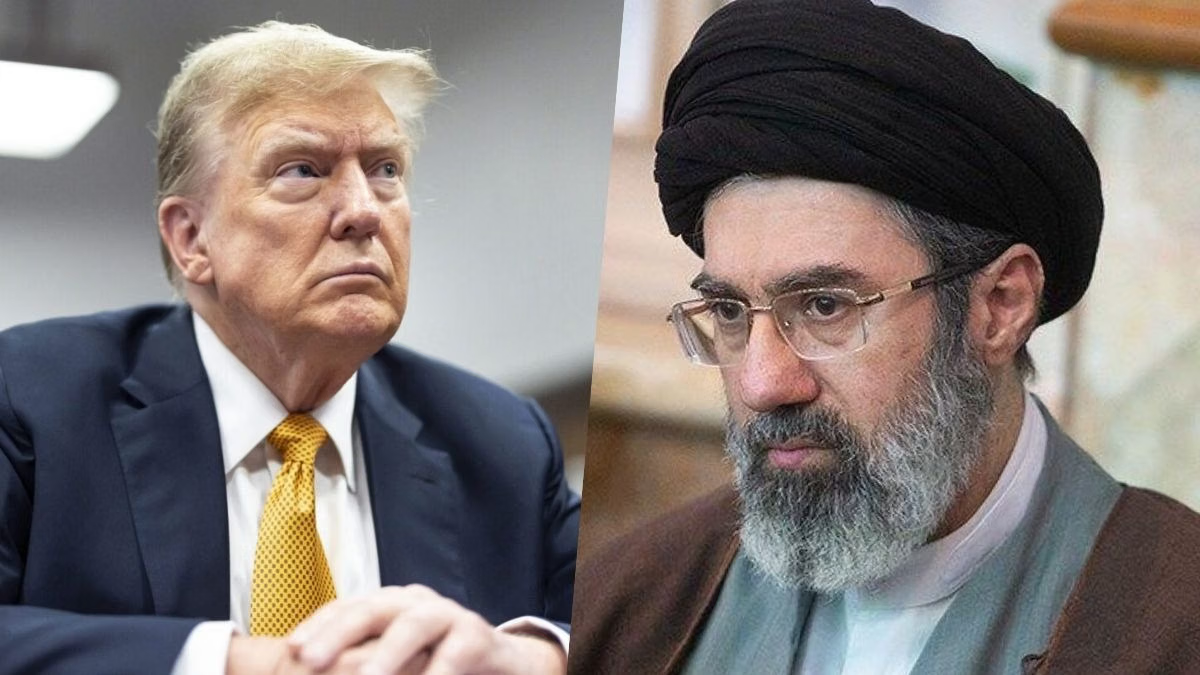
Washington: US President Donald Trump has called off fresh military strikes against Iran at the 11th hour, just moments before Washington was poised for escalation on Thursday. Declaring termination of strikes on Iran, Trump cited breakthroughs in negotiations that had reportedly reached the very top of Tehran’s leadership. The decision followed days of rising tension and public warnings from Trump on Thursday that the United States was ready to act “VERY HARD TONIGHT”, including threats to seize control of Kharg Island, Iran’s key oil export terminal.
In a post on Truth Social, the US President stated that the decision to halt escalation came after discussions with the Islamic Republic advanced to its highest political level and secured approval. He confirmed that scheduled attacks expected later in the day would no longer proceed. Trump’s announcement was a sharp reversal from his earlier stance and raised hopes of a diplomatic breakthrough after over 3 months of conflict.
Donald Trump disclosed that the terms now agreed in both concept and detail had the backing of a wide coalition. According to his statement, the United States, Israel, Saudi Arabia, UAE, Qatar, Turkey, Pakistan, Bahrain, Kuwait, Jordan, Egypt and other partners had signed off on the framework. The president asserted that the timing and venue for a formal signing would be announced shortly.
Negotiations Reach Iran’s Top Leadership
“Based on the fact that discussions with the Islamic Republic of Iran have been brought to the highest level of Iranian leadership and approved, I have, as President of the United States of America, cancelled the scheduled strikes and bombings against Iran this evening,” Trump wrote. He added that the talks had moved forward “in both concept and great detail” with all relevant parties involved, signalling that the deal now reflected a broad regional consensus.
The US president made clear that while the strikes were off, pressure would not ease entirely. “The Naval Blockade will remain in full force and effect until this Transaction is finalized — Time and place of the signing to be announced shortly,” he stated. The remarks suggested that Washington intends to keep leverage in place until the agreement is formally completed, even as the immediate threat of military action receded.
In a post on Truth Social, Trump said, “Based on the fact that discussions with the Islamic Republic of Iran have been brought to the highest level of Iranian leadership and approved, I have, as President of the United States of America, cancelled the scheduled strikes and bombings against Iran this evening. Discussions and final points have been, in both concept and great detail, approved by all parties involved, including the United States, Israel, Saudi Arabia, UAE, Qatar, Turkey, Pakistan, Bahrain, Kuwait, Jordan, Egypt, and others. The Naval Blockade will remain in full force and effect until this Transaction is finalized — Time and place of the signing to be announced shortly.”
Threat To Truce In Hours
Earlier on Thursday, Trump had warned of severe retaliation, declaring the United States would hit Iran “VERY HARD TONIGHT”. He also floated the possibility of taking control of Kharg Island, a move that would have struck at the heart of Iran’s oil revenue. Therefore, the sudden cancellation caught observers off guard and underlined how quickly diplomatic channels had progressed behind the scenes.

In an earlier post on social media, Trump had said, “The United States will be hitting Iran (whose Navy, Air Force, Radar, Anti Aircraft, and all other forms of Defense, together with most its offensive capability, are GONE!), VERY HARD TONIGHT. At some point in the not too distant future, we will be taking Kharg Island, and other oil infrastructure points, and assume total control of their Oil and Gas Markets, much like we have with Venezuela, which is working out brilliantly for both Venezuela and the United States of America. Thank you for your attention to this matter!”
The development came at a volatile moment in the region, with 3 months of hostilities having strained ties across the Gulf. As per Trump, the accord, when finalised, could mark the first coordinated step toward de-escalation involving Iran, its Gulf neighbours and Western allies. Meanwhile, the blockade remains active and the world awaits details on when and where the signing will take place.
Nuclear Stalemate And Regional Spillover
Beyond the Strait of Hormuz, which is a crucial passage for ships and vessels amid a growing global energy crisis, friction continues over Tehran’s nuclear ambitions. Iran insists that the programme exists only for civilian energy and medical use. However, Washington and Israel remain uneasy about the volume of highly enriched uranium Tehran now holds, warning it could be diverted toward weapons capability if left unchecked.
The diplomatic equation grows more complicated because of Lebanon, with Iran stressing that any agreement to halt the current war must also stop hostilities between Hezbollah and Israel. Though Israeli Prime Minister Benjamin Netanyahu appears focused on dismantling Hezbollah’s military infrastructure, suggesting his objectives do not align with Tehran’s conditions.
Maritime Clashes Escalate As Civilians Bear The Cost
Meanwhile, anxiety is deepening on the ground in Iran as a 25-year-old university student from Babol in the north explained a growing sense of dread among ordinary citizens. Speaking anonymously for safety reasons, he said that people fear “chaos” as US-Israeli attacks intensify and domestic problems multiply. Daily life has become a struggle with jobs disappearing and food prices soaring into triple digits. “Everything is going wrong and there is no hope among the people,” he told the Associated Press. He had joined anti-government protests before the conflict began, but now his main worry is whether Iran can preserve its borders and maintain enough deterrence to withstand strikes from the US and Israel.
Also, maritime tensions are escalating alongside the bigger conflict, with the US Central Command (CENTCOM) reporting on Thursday that it had struck the Guinea-Bissau-flagged tanker M/T Jalveer after the vessel tried to bypass the American blockade on Iranian oil exports. According to CENTCOM, the ship was carrying Iranian crude and was disabled late Wednesday when the crew ignored repeated US orders. The Jalveer is the 9th merchant vessel the US claimed to have disabled while enforcing the blockade.
Apart from escalating tension in the Strait of Hormuz, casualties are already mounting. The Indian government confirmed that 3 Indian sailors died on Tuesday when American forces hit the Palau-flagged M/T Settebello. CENTCOM responded that warnings were issued before the strike, which targeted the tanker for allegedly attempting to evade the blockade. The head of the International Maritime Organization, a UN agency, has also condemned the attack.