Breaking
Tinubu unveils next-generation Nigerian satellite models, links space economy to $1trn GDP target

From Juliana Taiwo-Obalonye, Abuja
President Bola Tinubu has challenged African countries to end their dependence on space technologies developed outside the continent and invest in local innovation, manufacturing and commercialisation to secure a stake in the rapidly expanding global space economy, projected to reach $1.8 trillion by 2035.
Tinubu said Africa could no longer afford to remain a consumer of space technology when the sector offered enormous opportunities for economic growth, national security, job creation and sustainable development.
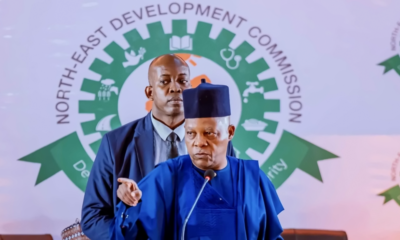
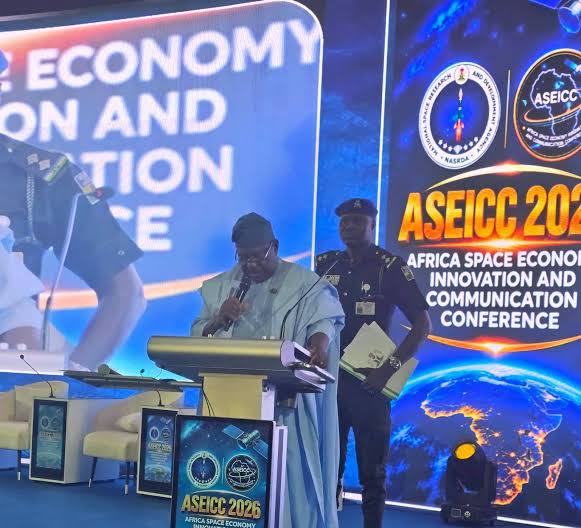
The President spoke yesterday while declaring open the Africa Space Economy, Innovation and Communication Conference 2026 at the International Conference Centre, Abuja. He was represented by the Secretary to the Government of the Federation (SGF), George Akume.
He said the global space economy, currently valued at $686 billion, was projected to grow to $1.8 trillion by 2035, warning that Africa must position itself to benefit from the expanding market rather than remain on the sidelines.
“Africa must stop being a consumer of space technology. We must build, innovate and compete,” he declared.
Tinubu said Nigeria had recorded significant progress in its space programme through the National Space Research and Development Agency (NASRDA), with investments in satellite technology, Earth observation, satellite communications and related applications.
He, however, stressed the need for the country to move beyond building scientific and technological capabilities to industrialisation and commercialisation.
“We must translate the outcomes of our scientific research and technological development into marketable products, viable enterprises, and solutions to real-world challenges.” He called for increased private sector investment in the space industry and stronger collaboration between research institutions and businesses, stressing the need for policies that encourage innovation and enterprise development.
At the conference, Tinubu unveiled models of Nigeria’s next-generation satellites, comprising Earth Observation Optical and Synthetic Aperture Radar satellite platforms.
He said the satellites would strengthen Nigeria’s capacity to monitor its land and water resources, support national security operations, assess the impact of climate change, track environmental degradation, improve urban planning and enhance the mapping and monitoring of solid mineral resources.
Tinubu linked the development of Nigeria’s space industry to his administration’s ambition of building a $1 trillion economy by 2030, saying space-based applications could open new revenue streams, reduce revenue leakages, improve resource management and strengthen evidence-based decision-making.
He urged African countries to deepen cooperation through the African Space Agency and other continental platforms by pooling resources, harmonising policies, sharing expertise and developing joint programmes.
According to him, collaboration would provide the scale and collective capacity required for African countries to compete effectively in the global space industry.
He said Nigeria would pursue strategic partnerships and memoranda of understanding to promote technology development, knowledge exchange, investment and innovation across the continent.
Addressing investors and industry leaders, Tinubu cited the growing demand for space-enabled solutions, Africa’s expanding talent base and the need for innovative responses to development challenges as opportunities for investment.
He also urged young scientists, engineers, innovators and entrepreneurs to position themselves to take advantage of emerging opportunities.
“The future of Africa’s space economy belongs to you as much as it belongs to established institutions and governments,” he said.
The President said the three-day conference would focus on Earth observation, satellite communications, Global Navigation Satellite Systems, geospatial data, artificial intelligence, space manufacturing and workforce development.
He tasked participants with producing measurable outcomes, including investment pathways, viable partnerships, stronger institutional collaboration and actionable recommendations.
Tinubu also expressed appreciation for the Space Grand Commander Award conferred on him, accepting the honour on behalf of Nigerians.
Declaring the conference open, he challenged delegates to ensure that their discussions and agreements translated into practical benefits for their respective countries, saying the outcome would help determine whether Africa would merely watch the expansion of the global space economy or emerge as an active, innovative and competitive participant.