Society
Tinubu should remain in office for another 10 years if possible – Bisi Akande

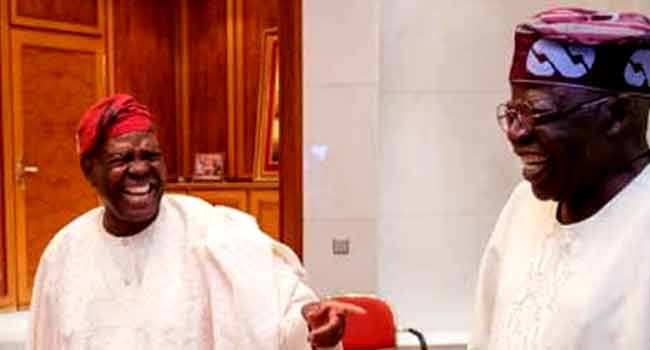
Former Osun State Governor, Chief Bisi Akande, has expressed support for President Bola Tinubu’s continued leadership, saying he would prefer the President to remain in office for as long as 10 years, if possible, to consolidate his policies and complete ongoing projects.
Akande made the remarks during an interview on the Frankly Speaking with Icon podcast, published on Friday, where he argued that Tinubu’s administration needed more time to deliver lasting changes to the country.
The former governor said Nigeria required sustained leadership to address challenges he attributed largely to decades of poor governance and military intervention, particularly in agriculture, education, infrastructure and economic development.
To support his position, Akande referred to comments reportedly made by the Olubadan of Ibadanland about road construction projects across parts of the South-West, including routes connecting Ijebu-Ode, Abeokuta, Oyo and Ikire.
According to Akande, the traditional ruler had commended the ongoing infrastructure work and suggested that Tinubu deserved another four-year term to complete the projects.
Quoting the Olubadan, Akande said: “If you are working like this, and this had not been done 50 years before you, what again do we still say you should do, and you have not done?
“But so that you will be able to complete this good job that you started, Ibadan people and Oyo State people are supporting you to do another four years.”
Akande said he shared that position but went further, arguing that the President should have an even longer period to complete his agenda.
“What else do you want me to say? So Bola Tinubu should be allowed to do another four years to be able to complete that good job he has started.
“He should remain in office, if possible, for another 10 years; otherwise, we go back to the situation of Ebinpawa because there has been a foundation for hunger,” he said.
The former governor blamed successive military administrations, particularly from 1966 onwards, for policies and decisions that, in his view, weakened agricultural production, discouraged education and slowed Nigeria’s modernisation.
He argued that the country had spent decades neglecting productive sectors of the economy, leaving successive governments with significant challenges to address.
“Forty years before he came, since 1966, when the military started ruling you, you have been laying the foundation for hunger. You have abandoned your farms. You have abandoned the job. You have refused to be educated. You have refused to be modernised,” Akande said.
Expressing optimism about the long-term impact of Tinubu’s policies, Akande predicted that continued reforms could bring wider improvements in electricity supply and modernisation over the next decade.
“So in another 10 years there will be electricity everywhere. There will be modernisation,” he said.
Akande also defended the liberalisation of the electricity sector, arguing that it had expanded opportunities for individuals, businesses and communities to generate their own power.
He said the policy represented a departure from the restrictions he associated with previous military administrations, when electricity generation was largely controlled by the Federal Government.
“They liberalised electricity. If you have money today, you can create electricity in your home. You can create it in your city. You can create it around you,” he said.
Contrasting the current policy direction with the previous system, Akande claimed that individuals who attempted to generate electricity independently under military rule faced restrictions and possible arrest.
“Unlike what the military did before, if you tried to create electricity, they would arrest you. They would make you a debtor. They wouldn’t let you do it. They said only the Federal Government could do it. Tinubu came and said everybody can do it,” he added.