World
'They've Spilled the Beans': Iran Reacts to Reports on Kamikaze Dolphins

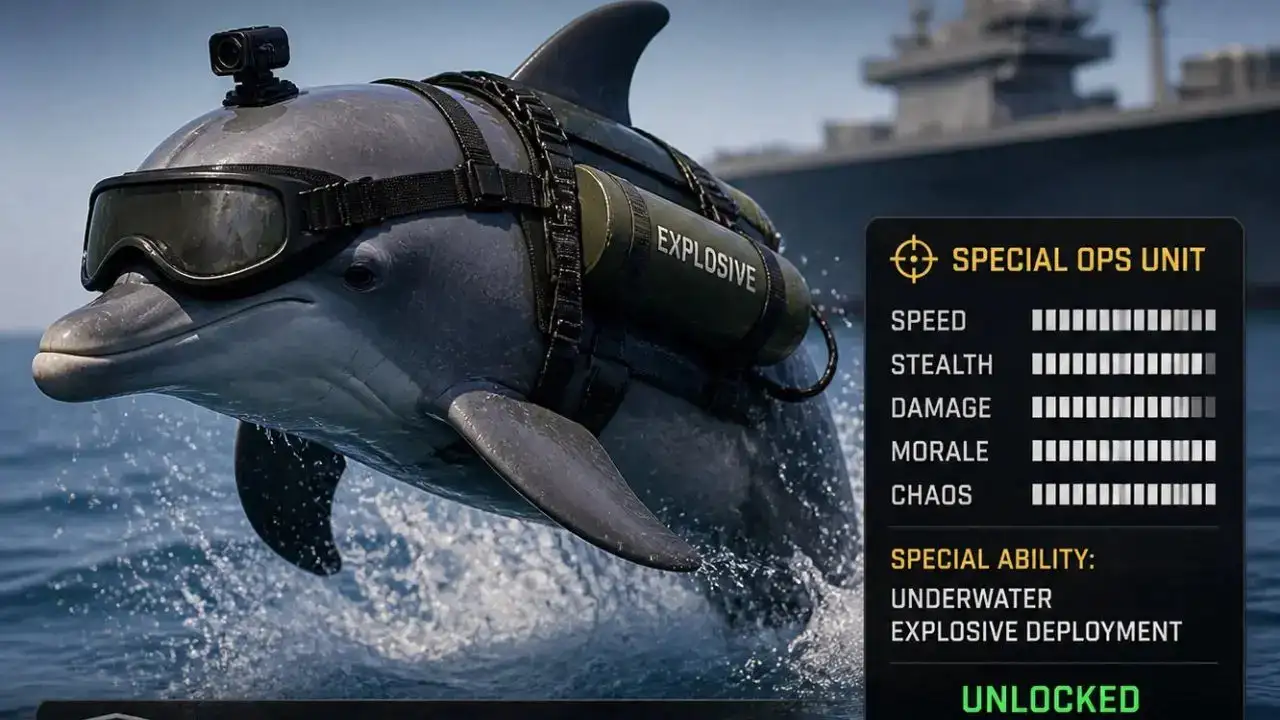
The response was short. But it carried weight. “They’ve finally spilled the beans, it’s all out now.” That remark, posted by Iran’s consulate in Hyderabad, came after reports suggested Tehran could be considering a highly unusual tactic—training dolphins to carry explosive mines targeting US warships in the Strait of Hormuz.
The claim itself remains unverified, but the reaction has ensured it is being taken seriously, at least as a signal. At a time when tensions remain elevated despite a fragile ceasefire, even unconventional ideas can shape perceptions on both sides of the conflict.
They've finally spilled the beans, it's all out now.😉 https://t.co/MgsByx5Zpw pic.twitter.com/IYvSQwsZeN
— Iran In Hyderabad (@IraninHyderabad) May 3, 2026
Reports Point To Unconventional Option
According to reporting cited by The Wall Street Journal, Iranian officials have explored the possibility of deploying marine mammals equipped with mines to approach naval targets. The idea reflects a broader search for low-cost, asymmetric responses to US naval dominance in the region.
This would not be entirely without precedent. Iran is believed to have acquired trained dolphins from the former Soviet navy in 2000, with capabilities reportedly including reconnaissance and underwater operations.
However, there is no confirmation that such capabilities remain active or operational today. At this stage, the reports sit in a grey zone—part intelligence assessment, part speculative planning.
Pressure Inside Tehran Driving Calculations
The backdrop is economic strain and strategic pressure. A prolonged blockade has restricted Iran’s oil exports, tightening financial conditions. Within Tehran, some hardline factions increasingly view this not as diplomacy under strain but as a form of ongoing conflict.
Hamidreza Azizi, a visiting fellow specialising in the Middle East, noted that such conditions can alter strategic thinking. “The blockade is increasingly viewed… as a different manifestation of war,” he said, adding that decision-makers may begin to see escalation as a less costly option. That shift, if sustained, could expand the range of tactics under consideration.
Strait Of Hormuz At The Centre
The focus remains the Strait of Hormuz—a narrow maritime corridor critical to global oil shipments. Any disruption, even temporary, can ripple across energy markets and shipping routes. For commercial operators, uncertainty itself is often enough to trigger rerouting.
While above-water threats remain the primary concern, the possibility of underwater hazards—particularly mines—adds another layer of complexity. Even limited deployment can slow traffic and complicate navigation.
Military Capabilities And Constraints
The US military maintains established systems for detecting and clearing mines. These include sonar-equipped surface drones, underwater vehicles such as the MK18 Kingfish, and helicopter-based scanning platforms. The process is methodical—scan, identify, neutralise. It is effective, but not immediate.
Interestingly, the US Navy has also historically used trained dolphins for defensive roles, primarily for mine detection rather than offensive deployment. Emerging technologies—autonomous systems and AI-assisted scanning—are being tested, but remain limited in operational scale.
In conflict environments, that ambiguity can serve a purpose. It introduces uncertainty, shapes risk perception, and keeps adversaries guessing.