World
The world is turning dangerous for Jews again. Israel has to get its house in order

This Editor’s Note was sent out earlier Wednesday in ToI’s weekly update email to members of the Times of Israel Community. It is adapted from a talk I gave last week at Tel Aviv University’s Irwin Cotler Institute. To receive these Editor’s Notes as they’re released, join the ToI Community here.
Barely a week goes by without summations of record or near-record levels of antisemitism — attacks, incidents, rhetoric — in Germany, in Canada, Australia, the United States, Britain, France, Italy, Belgium… the list goes on.
I’m going to focus initially on England, where I grew up before moving to Israel 40 years ago, and where I often visit. It’s the community I know best and where I feel the strongest personal connection. But the picture I’ll draw is emblematic of the reality and the challenges facing many other Diaspora Jewish communities.
I’m going to start with a little bit of family history; if that seems strange when discussing a very current crisis, you’ll understand why quite soon.
My family, on my father’s side, is a largely Orthodox, sometimes rabbinical family. My great-grandfather founded the Borneplatz Synagogue in Frankfurt, and they were that fairly common mix of very Orthodox Jews and very loyal Germans. My grandfather served in the German Army in World War I — indeed, he was nearly killed in World War I — wounded just above the heart. I have at home the Iron Cross he was awarded; quite the medal to look at, given its widespread use by the Nazis in World War II.
It took my grandfather quite a while to internalize that the Nazis were not a passing phase, and that there was no future for Jews in Nazi Germany. He was a lawyer by profession, and it is said that one of his clients, who was Jewish, unjustly jailed, took his own life, and that this was the event that brought home to my grandfather that he had to get his family out.
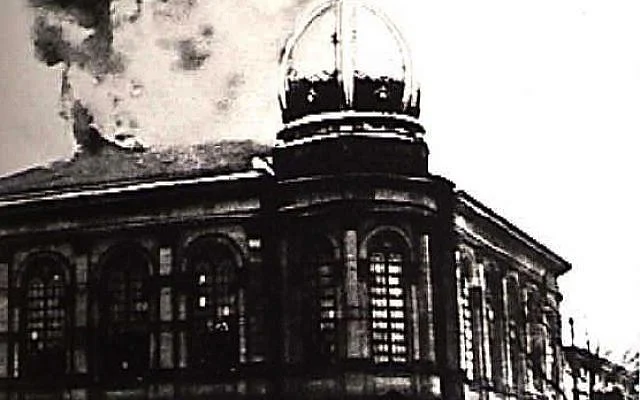
They fled to England in 1937; my great-grandfather’s synagogue was burned to the ground on Kristallnacht — the Night of Broken Glass — the following year.
The Horovitzes settled in northwest London, in a quite heavily Jewish neighborhood called Golders Green, and gradually started their lives all over again.
Every Shabbat when I was a kid, we would walk from our home in nearby Hendon to visit my wonderful grandmother in Golders Green — a peaceful 20-minute walk, through leafy London.
Three months ago, four ambulances owned by Hatzola, a Jewish volunteer emergency service, were destroyed by arsonists outside a synagogue on the main Golders Green Road, a short walk from my now late grandmother’s house. Less than a month later, two Jewish men were stabbed a short distance away, one of them seriously wounded; the suspect, a Muslim man born in Somalia who has been charged with attempted murder, allegedly set out to attack “visibly Jewish” people.

Other synagogues in London have been targeted in recent months. On Yom Kippur last October, a British citizen born in Syria attacked congregants at a synagogue in Manchester, in northwest England, killing one of them. A second congregant was killed, in error, by police, as he and others were blocking the synagogue doors.
There was an undertone of antisemitism in the England in which I grew up. I went to a Jewish high school in Camden Town, a working-class inner-city area, and we’d have occasional fights at the bus stop with the kids from the not-Jewish school down the road, but these were not particularly violent and nobody was ever badly hurt.
The several Jewish cabinet ministers in Margaret Thatcher’s governments didn’t speak too much about their Jewishness; much of the community was wary of drawing too much attention to itself, feeling, perhaps, that they were living in the UK on sufferance. But Thatcher was a philo-semite, and one of her most trusted advisers was the chief rabbi, Immanuel Jakobovitz. None of the governments when I grew up, least of all Thatcher’s — and none since, I’d say — were fanning the flames of antisemitism.
Indeed, Anglo-Jewry became emboldened in the decades after I moved to Israel. The turning point was the Labour Party leader Jeremy Corbyn’s bid to become prime minister in 2019, when Ephraim Mirvis, the British chief rabbi then and now, did something quite unprecedented. Reluctantly, Mirvis intervened in British politics by penning an op-ed in The Times in which he charged that “anti-Jewish racism — a poison – sanctioned from the very top” – had “taken root” in Corbyn’s Labor Party, and all but explicitly discouraged the British electorate from voting for Corbyn. “I ask every person to vote with their conscience,” wrote Mirvis. “Be in no doubt – the very soul of our nation is at stake.”
Corbyn, an anti-Israel obsessive and, in my view, an antisemite, lost the election by a landslide — in small part, perhaps, because of his antisemitism — and was booted out of Labour by now-outgoing Prime Minister Keir Starmer, whose wife is Jewish and has family in Israel. Like Labour, the main opposition Conservative party is committed to protecting British Jewish life, and would likely be more proactive in doing so than apparently weak-willed Starmer.
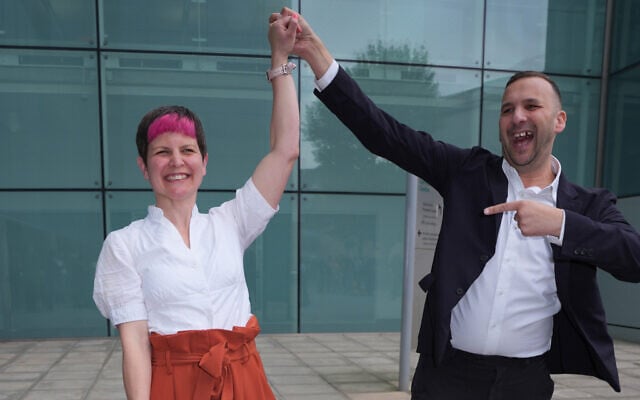
But the Green Party, whose leader is both Jewish and virulently hostile to Israel, is riddled with antisemitism and on the rise from the far left, and Britain’s current most popular party, the hard-right, anti-immigration, Reform UK of Nigel Farage, is regarded with concern by many of Britain’s 300,000 Jews.
In England as elsewhere, obsessive hostility to Israel and antisemitism constitute a rare common ground for extremists on left and right.
On a fairly recent trip to London, my wife and I watched anti-Israel protesters march down Regent Street, united in their singular focus on the Jewish people’s one small, embattled, admittedly far from perfect country. In February 2024, anti-Israel activists projected the slogan “From the River to the Sea,” which they most certainly intended as a call for the eradication of Israel, onto Big Ben, the clock tower at the Houses of Parliament, mother of all democracies.

A British jury five months ago failed to convict an anti-Israel Palestine Action activist who they had watched on film attacking and badly injuring a policewoman with a sledgehammer during a raid on a factory run by Israeli defense firm Elbit. At that point, I really began to wonder whether mainstream Britain was now so afflicted with hatred for Israel that it could not bring itself to punish an anti-Israel activist who had done the unthinkable: attacked a British policewoman. But Sledgehammer Man was convicted in a retrial in May, and he was jailed last month for almost eight years.
Some of the incidents I’ve described underline the obsession with Israel’s crimes and ostensible crimes — a purported concern with human rights but one focused solely on Israel; there was overwhelming indifference, for instance, to the mass murder of tens of thousands of Iranian civilians by their own government early this year. To my mind, when the world’s supreme offender is purported to be Israel, and Israel is the unique focus of protest and activism, we have entered the territory not only of anti-Zionism but of antisemitism.
And plainly, there is a growing conflation between Israel and Jews — in England and around the world — which means some of those rising masses so deeply and sometimes violently hostile to Israel are inclined toward hostility and sometimes violence towards Jews as well.
A few weeks ago, not long after the Golders Green stabbings, I interviewed Michael Wegier, the chief executive of the Board of Deputies of British Jews, the community’s main representative body, and he demurred when I asked him whether British Jews were now living in fear. And as far as I know, there is no massive outflow of British Jews to Israel or anywhere else. But he did acknowledge what he called “a climate of anxiety.”
Evaporating US support for Israel; record numbers of attacks on Jews
Since October 7, 2023, and the Hamas invasion, there has been a steep rise in incidents of antisemitism in the UK, and the political climate, too, as I’ve said, may well be changing in ways that are concerning for Jews. Much of that summation applies, as well, to many other Jewish communities around the world.
In some, Jews would be more likely to say they are indeed living in fear, rather than “anxiety.” That would seem to be the sense emanating from many Jews in Canada, for instance, or Australia, where the government has proven particularly indulgent of intensive anti-Israel activism and hostility. A series of attacks on synagogues and other Jewish targets — none of which produced firm, government-ordered action — culminated in the massacre on Bondi Beach in December, in which 15 people were shot dead, again by Muslim murderers, in an attack coldheartedly targeting a first-night-of-Hanukkah celebration. An event marking the Jewish festival of light was subject to the first fatal attack on Jews in Australia, and the worst terrorist attack in Australia’s history
But I want to focus a few more words on the United States, home to the only substantive Jewish community outside Israel. In Israel, we are perhaps 7 million; in the US, maybe slightly fewer, depending on your definitions of Jewishness. No other Jewish community worldwide comes close to being a million strong. Many people think there are tens of millions of Jews worldwide. In fact, there are about 15 million — 0.2 percent of the global populace, and still fewer than before the Holocaust wiped out 6 million.
Many, many years ago, when I first attended the massive conferences that AIPAC, the pro-Israel lobby, used to hold in Washington, DC, I marveled at the confident display of power at the events’ annual gala dinners. AIPAC leaders would stand at the front of the hall and read out the names of all the administration officials, the senators and members of Congress, the ambassadors, who were present in the room — dozens upon dozens of names, each of them applauded. The cavernous hall reveled in the display of support and solidarity.
Now, in the United States, support for Israel at the highest levels is gradually evaporating. A staggering 60 percent of Americans have an unfavorable view of Israel. And, again by extension, antisemitism is soaring. The ADL reported a record high number of physical assaults on Jews in America last year, and the first fatalities since 2022 — including the murders of two staffers from the Israeli Embassy.
My wife studied at Columbia University on the Upper West Side of Manhattan. After October 7, the Columbia campus, like so many others in the US and worldwide, was a center of anti-Israel activism. Students joined marches along Broadway, where my sister-in-law lives, some carrying “From the River to the Sea” placards — some of them useful idiots who, when asked, genuinely did not know between which River and which Sea they were advocating for Israel’s demise.
I never thought I’d see “From the River to the Sea” projected onto Big Ben. And I’m sure my wife’s family never dreamed they’d watch people in Hamas headbands marching down Broadway.

Anti-Israel activists regularly rally outside synagogues in New York carrying the flags of the Hezbollah terrorist organization. Zohran Mamdani, the mayor of New York City, far from joining the annual Israel Day parade in the tradition of his predecessors, does not believe that the Jewish nation has the right to statehood in its ancient homeland. In a city with more Jews than any other on Earth, vicious hostility to Israel, far from being an impediment to political success, proved central to the clean sweep in last week’s Democratic primaries of Mamdani-endorsed candidates.

An Israeli government hobbling Israel’s cause
Anyone who reads my weekly op-eds in The Times of Israel will know that I am deeply concerned about the direction Israel has taken domestically under the Netanyahu government. To put it bluntly, I see a coalition in which racist, Jewish supremacists hold central roles, alongside an ultra-Orthodox leadership that insists that its young males be exempted from the responsibilities of military service and be paid to study Torah full-time en masse. That’s a demand that skews Jewish history and Jewish principle, but one that Prime Minister Benjamin Netanyahu has relentlessly sought to indulge in order to retain power — leaving the army short of recruits in an era of war, and tearing at Israel’s social cohesion.
I’m not convinced, either, that the IDF is as dependably moral as it was — the ethos is principled, the orders strive for morality, but in the field, discipline and standards and practices are clearly fraying, with a minority of soldiers fashioning their own insignia in the cause of messianic war, failing to effectively thwart violent settler attacks on Palestinians, and even participating.
In its essential resort to force against Hamas following the October 7 massacre, and in the multifront wars since, the Israeli government, as ever, has failed utterly on the second battlefield — the war for global public opinion. It simply doesn’t fight. It has no hierarchy staffed or resourced to even disseminate real-time information, an honest Israeli narrative. Instead, it relentlessly hobbles Israel’s own cause.
Ministers push to annex the West Bank and Gaza — steps that would destroy Israel as a majority-Jewish state or a democracy, or both. One minister talked about nuking Gaza. Our national security minister — who last month posted video footage of himself taunting flotilla detainees — just days ago, after four soldiers were killed by Hezbollah, demanded that: “For every tear of an Israeli mother, a thousand Lebanese mothers must weep.” And “All of Lebanon must burn!”
Other ministers seem bent on alienating even the most steadfast Diaspora Jewish supporters of Israel; one recently declared that rabbis in the Reform movement, the largest Jewish stream in the US, perform marriages for dogs in their synagogues.
Israel should be working strenuously to try to address and defang resonant and often false allegations against it, an uphill battle but one that would nudge the needle, give succor to Israel’s supporters, and help to at least somewhat calm the climate of increasingly murderous hostility to Jews in parts of the Diaspora. Instead, the government is exacerbating the crisis.
The essential homeland
Again, Israel is not perfect, but it is being unjustly delegitimized and turned into a global pariah, in an effort led by haters who fully intend to render it defenseless and get it destroyed.
And my point in highlighting all of that in this article is to recall and remind us all that the modern Jewish state was, terribly, tragically, revived too late to serve as a refuge for Jews from the Holocaust. But it has served as a refuge for persecuted Jews from all over the world, as well as immigrants by choice, ever since its revival. A vital, necessary refuge for Jews.
Diaspora Jewry is under heaviest attack by those who claim to oppose Israel, but whose obsessive hatred for the Jewish state is a paper-thin cloak for antisemitism.
And when I look out at the Diaspora today — facing that soaring antisemitism, and that rising tide of attacks, with feckless governments failing to protect their Jewish communities — I see a growing imperative for this country to make sure it survives, and thrives, and upholds authentic Jewish values, and is capable of defending itself. We won’t be able to do that if we are tearing ourselves apart from within, from the top, which makes October’s elections arguably the most fateful in the brief modern history of Israel.
The fact is, and I make no apology for ending in tones of such concern, that our survival is not something we can dare take for granted, given that Israel is demonized, isolated, imperfect, and fraying. Indeed, Israel is, outrageously, the world’s most toxic nation right now.
And since I began drafting this speech-turned-article, we seem to be in the process of being abandoned by our most important ally, the United States: The Trump administration last month signed an accord with Iran committing to the “permanent” cessation of hostilities against a rapacious regime that is steadfastly working for our destruction. It is an accord which Israel had no role in drafting, which for now leaves Iran’s nuclear program, its ballistic missile program, its terror proxies and the regime itself, all intact — and yet whose very first clause declares that it is binding on the US, Iran and “their allies” — as in, binding on us. As in — and you can read the memorandum of understanding for yourselves — Israel, with no say in the matter, is barred by the United States from initiating military action that it might deem vital to its survival.

In subsequent talks, US Vice President JD Vance revealed last week, a “deconfliction mechanism” was agreed under which CENTCOM and Iran’s Islamic Revolutionary Guard Corps are supposed to work together to reduce conflict — the US army, that is, coordinating on “deconfliction” with Iran’s main US-designated terror group, responsible for the arming, training and activities of Iran’s terror proxies in Lebanon, Gaza and beyond, for innumerable global bombings, assassinations and other acts of terror, and for the murder of Iranian citizens. Words fail.
And all this at a time, in this dire global climate, when Israel manifestly needs to be able to defend itself as acutely as ever, and, moreover, needs to be able to keep its doors open and securely welcoming for Jewish people worldwide.
We are not in Nazi Germany in the 1930s. But this is a global crisis for Jews. Because almost all of them are anxious. And many of them are living in fear.