Society
The Lion of Lufodo: What Olu Jacobs kept hidden from the public

By Sherifat Kazeem
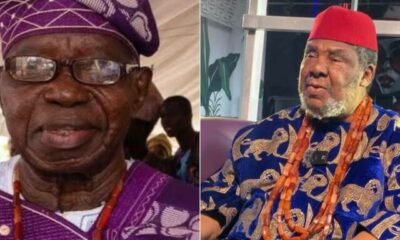
Veteran actor Olu Jacobs, who died on Wednesday at 84, is being mourned across Nigeria as ‘the Lion of Lufodo’ – a family tribute to a life ‘well lived and fought.’ Yet, beneath five decades of screen dominance lies a narrative largely hidden from his adoring public. It is the quiet history of a young man who defied his father for the stage, a family bearing the weight of a private tragedy, and a fierce health battle fought in the shadows, even as recurring death hoaxes forced his loved ones into the harsh glare of the media.
A Secret Visa and The British Stage
Olu Jacobs’s path into acting began not in a Nigerian studio but at a travelling concert party. As a young man, he watched Chief Hubert Ogunde perform at the Colonial Hotel in Kano, and the experience never left him. When he told his father he wanted to study drama in Britain, he was discouraged from pursuing it. Instead of dropping the idea, Olu Jacobs quietly applied for a visa without his father’s knowledge. It was approved, and in 1964 he left Nigeria for London.
He trained at the Royal Academy of Dramatic Art (RADA) in Bloomsbury, one of Britain’s oldest and most demanding actor-training institutions, founded in 1904. Few Nigerians of his generation had access to that kind of training, and fewer still pursued it against a parent’s wishes.
What followed is a chapter of his career many younger fans know little about: 15 years working British stage and television before he ever appeared in a Nigerian film. He took his first professional stage role in 1972 in A Taste of Honey at the Crucible Theatre in Sheffield, and went on to appear in British TV series including The Goodies, Till Death Us Do Part, Barlow at Large, The Venturers, Angels, The Tomorrow People and The Professionals. Those years abroad also left him with dual citizenship, Nigerian by birth, British by naturalisation a detail rarely mentioned alongside his Nollywood legacy.
Jacobs did not return home until 1980. Colleagues and film historians say that British apprenticeship, built on a decision he made in secret, laid the foundation for the range that later made him, alongside Pete Edochie, one of Nollywood’s acknowledged “godfathers.”
The Tragedy of Dayo: The Pain Olu Jacobs and Joke Silva Hid from the World
Jacobs married actress Joke Silva, and the couple became one of Nigerian entertainment’s most publicly celebrated partnerships. Less publicised is that their first daughter, Dayo, died a loss the family has referenced only sparingly over the years even as they remained in the public eye. Their two sons, Olujosimi and Olugbenga, grew up largely outside the spotlight their parents occupied.
In his later years, Jacobs lived with dementia, a diagnosis Joke Silva confirmed publicly only in 2023, after years of managing his care privately as his primary caregiver. She described the toll candidly in one interview, saying that for much of the time, the husband she knew was no longer fully present even as she continued to care for him.
That private illness became entangled with public confusion: Jacobs was wrongly declared dead on social media at least twice before his actual death in 2020, when the Actors Guild of Nigeria had to step in to deny it, and again in 2024, when his son Olusoji Jacobs and publisher Betty Irabor both had to publicly confirm he was still alive. The family that finally announced his real death this week is the same family that spent years quietly correcting false reports of it.
Forget the Movies: The Untold Story of the multi-million Naira Lufodo Legacy
Fewer Nigerians know the scale of what Jacobs built away from film sets. In 1985, he and Silva founded the Olufodo Academy of Performing Arts, initially visiting privately owned schools to introduce children to theatre. It was formally incorporated in September 2000 as a full media and entertainment company, later becoming the Lufodo Academy of Performing Arts (LAPA) the same “Lufodo” his family invoked in this week’s announcement.
Beyond LAPA, Olu Jacobs also headed a training body focused on teaching movie practitioners the fundamentals of theatre craft, and ran a consultancy offering presentation and communication training to corporate executives work entirely removed from the roles the public knew him for.
That quieter legacy was recognised internationally in 2011, when Jacobs received a standing ovation and the Prix Charles Mensah at the closing ceremony of the Écrans Noirs Film Festival in Yaoundé, Cameroon a moment far less remembered today than his 2007 Africa Movie Academy Award for Best Actor.
Those who worked closely with Olu say it is this side of Jacobs, the young man who defied his father for a shot at the stage, the father who carried private grief, and the mentor who quietly built institutions long after the cameras stopped rolling that they will remember most.