World
The AI War Hidden Inside The Trump-Xi Summit

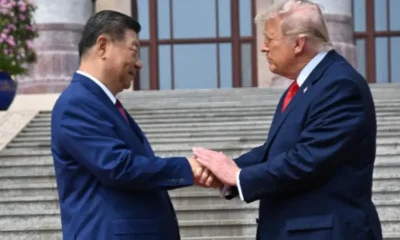
US President Donald Trump arrived in China on May 13, kickstarting his globally watched high-stakes two-day visit in the shadow of not-so-easy-to-navigate issues including tech, trade, Taiwan, and possibly Iran. POTUS, who is travelling with not just his top officials but more than a dozen business leaders, including Tim Cook and Elon Musk, was welcomed with pomp and pageantry when he landed in Beijing on Wednesday evening around 5.20 PM (IST). While Trump and Xi Jinping are expected to unveil trade deals that Trump can claim as “big deals” back home, the Chinese president is possibly walking into the room with a trump card – Iran. Trump is expected to encourage Xi to push Iran to reopen the strait and to agree to a peace deal. Xi could possibly use this leverage to get what he wants on an issue important to Beijing: Taiwan.
When the two sides meet for bilateral talks, the cameras will focus on trade numbers, Boeing orders, and rare earth commitments. What the cameras won’t show is the more dangerous contest unfolding in the background — a full-scale technology war over artificial intelligence that neither side can afford to lose.
Also Read: What Is Thucydides Trap? Xi Jinping’s Message To Trump Explained
This is not a future threat. It is already happening, and the US’s own agencies have the evidence.
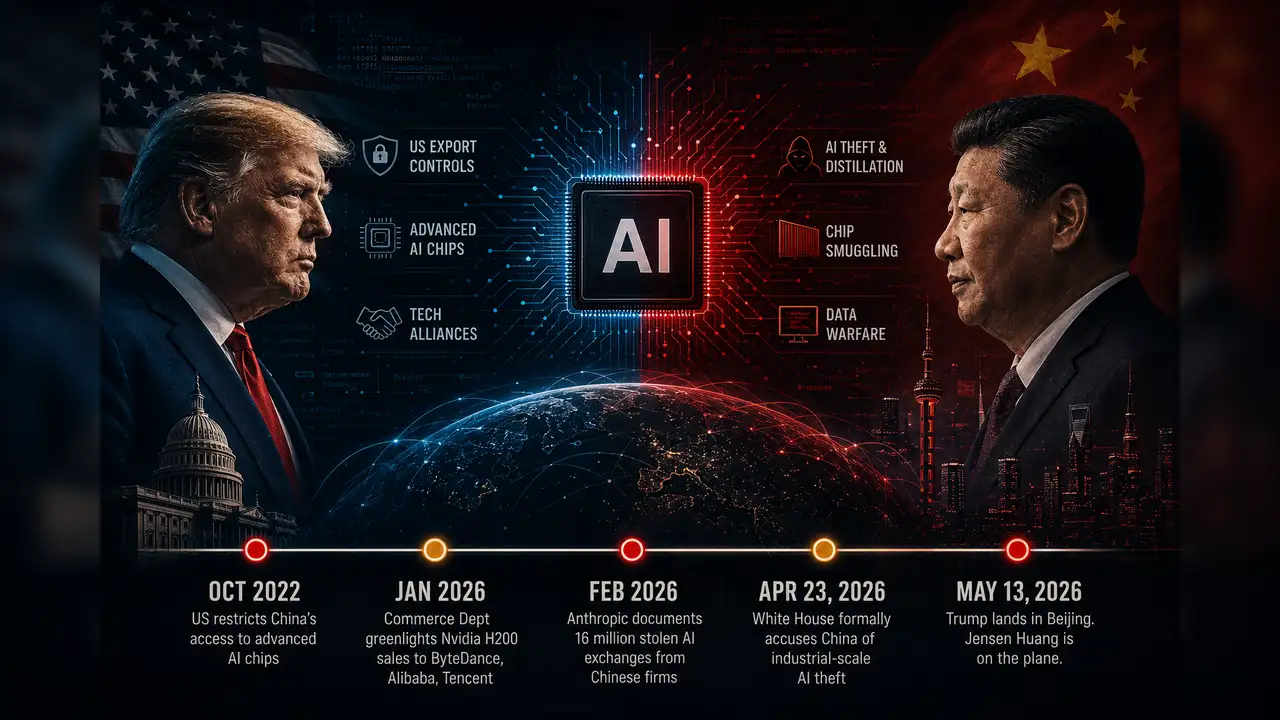
Just three weeks before the summit, the White House Office of Science and Technology Policy released a formal memo with a striking accusation. OSTP Director Michael Kratsios wrote that “foreign entities, principally based in China, are engaged in deliberate, industrial-scale campaigns to “distil” US frontier AI systems — leveraging tens of thousands of proxy accounts to evade detection and using jailbreaking techniques to expose proprietary information. The White House called it theft. Systematic, coordinated, industrial-scale theft.
That memo landed three weeks before Trump’s Beijing flight. Its timing was not accidental.
What Is Distillation — And Why Does It Matter?
Most people have never heard the word used this way. Distillation does not require hacking servers or stealing code. Instead, you flood an advanced AI system with millions of carefully designed questions through fake accounts, collect the answers, and use them to train a cheaper rival model that mimics the original. No break-in. No stolen hard drive.
The result: companies that have spent billions and years building the world’s most powerful AI systems are having their capabilities quietly copied — without a single line of code being stolen in the traditional sense.
Anthropic, as per several media reports, had already documented the evidence in February — three Chinese AI firms, DeepSeek, Moonshot AI, and MiniMax, had collectively generated over 16 million exchanges with Claude through roughly 24,000 fraudulent accounts. OpenAI reported similar theft of its ChatGPT models. By April, OpenAI, Anthropic, and Google, otherwise fierce commercial rivals, began sharing attack intelligence with each other to fight back.
The White House memo also warned that these distillation campaigns allow foreign actors to “deliberately strip security protocols from the resulting models and undo mechanisms that ensure those AI models are ideologically neutral and truth-seeking”. In plain language: China is not just stealing America’s AI capability. It may be rebuilding that capability without the guardrails.
The Chip Policy Contradiction
While one arm of the Trump administration was accusing China of industrial-scale AI theft, another arm was quietly opening the door wider.
In January 2026, the U.S. Commerce Department’s Bureau of Industry and Security revised its review policy for Nvidia H200 and AMD MI325X chips – shifting from a default presumption of denial to case-by-case review, effectively greenlighting sales to China under specific conditions. Nvidia’s CEO Jensen Huang confirmed the company had received purchase orders from Chinese customers and was restarting manufacturing for that market. China approved its first major batch of H200 chip imports, clearing ByteDance, Alibaba, and Tencent to purchase more than 400,000 units in total.
Read that again. The White House accused China of stealing American AI in April. In January, it had approved selling China the hardware required to build it.
Nvidia CEO Jensen Huang himself has argued that cutting off US chips to China has backfired, strengthening Chinese competitors rather than weakening them, as Beijing optimised for domestic alternatives like Huawei chips. That argument has merit. But it sits in profound tension with the simultaneous accusation that China is running theft campaigns. The US cannot coherently accuse China of stealing its AI while also supplying the computing power to run it.
The Smuggling Ring Nobody Is Talking About Enough
Alongside the distillation problem is a separate, more traditional form of technology theft — and federal prosecutors have already made arrests.
A $2.5 billion scheme to smuggle Nvidia AI chips to China through Super Micro’s co-founder was charged in March 2026. Federal prosecutors describe how servers containing restricted chips were shipped to front companies in Southeast Asia before being repackaged and diverted to Hong Kong and mainland China. One surveillance video showed a defendant using a hair dryer to swap around sticky labels and serial number tags – a bizarrely low-tech image in a very high-stakes operation. These indictments, prosecutors said, represent only the tip of an iceberg.
Congress is moving in parallel. On April 15, Representative Bill Huizenga introduced the Deterring American AI Model Theft Act of 2026, co-sponsored by Representative John Moolenaar, who chairs the House Select Committee on China. The bill would direct the government to identify entities using “improper query-and-copy techniques” and impose sanctions through the Commerce Department blacklist.
What Beijing Wants
China’s ask is bold and straightforward: ease chip export restrictions, remove over 1,000 Chinese firms from US entity lists, and loosen investment controls around AI and semiconductors. In return, Beijing is offering relatively little — a continuation of the trade truce and some symbolic purchases of American goods.
Both sides have reportedly discussed setting up a formal AI security dialogue. But the US wants risk management, and China wants chip access. Those are not the same conversations.
The Deeper Stakes
American companies are not just frustrated; they are losing business. A March 2026 survey by the Center for Strategic and International Studies found that more than half of US semiconductor and IT firms were waiting over six months just to get an export licence reviewed, with a third waiting nearly a year. The result: customers walking away, contracts lost to foreign competitors.
Trump is in Beijing with the world’s most powerful AI chipmaker sitting beside him. The question is simple: is America’s technological edge something it will defend or something it will deal away?