Politics
Supreme Court Gives Judgment on INEC’s 2026 Electoral Act

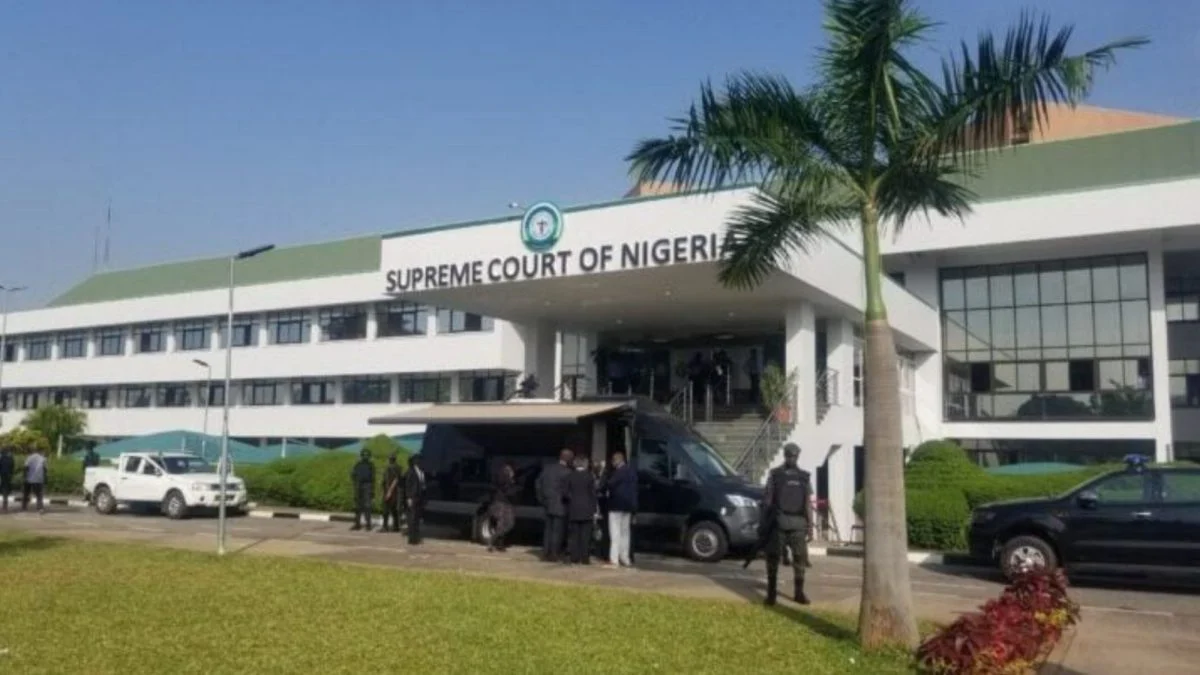
The Supreme Court has upheld the validity of key provisions of the 2026 Electoral Act on political party membership registers and the nomination of candidates through primaries, setting aside an earlier Court of Appeal judgment that had voided parts of the law.
A seven-member panel of the apex court, led by Justice Adamu Jauro, delivered judgment on Thursday in an appeal filed by the Independent National Electoral Commission (INEC) against the Court of Appeal decision.
The Supreme Court held that Sections 77(5) and 84 of the Electoral Act 2026 are not inconsistent with the 1999 Constitution and consequently restored the judgment of the Federal High Court.
The court also awarded N2 million in costs against the Zenith Labour Party (ZLP), which had initiated the legal challenge.
The dispute began after the ZLP approached the Federal High Court in Abuja in suit number FHC/ABJ/509/2026, challenging Sections 77(5), 77(6), 77(7) and 84(2) of the Electoral Act 2026.
Sections 77(5) to (7) contain requirements relating to the membership registers of political parties, while Section 84(2) provides for direct primaries or consensus as methods through which political parties may nominate candidates.
The ZLP argued that the provisions amounted to unconstitutional interference in the internal affairs of political parties and conflicted with provisions of the 1999 Constitution, particularly Sections 221 and 222, which establish the constitutional framework for political parties.
Justice Mohammed Umar of the Federal High Court dismissed the suit on May 5, 2026.
Dissatisfied with the decision, the ZLP appealed to the Court of Appeal in Abuja in appeal number CA/ABJ/CV/750/2026.
On July 16, 2026, the Court of Appeal allowed the appeal in part and voided provisions of the Electoral Act dealing with political party primaries and membership registers.
INEC subsequently approached the Supreme Court to challenge the decision of the appellate court. The commission’s appeal was filed as SC/CR/495/2026.
The apex court, after hearing arguments from the parties, reserved judgment last week. INEC was represented by Dr Alex Izinyon, SAN.
In its judgment on Thursday, the Supreme Court set aside the Court of Appeal’s decision and upheld the judgment of the Federal High Court, effectively affirming the challenged provisions of the Electoral Act.
The apex court also dealt with separate appeals filed by the Social Democratic Party (SDP) and the Youth Party (YP) against decisions involving INEC.
In the SDP case, the Supreme Court heard the appeal on its merit but dismissed it.
The court took a different position on the Youth Party’s appeal, striking it out after upholding INEC’s preliminary objection. The apex court held that the appeal was invalid and incompetent because it had been filed one day outside the prescribed time limit.
The judgments come as INEC continues preparations for the 2027 general elections and addresses legal and administrative issues surrounding the conduct of elections and the activities of political parties.
The Chairman of the commission, Prof. Joash Amupitan, had on Wednesday warned that inadequate funding could affect the commission’s ability to effectively handle security, logistics and other operations required for the 2027 elections.
Amupitan gave the warning in Owerri, Imo State, during the sixth Conference and Retreat for Senior Police Officers.
He said INEC’s responsibilities went beyond conducting elections to include voter registration, registration of political parties and the conduct of presidential, National Assembly, governorship and state House of Assembly elections.
The INEC chairman noted that although the commission’s funding is constitutionally provided as a first-line charge on the Consolidated Revenue Fund, the scale of its responsibilities required sustained financial support.
“Sometimes, it is not what you would like to do that you are able to do because of financial constraints,” Amupitan said.
He particularly highlighted the cost of deploying electoral officials and materials across local government areas, wards, registration areas and polling units.
According to him, adequate funding is also important for election security because INEC has statutory powers to request the deployment of security agencies during elections and voter registration.
Amupitan described voter registration as the foundation of the electoral process and warned that an inaccurate or outdated voters’ register could affect the inclusiveness and credibility of elections.
He also stressed the importance of the Inter-Agency Consultative Committee on Election Security, known as ICCES, in coordinating INEC, the police, other security agencies and relevant government institutions.
The chairman said stronger cooperation among the agencies would be necessary ahead of the 2027 elections, identifying the Nigeria Police Force as the lead agency responsible for election security.
He urged senior police officers to maintain professional neutrality, improve intelligence gathering and strengthen coordination with INEC and other security agencies.
Reflecting on recent off-cycle elections, Amupitan said the experiences had demonstrated the importance of effective security coordination in preventing incidents from disrupting elections.
He said lessons from those elections should be incorporated into preparations for 2027, particularly in intelligence gathering, logistics and inter-agency cooperation.
The INEC chairman also said Nigerians expected a highly effective electoral system but needed to recognise that maintaining such a system required substantial resources.
“In Nigeria, we want the best. We want our electoral system to be 100 per cent. But sometimes we don’t ask ourselves the question: if we want the nation to be perfect, there must be a cost for it,” he said.
He called on relevant authorities to provide INEC and security agencies with the resources required to carry out their responsibilities effectively, while expressing optimism that the Owerri retreat would produce an actionable roadmap for election security ahead of the 2027 general elections.