World
Strait of Disruption: Could helium shortage disrupt hospitals, semiconductor plants, and space missions across world?

Even after the United States and Iran agreed to a ceasefire, the troubles caused by weeks of war in the Middle East are far from over. The conflict has badly shaken global supplies of oil, natural gas, jet fuel, tungsten, sulfur and fertiliser. But there is one more material being affected which most of us never think about — helium.
Yes, the same gas that floats your birthday balloons and makes your voice sound funny is actually one of the most important materials behind modern life. Without helium, your hospital MRI machine cannot work. Your smartphone chip cannot be made. Even rockets, missiles, fibre optics and AI data centres run on it. So when helium supply is in danger, the whole modern world feels the shock.
Why Helium Is So Special
Helium is colourless, lighter than air and stays liquid only at around minus 269 degrees Celsius. This extreme cold property makes it the only gas that can cool down the powerful magnets inside MRI machines and quantum computers. In semiconductor factories, helium is used to keep silicon wafers — the thin round base on which chips are built — at a steady temperature. It also stops tiny vibrations during chip making and removes unwanted impurities from the air. Chipmakers need helium continuously, without any break, because even a small disturbance can damage millions of chips.
How Helium Is Transported
Transporting helium is not easy at all. Since it is the lightest gas after hydrogen, it must first be cooled down to around minus 269 degrees Celsius and converted into liquid form. This liquid helium is then stored in special double-walled containers called ISO cryogenic tanks or dewars, which work like giant high-tech thermos flasks. These containers keep the helium extremely cold using vacuum insulation. They are loaded onto ships, trucks and trains and shipped across oceans. Even with the best containers, a small amount of helium keeps escaping daily, which is called “boil-off”. This is why helium is treated like a perishable commodity such as vegetables or milk — it must reach its destination quickly. The world has very few storage facilities, making any supply disruption extremely painful.
How The Gulf War Triggered The Crisis
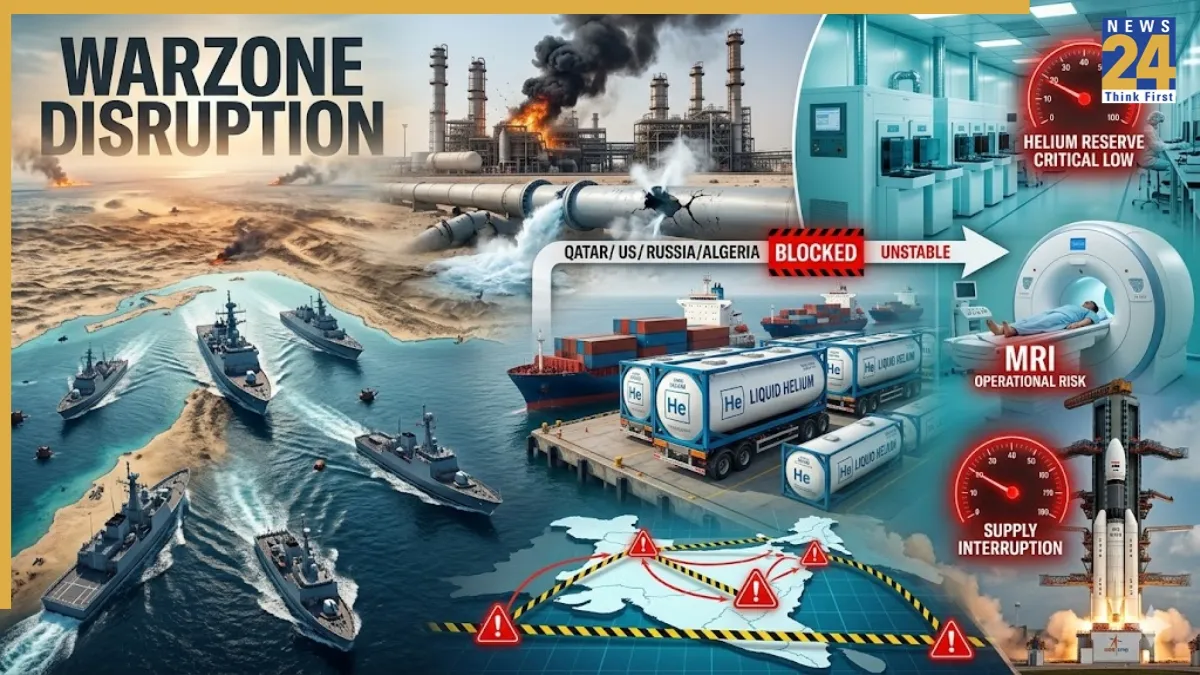
Most of the world’s helium comes as a byproduct of natural gas production. Qatar, the world’s second-largest LNG producer, was supplying nearly one-third of the global helium before the war began. When Iran attacked Qatar’s Ras Laffan facility — the world’s largest LNG plant — QatarEnergy stopped production and reduced its yearly helium exports by 14 percent.
To make matters worse, most of Qatar’s helium passes through the Strait of Hormuz, a narrow 21-mile sea route which has been blocked due to the war. Even though a ceasefire is holding, the strait is still closed. Industry experts warn that even if it reopens today, it will take four to six months for supplies to return to normal. Helium prices have already nearly doubled in the last month.
Why India Should Be Worried
India does not produce any meaningful quantity of helium. Almost 100 percent of our helium is imported, and a big share comes from Qatar through the same troubled route. Our hospitals depend on helium for MRI scans. Our growing semiconductor dream — including the new chip plants in Gujarat and Assam — will need huge amounts of helium. Our space programme, ISRO, uses helium to pressurise rocket fuel tanks. Our welding, fibre optics and electronics industries also depend on it.
If the Gulf situation worsens again, India could face a double blow — costlier MRI scans for patients and slower progress in the semiconductor mission that the government is pushing so strongly. Hospitals in smaller cities will be hit hardest.
Alternatives India Must Explore
First, India should diversify its helium imports. The United States produces about 43 percent of the world’s helium and remains the safest supplier. Russia’s Amur gas project, Algeria, Australia and Tanzania are also emerging as new helium sources. Long-term contracts with multiple countries will reduce our risk.
Second, India must build its own strategic helium reserve, just like our oil reserves in Visakhapatnam and Mangalore. The US once had such a reserve since 1925 but sold it off by 2024, and now experts there are regretting that decision. India should learn from this mistake.
Third, India has good potential to extract helium from its own natural gas fields in Rajasthan and the Krishna-Godavari basin. ONGC and GAIL should invest in helium recovery plants.
Finally, recycling helium in hospitals, research labs and chip factories must become compulsory. Many advanced countries already recover and reuse up to 90 percent of helium. India’s industries can do the same with the right policies.
The helium crisis is a quiet warning — India must act now, before the next balloon bursts.
(Girish Linganna is an award-winning science communicator and a Defence, Aerospace & Geopolitical Analyst. He is the Managing Director of ADD Engineering Components India Pvt. Ltd., a subsidiary of ADD Engineering GmbH, Germany.)
(Disclaimer: The views expressed above are the author’s own and do not reflect those of News24)