Special Report
Sanitation crisis in Lagos: who is responsible for the waste?

By Olukosi Sofiat
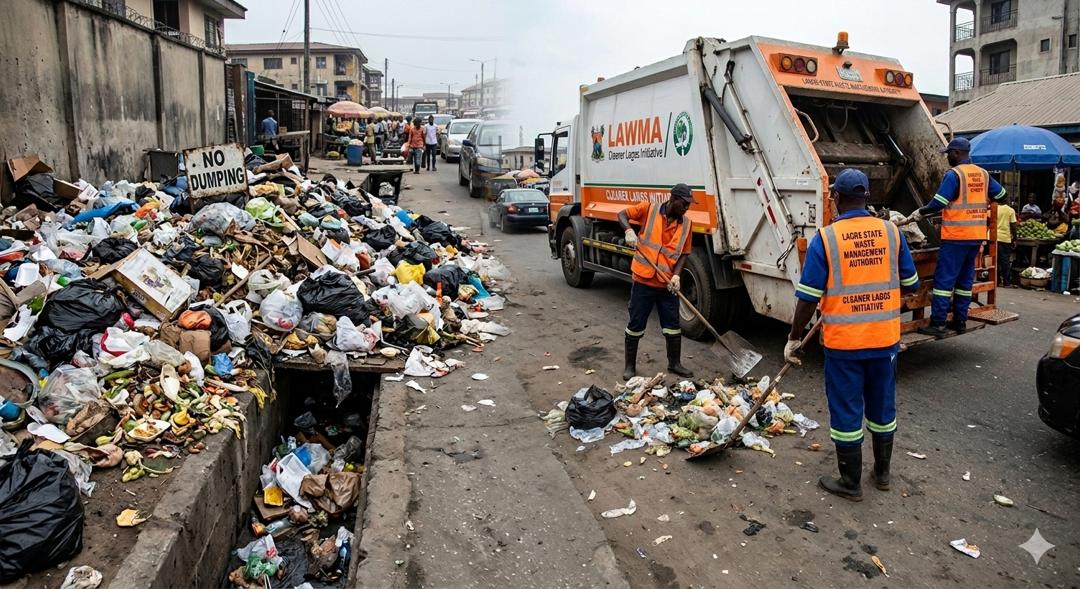
Gutters blocked!
Streets littered!
Stench in the air!
And still, Cleaner Lagos initiatives and LAWMA are always on the streets of Lagos every day.
It is a confusing paradox. If one drives through Igando or navigate the bustling markets of Iyana-Iba at 6:00 a.m., one will see them (the orange-clad sweepers) battling a tide of plastic and organic rot. Yet, by noon, the same spots often look as though a broom hasn’t touched them in years. This leads to a serious question: In a city where waste management is visible, why are we still drowning in filth?
The finger-pointing usually starts at the top. People might say that the Lagos State Government’s frequent policy shifts have created a “too many cooks” situation. We’ve moved from the old PSP (Private Sector Participant) model to the ambitious Cleaner Lagos Initiative (CLI) and back to a hybrid system.
READ RELATED NEWS UPDATES
Falana rejects Lagos restriction over sanitation exercise
“Embrace waste sorting for cleaner mega-city” — LAWMA boss urges Lagosians
Every time the strategy changes, bins disappear from street corners, collection schedules falter, and the mountains of trash grow. When the trucks don’t show up, the “cart pushers” return, often dumping refuse into the nearest canal just to empty their barrows.
But the government isn’t the only player in this drama. There is a deep-seated culture of “indiscriminate dumping” among residents. For many, the gutter is a convenient conveyor belt that carries trash away during a downpour but it doesn’t. It clogs, it breeds mosquitoes, and it eventually floods the very houses that fed it.
The truth is, we are trapped in a broken cycle. The government provides the system, but the citizens provide the discipline. Until the “Sanitation Corps” and the “Market Woman” are on the same page, the stench will remain a permanent resident of our streets.
It is time to stop waiting for a miracle. Residents must commit to proper bagging and paying their dues to assigned PSP operators while the government must ensure that “Cleaner Lagos” is an operational standard not just a slogan on a vest. We must fix the system and our habits simultaneously.
After all, the waste doesn’t walk onto the streets by itself and it won’t and until our habits change alongside the infrastructure, the stench will remain a permanent resident.
For More Details, Visit New Daily Prime