World
Report exposes pro-Israel network pushing Germany to defund UNRWA

A coordinated network of Israel-aligned organisations working to pressure Germany into cutting support for the United Nations Relief and Works Agency for Palestine Refugees in the Near East (UNRWA), has been uncovered by a new report.
Commissioned by the Rosa Luxemburg Foundation and written by German-Israeli researcher Alon Sahar, the report maps a transnational advocacy ecosystem that has worked for more than a decade to discredit UNRWA and weaken the Palestinian right of return. It argues that the campaign intensified after 7 October, 2023, when Israel accused UNRWA staff of links to Hamas, triggering a wave of donors suspending ties to the UN refugee group.
Germany is a critical target for the campaign. After the US halted contributions to UNRWA in January 2024, Berlin became the agency’s largest governmental donor. Germany gave $116.8 million to UNRWA in 2025, more than twice the contribution of the UK, the second-largest governmental donor.
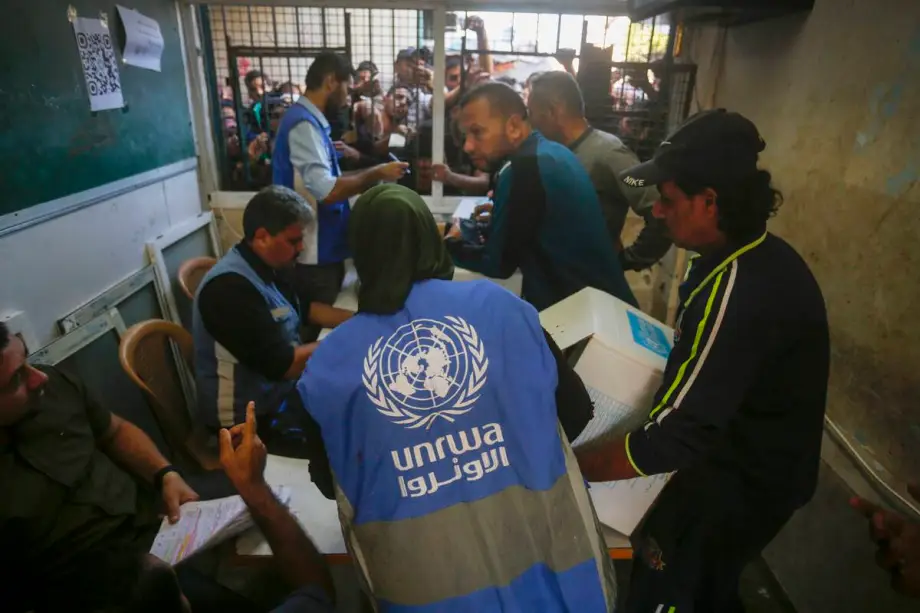
UNRWA provides education, healthcare, humanitarian aid and social services to around 5.9 million Palestinian refugees in Gaza, the occupied West Bank, Jordan, Lebanon and Syria. The Rosa Luxemburg Foundation report notes that Germany has supported UNRWA since 1952 and became one of its largest donors over the following decades.
UN Watch, based in Geneva, has focused on allegations of bias and links between UNRWA staff and Palestinian armed groups. NGO Monitor, based in Israel, produces reports attacking international and Palestinian civil society groups and has pushed donors to carry out excessive scrutiny of UNRWA.
READ: ‘The political-media-industrial complex’ undermining truth and democracy in service of Israel
IMPACT-SE focuses on school textbooks and has repeatedly alleged that Palestinian educational material promotes hatred. Wilf has become one of the most visible advocates of the argument that UNRWA sustains the Palestinian refugee issue and the right of return.
A second group functions as domestic brokers in Germany. The report lists the European Leadership Network (ELNET), the Deutsch-Israelische Gesellschaft (DIG), the Mideast Freedom Forum Berlin (MFFB) and Nahost Friedensforum (NAFFO).
ELNET, often described as a European equivalent of AIPAC, works through delegations, closed briefings and access to lawmakers. DIG maintains long-standing relations with German ministries and parliamentary groups and receives public funding. MFFB and NAFFO translate Israel-aligned arguments into German policy debates, parliamentary events and briefings.
The report also names several groups that shape how Germany talks about Israel, antisemitism and Palestine, including the Central Council of Jews in Germany, the Amadeu Antonio Stiftung and WerteInitiative. It says these organisations help move the debate away from UNRWA’s humanitarian role and towards questions of German responsibility, antisemitism and national security.
The media arm of the ecosystem, according to the report, includes the Axel Springer-owned outlets WELT and BILD. The study says BILD reproduced allegations from Israeli-aligned NGOs and Israeli intelligence sources, while WELT relied heavily on material from UN Watch and IMPACT-SE. It argues that repeated coverage in these outlets helped move claims about UNRWA from advocacy circles into mainstream political debate.
Because humanitarian and development budgets are negotiated in parliament, the campaign to defund UNRWA has focused heavily on German lawmakers. One Social Democratic Party (SPD) parliamentarian told Haaretz: “This lobby operates under the radar. No one in Germany wants to touch it.” The lawmaker added: “Political figures and journalists in Germany are scared to go against this very influential network, which also has deep ties to the media and business world.”
Ilyas Saliba, a political scientist and former Green Party foreign policy adviser, described the groups involved as “a delegitimization machine” targeting established NGOs. He warned that, in Germany, even suggesting that an Israel-aligned lobby exists can be branded antisemitic, leaving sceptical politicians afraid to challenge the network publicly.
Luise Amtsberg, the former federal government commissioner for human rights policy and humanitarian assistance, described Germany’s debate over UNRWA “was most definitely not evidence-based, but driven by a lack of understanding of UNRWA’s difficult mandate and by unsubstantiated allegations.”