World
Plans for unrealised ‘Trump Castle’ surface 40 years later

NEW YORK – It was never built, but in 1983, Donald Trump asked architect Philip Johnson and his partner to design a development for him on Madison Avenue, near 60th Street.
The US$200 million (S$258 million), 60-storey residential condominium was to be a joint project by the Trump Organisation and the Prudential Insurance Corporation of America. Designed by Johnson and his partner, John Burgee, it featured six spires of varying heights with gold-leafed, coned and crenelated tops.
The proposal made the news, then died, and a set of the drawings was never made public. Instead, the plans were scheduled to be discarded decades ago. But an archivist for Johnson, Ivan Zaknic, tucked them away for safekeeping.
Now Zaknic, an emeritus professor of architecture at Lehigh University, has decided to reveal them.
“Most of the unrealised projects were to be deposited in trash containers,” Zaknic said. “As an architectural historian, I felt uneasy about that, so offered them to others in the office while keeping some myself to share with my students.”
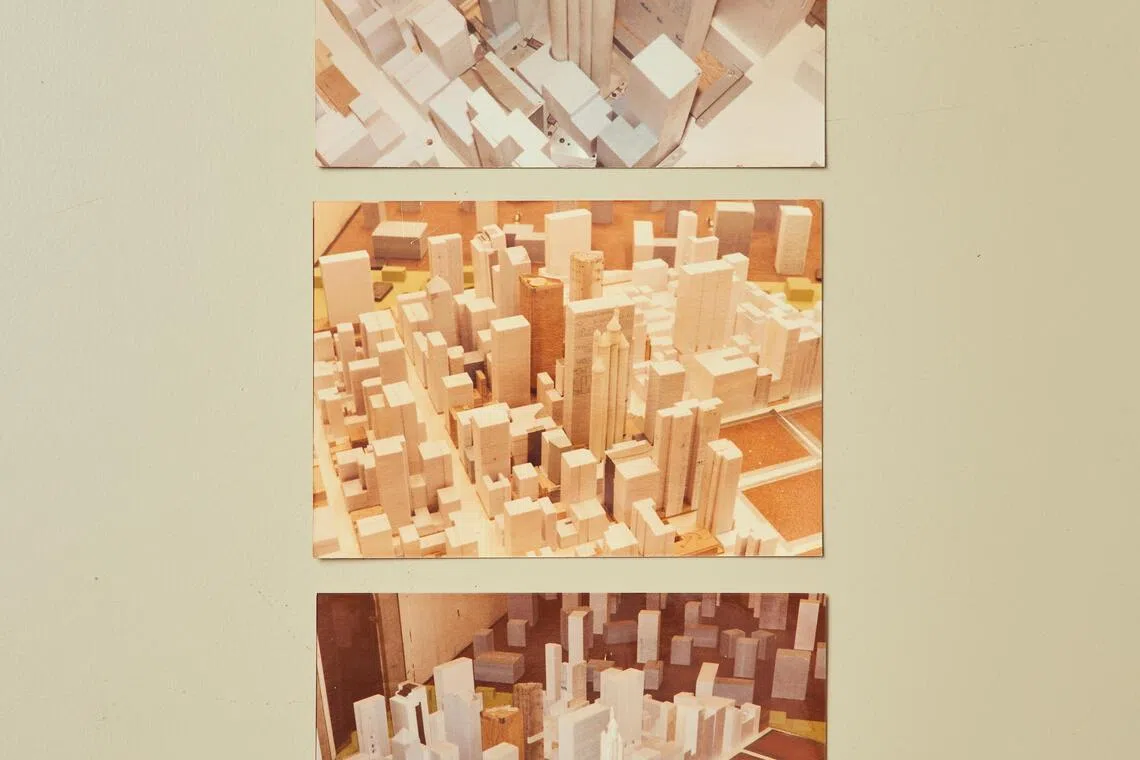
Now Zaknic thinks his effort to retain the 64 drawings and a model of the project was prescient. “I see connections everywhere to Trump’s current self-aggrandising projects,” he said.
The Madison Avenue castle that never came to be was designed to include drawbridges and a moat. Johnson, who died in 2005, said in a 1984 interview that these touches were his but he thought they aligned well with Trump’s tastes.
“Trump is mad and wonderful,” Johnson told The New York Times then, proclaiming that the castle was his “most exciting project” ever and commending Trump’s gut instinct. “Other developers come in with sober faces,” he added, “carrying their market-research studies on what the public will like.”
The project was abruptly shelved that year, though, when the developers decided not to proceed, citing the costs and other issues. The property was instead sold.
“He called and said, ‘Well, I’ve sold the property, and I’ve gotten rid of it, so the project’s over, forget it,’” Burgee, 92, recalled in a telephone interview, referring to Trump, “‘and I’m not paying the bill.’”
White House officials declined to address a question about the bill or the proposed building. But they released a statement reiterating Trump’s intentions with the construction of the White House ballroom and other changes.
“These long-needed upgrades will benefit generations of future presidents and American visitors to the People’s House,” said the statement from Davis Ingle, a White House spokesperson.
The architecture firm finally did get a check, but only for a portion of the fee, Burgee said, adding, “I was a little cantankerous about it.”
The name Trump Castle was ultimately used for a hotel and casino in Atlantic City, New Jersey, that Trump purchased from Hilton Hotels in 1985. It was renamed Trump Marina in 1991 and was bought in 2011 by Landry’s, a hospitality company, which rechristened it the Golden Nugget.
When Zaknic encountered the castle project drawings, he was working for Johnson and Burgee as an academic archivist to prepare a monograph for the office, “Philip Johnson/John Burgee Architecture 1979-1985,” published by Rizzoli in 1985.
When Johnson and Burgee were moving into the so-called Lipstick Building they had designed on Third Avenue in midtown Manhattan, completed in 1986, Zaknic was put in charge of preserving the archives for the architects, who had been partners since 1967. They went their separate ways in 1991.
Johnson, who with Burgee had just designed the AT&T building elsewhere on Madison, got along well with Trump, Burgee said, despite what he described as Trump’s impatient way of doing business.
“Donald was a very personable guy,” the architect said. “He didn’t carry out long conversations. Meetings didn’t last very long.”
Burgee said that Trump Castle seemed to fit in the context of other ambitious Manhattan buildings, but he described Trump’s current Washington projects as “overgrown”.
“He was obviously into himself,” Burgee said of Trump, “but he didn’t have this grandiose plan like he now does.”
Trump supporters, including the panelists on the Commission of Fine Arts that he appointed, have backed the ballroom plan that will expand the White House’s capacity for events and an arch as part of an effort to summon more of the classical spirit envisioned by French architect Pierre Charles L’ Enfant in his master plan for Washington.
Trump has stood by his arch design. “The one that people know mostly is the Arc de Triomphe in Paris, France, and we’re going to top it by, I think, a lot,” the president said in December. “The only thing they have is history.” NY TIMES
This article originally appeared in The New York Times.