World
Nuclear Ploy & American Double Standards – Why Iran War Is Unjustified

The global outrage over Iran’s nuclear ambitions is not about peace, stability, or morality. It is about control.
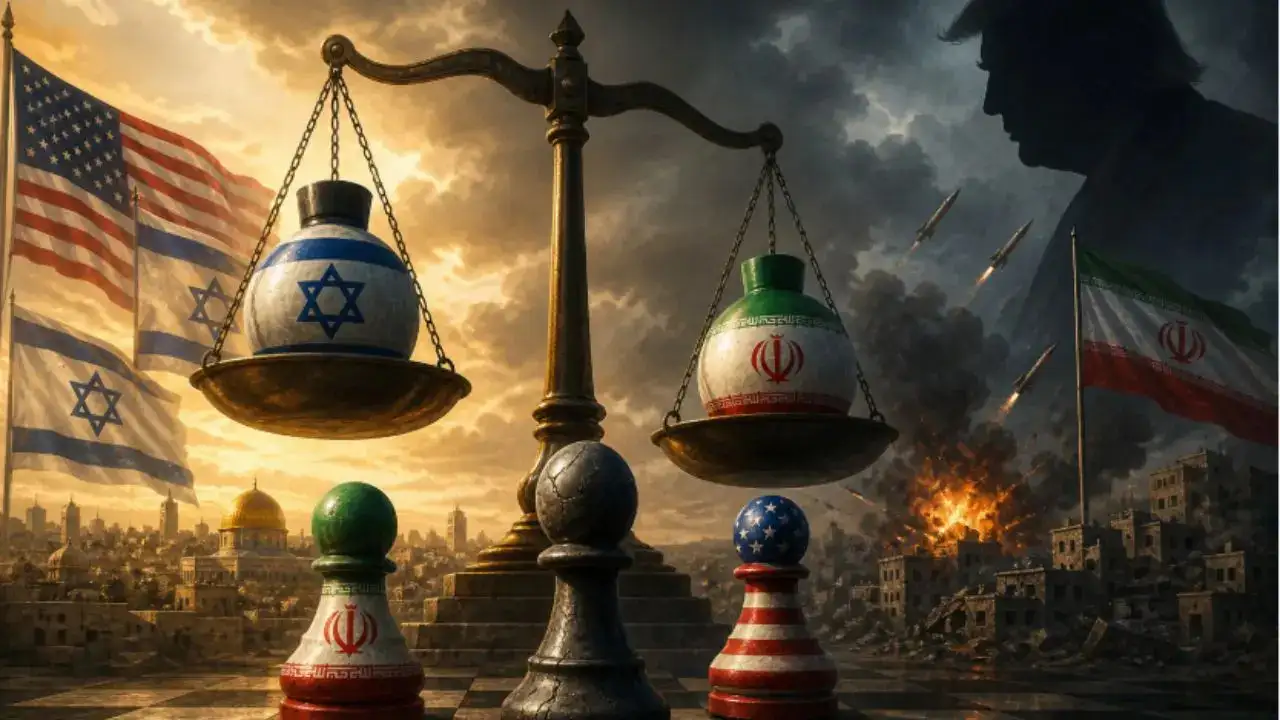
Because if this were truly about principles, the first country under scrutiny would be Israel – a state widely believed to possess nuclear weapons, yet one that refuses international inspections and faces no sanctions, no isolation and no threats of regime change. Instead, it enjoys unconditional political and military backing from the United States, to the extent that it has used the cover of the current West Asian-Iran conflict to invade Southern Lebanon and take over large swathes of its territory.
So let’s be honest: this is not a rules-based order. It is a brute power-based order.
And Iran is being told to obey rules that others openly ignore.
The deeper hypocrisy becomes clearer when one looks at history—not rhetoric, but documented fact.
In 1953, the United States and Britain jointly orchestrated the overthrow of Iran’s democratically elected Prime Minister, Mohammad Mossadegh. His “crime”? Attempting to nationalize Iran’s own oil resources, which were largely controlled by a British company. The operation—known as Operation Ajax —was not speculation; it is now openly acknowledged, including by the US’ CIA itself.
Mossadegh’s government had moved to take control of Iran’s oil wealth from foreign hands. In response, Britain imposed economic pressure and, together with the USA, engineered a covert operation involving propaganda, paid unrest, and political manipulation to remove him.
The result? A democratically chosen leader was removed, and the rule of a pro-Western monarch—the Shah Mohammad Reza Pahlavi—was cemented and supported for decades.
Clearly, this was not about defending democracy. It was about overturning it.
If one wants to understand why Iran distrusts the West today, the answer begins here: democracy was acceptable only until it interfered with oil.
This pattern did not end in 1953—it evolved.
Half a century later, the United States led the Iraq War under the claim that Iraq possessed weapons of mass destruction. Those weapons were never found. A country was invaded, destabilised, and shattered on a premise that collapsed.
Or, more recently, take the case of Venezuela. In January of this year, Trump undertook a regime change operation in Venezuela. Except it was not a regime change. It was just replacing the President with the Vice President. The regime remain in tact. It was clear to any neutral observer that Operation Absolute Resolve which was launched to dislodge long-time Venezuelan ruler Nicolas Maduro was just an excuse for Trump to contro;l Venezuela’s vast oil resources. Venezuela is the world’s fifth largest producer of oil and gas.
The message to the world was unmistakable: accusations about weapons can become pretexts for war.
Now, the same language is being deployed against Iran , with US President Donald Trump and his colleagues initially claiming that Iran has nuclear weapons and later altered that statement claiming that Iran needed only “two weeks to four weeks”to make a nuclear weapon.
At the same time, Iran has faced relentless economic pressure—sanctions that first started in November 1979 that have frozen assets, restricted trade, and strained its economy. These measures are often described as “non-military,” but their real-world impact on ordinary citizens is profound. They function as economic warfare designed to force submission without formal invasion.
And yet, the expectation remains that Iran should simply trust the very powers that have historically undermined its sovereignty. That expectation borders on absurdity.
Modern geopolitics reinforces the lesson. When Ukraine gave up its nuclear weapons in 1994 under the Budapest Memorandum, it received security assurances against threats or use of force regarding its territorial integrity. Decades later, it was invaded by Russia. Whatever the complexities of that conflict, one conclusion has spread globally: security guarantees without hard power may not hold and countries without nuclear deterrence are more vulnerable.
Also, India was penalised for a number of years after the 1998 Pokhran nuclear tests. In May 1998, the government led by PM Atal Bihari Vajpayee conducted a series of nuclear tests at Pokhran Test Range under Operation Shakti. These tests, which were five in total over two days, formally declared India as a nuclear weapons state, ending decades of strategic ambiguity that dated back to the 1974 “Smiling Buddha” test under then PM Indira Gandhi. As punishment, America, under President Bill Clinton imposed economic and technological sanctions under the Glenn Amendment which included suspension of military and dual-use technology transfers and restrictions on loans from international financial institutions. Eventually, India overcame these troubles.
For Iran, the implication is simple—deterrence matters.
Critics argue that allowing Iran to acquire nuclear weapons would destabilise the region. But that argument ignores a crucial reality: the region is already destabilised, in part due to decades of interventions, wars, and covert operations by external powers.
So the real question is not whether nuclear weapons are dangerous—they are. The real question is: who gets to have them, and who decides?
Here is what is crucial: who is America to decide who can have nuclear weapons in the first place? America’s track record shows that it is the country which has attacked several others under the false narrative of possession of nuclear weapons, simply using it as an excuse to take control of their oil. Having mere possession or the capability of making nuclear weapons in a few weeks or months is also no excuse to dismantle the sovereignty of another state.
If the United States maintains one of the world’s largest nuclear arsenals, if Israel can remain outside global oversight, and if military intervention continues to be used as a policy tool, then the moral argument against Iran collapses under the weight of its own contradictions.
You cannot preach restraint while practicing dominance.
You cannot demand compliance while violating the same principles.
And you cannot expect a nation with a long history of foreign interference—economic, political, and military—to leave itself permanently vulnerable.
Here’s where the double standards on nculear weapons comes to the fore. Israel started its nuclear program back in the late 1950s, driven by security concerns after the creation of the state in 1948 and repeated wars with Arab neighbors. With crucial assistance from France, Israel built the Dimona nuclear facility in the Negev desert. By the late 1960s, Israel is widely believed to have developed its first nuclear weapons capability, though it has never officially confirmed this.Israel follows a doctrine called “nuclear opacity”—neither confirming nor denying possession of nuclear weapons. Israel is not a signatory to the Nuclear Non-Proliferation Treaty. Israel has not declared its nuclear arsenal publicly, but most independent analysts suggest it has anywhere upto 200 nuclear warheads.
Iran’s alleged pursuit of nuclear capability is not happening in a vacuum. It is the direct consequence of a world order shaped by selective rules, historical intervention, and strategic coercion.
Until that changes, no amount of pressure or condemnation will alter the underlying logic.
Because in a world defined by power, nations do not rely on promises.
They rely on deterrence.
Here, let us go back to Iraq– the example closest at hand, and also closest to Iran.
Let ’s stop pretending that the Iraq War was about democracy, freedom, or global security.
It wasn’t. It was about power—and power over resources.
The war was sold to the world on the false claim that Iraq possessed weapons of mass destruction. That claim collapsed. No such weapons were found. Yet by the time the truth emerged, a country had already been invaded.
So the question is whether it was a mistake or a deliberate strategy and false narrative spread by America , the answer lies in The question : what came after?
Because what followed, tells the real story.
Iraq, before 2003, had one of the most tightly controlled national oil sectors in the world. Its resources were state-owned, its policies domestically determined. After the invasion, that system was fundamentally reshaped. Under the authority of Paul Bremer (appointed in May 2003) and the Coalition Provisional Authority, Iraq’s economic framework was rewritten—under occupation. Laws were introduced to open the country’s economy to foreign investment. Oil fields, while still technically state-owned, were opened to long-term contracts with global corporations. Companies like ExxonMobil, BP, and Shell entered the picture, securing roles in developing and operating Iraq’s most valuable resources.
Now let’s be precise: the oil was not loaded onto ships and taken away as spoils of war. But control is not just about ownership. Control is about who decides, who benefits, and who holds leverage.
And those decisions were shaped at a time when Iraq was not fully sovereign—but occupied.
At the same time, Iraq’s oil revenues were funneled through mechanisms like the Development Fund for Iraq, operating under heavy international—and effectively American—influence. Its financial system became deeply tied to global structures where the United States holds enormous sway.
So when people say “America stole Iraq’s oil,” they are not describing a literal act of theft. They are describing something more subtle—and in many ways more powerful: The use of military force to restructure a nation’s economy in a way that aligns with external interests.
And that raises a far more uncomfortable question: If a country is invaded on false premises, its system dismantled, and its most valuable sector opened up under foreign-designed rules—what do you call that? Because it may not fit the narrow legal definition of theft.
But it certainly does not look like justice.
This is why so much of the world remains skeptical when the United States speaks about rules, order, and sovereignty.
And that is the core issue.
Because the record shows that when its strategic interests are at stake, those principles become flexible, amorphous, and totally self serving.
Not just Iraq, not just oil –but the precedent it sets.
Because if power allows one nation to reshape another’s economy after war and draw on its resources for its own interests— then the debate is no longer about law.
It is about dominance and control.
So that takes us to the conclusion: Dominance and a separate set of rules for the US and Israel strips away the rights of countries like Iran, including the right to arm themselves.
The global nuclear order is not governed by morality or law—it is governed by power. And nowhere is that hypocrisy more visible than in the way the world treats Iran versus allies of the USA… like Israel.
Let us strip away the diplomatic language. Israel is widely understood to possess nuclear weapons, yet it has refused to sign the Nuclear Non-Proliferation Treaty and does not allow international inspections of its arsenal. There are no crippling sanctions by America or the world on Israel . No global outrage. No threats of military strikes on Israel for not allowing inspections or potentially possessing nuclear weapons .
Iran, on the other hand, has faced economic strangulation since 1979 and repeated wars, including the ongiong conflict since February 28, 2026 –despite being a signatory to the NPT and subject to inspections for years.
If this is a rules-based order, it is one where the rules apply only to the weak.
The argument that Iran must never acquire nuclear weapons collapses under even minimal scrutiny when viewed through history.
Iraq is not an isolated case. From the Vietnam War to interventions in Afghanistan, Libya, and beyond, the United States has repeatedly projected military force across the globe. Brown University’s Costs of War project estimates that post-9/11, wars alone have resulted in hundreds of thousands of direct civilian deaths and millions displaced, long term health consequences and significant environmental damage. Critics argue that, over decades, U.S.-led or U.S.-backed conflicts have contributed to millions of deaths worldwide.
Against this backdrop, the idea that Washington has the moral authority to decide which countries can defend themselves rings absolutely hollow.
Moreover, in a world where nuclear weapons act as deterrence, the lessons for all to see are very clear. And Iran sees them clearest of all.
If countries like the United States and Israel insist on maintaining overwhelming military and nuclear superiority – while using sanctions, covert actions, and force against adversaries—they should not be surprised when those adversaries seek the ultimate deterrent.
In that context, the unstated and unproven allegation of Iran’s pursuit of nuclear weapons is not irrational. Infact some experts think it is necessary in the current world order as a detterence. It is the predictable outcome of a world order that demands restraint from some while excusing excess from others.
And until that imbalance is addressed, no amount of pressure, sanctions, or rhetoric will make that logic disappear.