World
NATO summit, Trump’s support for F-35s sale, boost Turkey’s standing, as slumping Israel sees clout erode

As US President Donald Trump visits Ankara for the annual NATO summit, Israel is doing what it can to convince the White House not to provide Turkey with advanced military hardware that would drastically improve its air force.
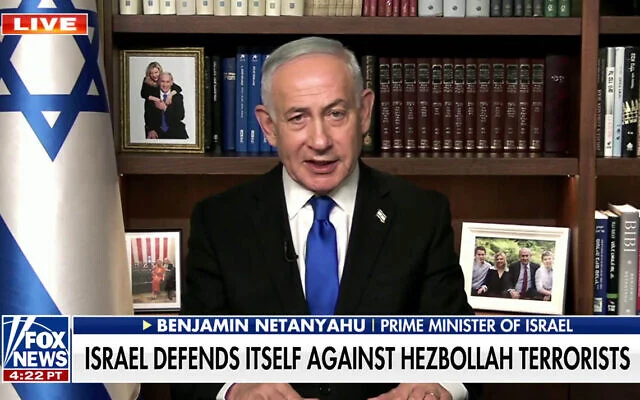
During a Friday phone call, Prime Minister Benjamin Netanyahu reportedly urged Trump not to sell Turkey fighter jet engines or allow Ankara back into the F-35 program.
In a Monday interview with Fox News, Netanyahu called Turkey “a regime infected by the Muslim Brotherhood, an extreme movement that hates America and chants ‘Death to America.’”
“I don’t think they should be given F-35s or engines for their fighter jets,” he declared.
Foreign Minister Gideon Sa’ar has also joined the rhetorical campaign, accusing his Turkish counterpart of incitement to genocide after he called Israel a “burden that humanity can no longer bear” and said it was a “problem” for the world.
Israeli leaders’ statements aren’t a backhanded attempt to undermine another regional power. Turkish President Recep Tayyip Erdogan has indeed positioned himself as a leading critic of Israel, and his government openly backs and hosts Hamas.
Yet despite Erdogan’s dismantling of Turkish democracy, extreme anti-Israel rhetoric, and support for a terrorist group, Jerusalem is unlikely to succeed in driving a wedge between Washington and Ankara. Hosting world leaders for the North Atlantic Treaty Organization confab, Turkey is consolidating its position in the region and beyond, while Israel is trending in the opposite direction.
“It’s symbolic, but it also says something about the status of Turkey,” said Nimrod Goren, president of Mitvim – The Israeli Institute for Regional Foreign Policies.
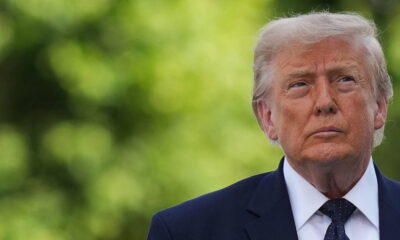
And, indeed, at a joint press appearance with Erdogan in Ankara on Tuesday, Trump said “we would consider” selling F-35s to Turkey, and noted “we have a better relationship with Turkey, and Turkey has been in many ways much more loyal, than other countries.”
Turkish recovery
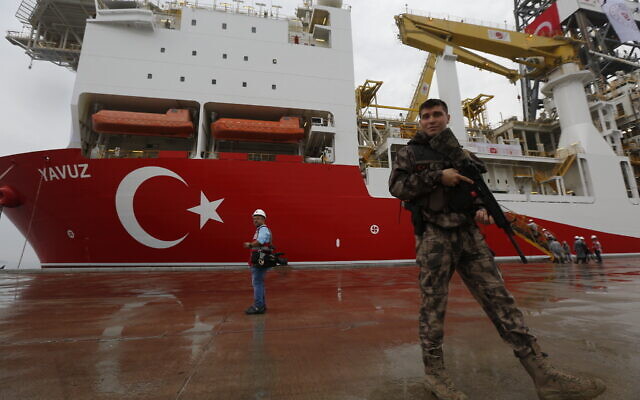
For much of the decade after the Arab Spring protests erupted in 2011, Turkey pursued an aggressive policy in the eastern Mediterranean that antagonized regional powers and pushed its rivals to ally with one another.
Erdogan backed the Muslim Brotherhood in Egypt after the group was ousted from power in Cairo in 2013. The rivalry between the two Sunni Muslim powers metastasized into other areas and split the Middle East, with Turkey and Qatar leading a pro-Islamist faction, and Egypt siding with Saudi Arabia and the UAE in a pro-Western camp.
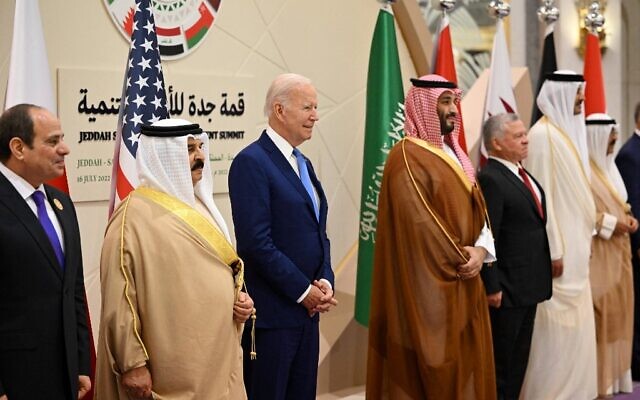
In the Mediterranean, Egypt aligned itself with Greece and Cyprus, which accuse Turkey of illegally drilling for natural gas in their exclusive economic zones. Together with Israel, the countries formed the EastMed Gas Forum, headquartered in Cairo, and conducted joint military exercises.
Ankara also faced worsening ties with Europe. Erdogan, who has stoked Islamist sentiment, infuriated French and EU officials by stating that President Emmanuel Macron needed “mental treatment” for condemning the beheading of a teacher who had displayed a picture of the Prophet Muhammad.
Refugees were also an ongoing sticking point, with Erdogan threatening to let migrants fleeing from Africa and the Mideast across its border into Greece if the EU did not keep its end of a 2016 refugee deal. EU leaders have also criticized Turkey for human rights abuses.
Erdogan’s pugnacious posture led him nowhere. Isolated from Europe and many Arab states, facing an unfriendly Joe Biden White House, its economy buffeted by the COVID-19 pandemic, Turkey finally changed course.
A Turkish delegation visited Egypt in 2021 to discuss normalization, and Erdogan and Egypt’s Abdel-Fattah el-Sissi conducted reciprocal presidential visits in 2024.
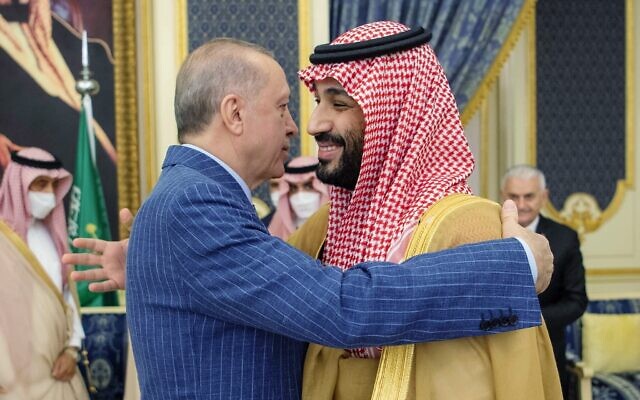
Erdogan also patched up ties with Saudi Arabia’s Crown Prince Mohammed bin Salman, whom he had accused of killing dissident journalist Jamal Khashoggi. The two leaders met in February to discuss defense ties.
“We are seeing Turkey succeed in rising from the canvas and rehabilitating its status in the region,” said Goren.
Hostility with Israel, trust from Trump
Turkey’s ties with Israel followed a similar pattern.
In 2018, Turkey recalled its ambassador and asked Israel’s envoy to leave in the wake of violent protests on the Israel-Gaza border, in which dozens of Palestinians were killed. Turkish and Israeli leaders criticized each other bitterly, with Erdogan calling Israel a “child-murderer” country and Netanyahu accusing Erdogan of killing Kurdish civilians.
A rapprochement process began in 2020, with an El Al plane landing in Turkey for the first time in a decade. Both sides returned their ambassadors in 2022, and — with the Naftali Bennett-Yair Lapid government in power — senior Israeli officials met with Erdogan.
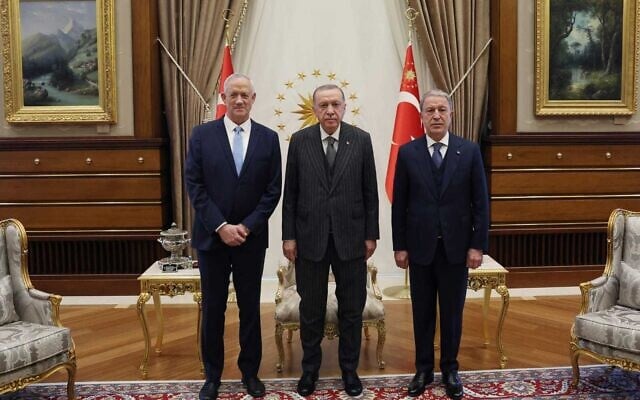
But relations collapsed once again in the wake of Hamas’s invasion of Israel on October 7, 2023, as Erdogan praised the terror group and accused Israel of committing genocide. Turkey suspended its trade with Israel, closed its airspace to Israeli planes and issued arrest warrants for 37 Israeli officials, including Netanyahu.
Turkey’s open hostility toward Israel has grown sharper as it has returned to the center of regional alliances and decision-making, emboldening Erdogan.
As he did in his first term, Trump sees Erdogan as a reliable partner in a turbulent Middle East.
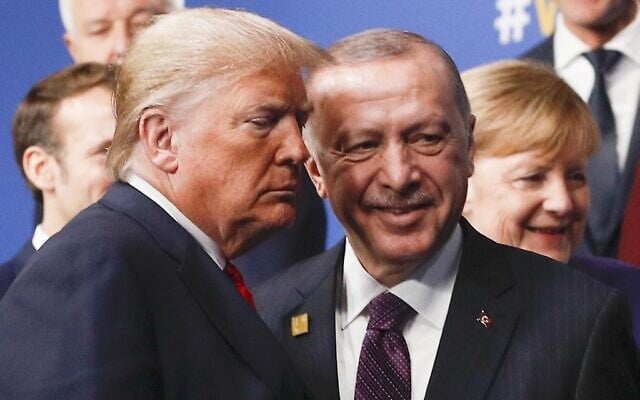
In April 2025, with Netanyahu sitting next to him in the Oval Office, Trump described Erdogan as “very smart” and congratulated him for “taking over Syria.”
“Any problem that you have with Turkey, I think we can solve, as long as you are reasonable, you have to be reasonable,” he hectored Netanyahu.
Less than two weeks earlier, Erdogan had called for Allah to “destroy Zionist Israel.”
There is an emphasis on Erdogan as a leader who can brings the goods.
Nonetheless, Turkey managed to position itself as a key mediator between Israel and Hamas, especially in talks on the Trump-backed deal that saw the final Israeli hostages freed.
“There is an emphasis on Erdogan as a leader who can bring the goods,” said Gallia Lindenstrauss, a senior research fellow at the Institute for National Security Studies in Tel Aviv.
According to Tom Barrack, who serves as both US special envoy on Syria and as US ambassador to Turkey, Trump called Erdogan hours before the Gaza ceasefire was reached in October, requesting his assistance in bringing two Hamas leaders on board.

“President Erdogan, [Foreign Minister] Hakan Fidan, [Intelligence chief] Ibrahim Kalin all spent that afternoon and brought those two Hamas leaders over,” Barrack recalled.
Turkey managed to use the 2026 Iran war to further cement its position in the region.
The US-Israeli campaign sparked fears of worst-case scenarios for Turkey, including a massive refugee wave, an armed Kurdish uprising, or attacks on its own territory.
“Turkish officials repeatedly say that they don’t want a war at their doorstep, as the consequences of such turmoil had side effects on Turkey,” a former Turkish diplomat told The Times of Israel, pointing to the 1991 and 2003 Iraq wars and the Syrian civil war.
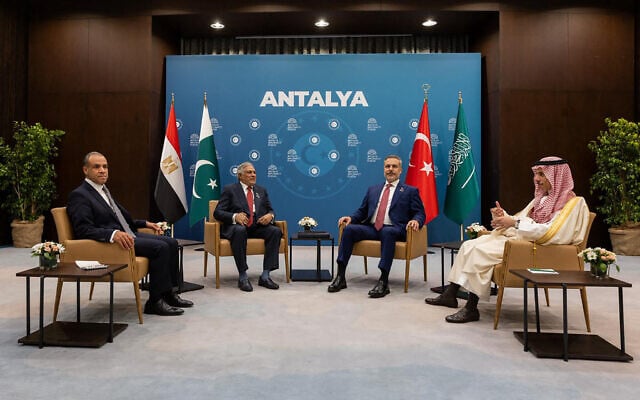
Despite those concerns about the Iran conflict — only the latter of which came to pass — Turkey succeeded in proving itself again a reliable channel for Trump as it passed messages between Iran and the US.
When Trump sought an exit from the war, Turkey was there, along with Pakistan and former rivals Saudi Arabia and Egypt, to help mediate ceasefire talks that led to the end of fighting.
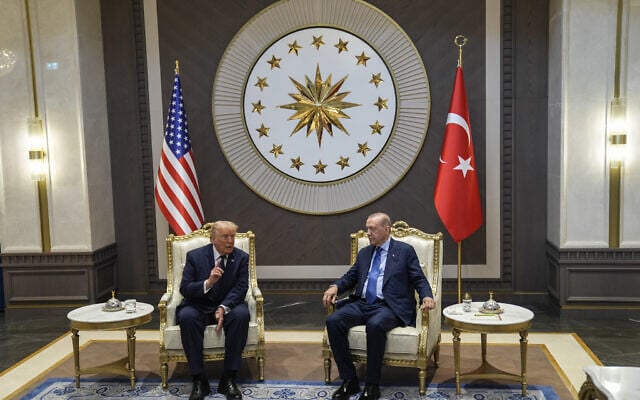
At Erdogan’s side in Ankara on Tuesday, Trump praised Turkey for not “getting into the fight” — on the side of Iran, in the war — given Turkey’s acrimonious “relationship with Israel.”
Europe needs Turkey, too
The NATO summit is the latest evidence of how far Turkey has come in restoring its relationships.
“For NATO, there are two hot bubbles on the agenda,” said the former Turkish diplomat, “war in Ukraine and tension between US-Israel and Iran. Turkey is between these two bubbles.”
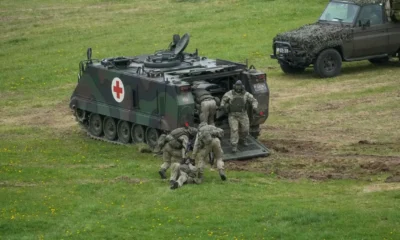
The war in Ukraine made Turkey indispensable for Europe as well. It needs Turkey’s army — the second-largest in NATO after the US — to provide a credible deterrent to Russia. Moreover, as European countries rush to arm themselves, Turkey’s arms industry is a crucial source of weapons.
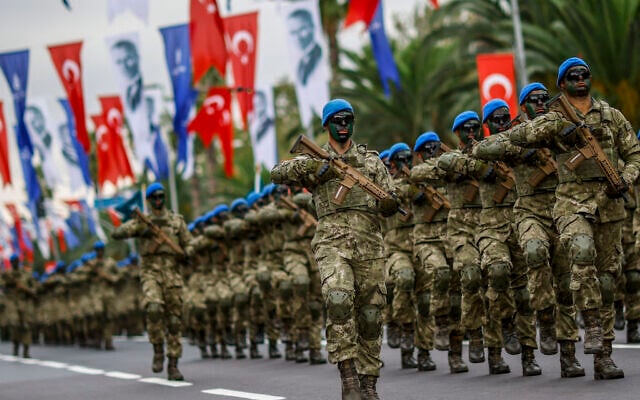
Trump’s shaky commitment to the transatlantic alliance only underscores to European countries how much they need Turkish military hardware.
The US president himself indicated that he would have stayed away from the NATO summit if it were not hosted by Erdogan. “I would not have gone for most people…” said Trump. “I’m going out of respect to President Erdogan.”
A chance for improved ties
While Turkey enjoys a string of diplomatic successes, Israel is in a slump.
Jerusalem’s regional partners are cooperating with its rivals on diplomatic initiatives that go against Israel’s wishes. The end of the Iran war, and the subsequent memorandum of understanding, were negotiated without Israel in the room.
Relations with neighbors Egypt and Jordan remain strained, and there is little prospect of more Arab states normalizing ties with Israel in the foreseeable future.
That being said, Israel has managed to make Turkey pay a price for its hostile stance. Turkish representatives were not allowed to participate in the Civil-Military Coordination Center overseeing the Gaza ceasefire or to send troops to join the international peacekeeping force that it meant to enter the Strip at some point.
Israel’s advancing peace talks with Lebanon have also managed to freeze Turkey out of a process it likely has significant interest in guiding.
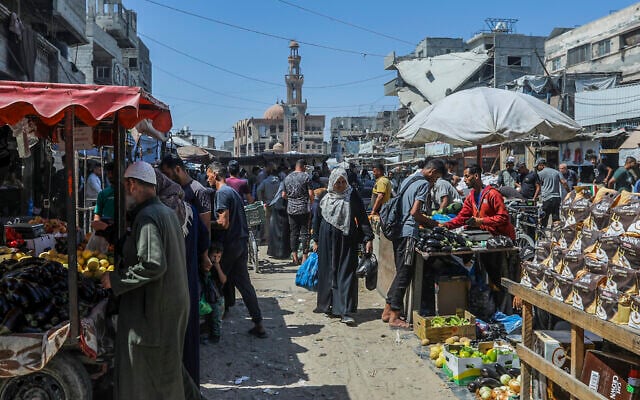
Ankara and Jerusalem still maintain ties, even if incredibly strained, and there are indications that there could be something of a thaw between them.
Intelligence coordination continues, and the coordination mechanism in place to avoid escalation in Syria appears to be working well.
Decades of deep business ties mean that many channels between the countries remain open, even if well below the radar.
Barrack has also said he is working to improve Turkey-Israel ties.
In the meantime, the current trends look to continue — Turkey will be at the center of regional processes, while Israel will struggle to make itself heard.
That looks to bear fruit soon for Turkey, with Trump publicly throwing his support behind the sale of the F-35s, even as legal and congressional hurdles have yet to be fully resolved.
“Trump and the Trump administration currently see Turkey as a stabilizing factor,” said Lindenstrauss, “whereas Israel is seen as a destabilizing factor.”