Trends
#NairaLife: She Quit Her Toxic Bank Job With No Plan. Now She Earns 50% More

Every week, ThePress seeks to understand how people move the Naira in and out of their lives. Some stories will be struggle-ish, others will be bougie. All the time, it’ll be revealing.
Hisa lets you buy and sell Nigerian and US stocks straight from your phone, all in one app. And with Hisa’s zero-commission campaign, new users who sign up before the end of 2026 can trade in both markets without paying trading commissions during the promotion. Ready to own a piece of the companies you know?
Download Hisa, create an account and start investing. Terms apply.
I grew up in what I would call a very comfortable family. I had everything I wanted and needed, so I never really understood how money worked. All I knew was that if I wanted something, it was available, and if it wasn’t, all I needed to do was ask, and it would be provided.
I didn’t handle money as a child. I wasn’t one of those kids who would do petty things and get rewarded with cash. My parents provided everything. It wasn’t until I lost my dad and the dynamics shifted that I understood the value of money.
It’s okay. He passed when I was 12, around the time I was in JSS 2 or 3.
We had a lot of domestic staff; people who handled the driving, the logistics, and household needs. I was pretty much a nepo baby.
My dad was very wealthy. He ran chains of businesses in Kaduna, from hotels and guesthouses to other side ventures. My mum was a housewife. All she had to do was look pretty and take care of the family.
When my dad died, I didn’t immediately clock that I would never see him again. I didn’t even cry because I didn’t know what I was supposed to feel. That’s to show just how much of a bubble I was in. I didn’t understand that my living conditions might change. I thought everything would still be alright and we wouldn’t lack anything. It wasn’t until a few months, and then years, down the line that I realised there was a huge void.
The first time it hit me badly was during my JSS 3 graduation. I didn’t attend because my mum couldn’t foot the bills for the party. That morning, right after our family devotion, she called me aside and said, “After your exams, that will be it. No graduation, no preparation, nothing, because I need to channel the money elsewhere for your siblings.”
I can never forget that morning. Prior to that, I had already been making plans with my classmates about the outfit and hair I’d wear to the junior prom. Having my hopes dashed like that felt terrible. It was the first major sign that things had changed.
Definitely. There were a couple of times when my school fees were delayed, and I had to pass up certain luxuries because we didn’t have them anymore. For instance, we had about three or four cars, and after my dad passed, my mum had to sell every single one of them. We moved from changing cars to shuffling between public transport.
My mum took over managing one of my dad’s businesses, but the hospitality industry in the North was changing, becoming even more conservative, and the boom it had experienced while I was in primary school had died down.
I tried getting receptionist and nanny jobs right after secondary school to make money, but my mum never endorsed it. She didn’t want my siblings and me to have the mindset that, because our dad was gone, we had to forget school and start working to make money.
Because I didn’t get admission immediately, I stayed at home for two years writing JAMB and attending lessons, then completed a brief pre-degree programme in 2015 before enrolling in a state university in 2016 to study microbiology. It wasn’t until I got into uni that I started doing things for money.
Not to toot my own horn, but I am quite smart, and people around me knew I was very book-focused. I started attending night classes from my very first year. So whenever people needed someone to cover attendance, do assignments, or write exams for them, they knew to reach out to me.
If I didn’t want to take the risk of actually writing an exam paper for someone, I’d go into the hall with them and let them copy from my sheet.
Exams were usually between ₦10k and ₦15k per course. Sometimes, if I met big girls who had money, I could charge ₦20k or ₦25k, and they’d pay. Assignments were much cheaper, around ₦3k to ₦5k. Other times, on really hungry days, I’d do an assignment and tell the person, “You know what, just give me food.”
In a good month, especially in my third and final years when I met a lot of unserious students with carryovers, I was making an average of ₦30k to ₦40k writing exams.
My pocket money was like ₦3k to ₦5k per month, and sometimes it didn’t even come. As the first daughter, my mum expected me to understand her financial situation and make sacrifices. It could be something like, “Oh. I can’t afford to send you money because of your younger siblings.” And I couldn’t question it. I just had to accept and manage somehow.
I knew that getting caught impersonating during exams meant automatic rustication, or paying serious bribes to junior lecturers, so there was always tension. But I felt like I was helping my mother help me. I used the money to take care of myself and buy clothes.
By my final year, I was even making enough to outsource chores like laundry and fetching water. I didn’t save anything from those hustles, though. I didn’t feel a need to keep money somewhere. I’ve always felt money is meant to be spent.
I did that throughout my time in uni, until I graduated in 2019.
We surveyed 5,000 workers across Nigeria’s formal and informal sectors to examine what Nigerians earn, where the money goes, and whether hard work actually translates to financial security. This is what we found. Download the ThePress State of Income Report.
I went back to Kaduna, and then COVID hit in 2020. I ended up spending the whole of 2020 and 2021 at home because I didn’t have the money to return to school for clearance. I needed about ₦250k – ₦300k because clearance at my school was incredibly slow and often took months. That money was to cover transportation, rent for an apartment (I’d left mine after graduation), and pay any outstanding school bills.
I didn’t have that much, and my mum didn’t have it either. Those two years at home were some of the most frustrating years of my life. Classmates whose exams I literally wrote were posting pictures from NYSC camp, while I was stuck at home.
My mum didn’t let me take menial jobs, so I spent my time doing house chores, taking care of my siblings, and reading novels and poetry. I subscribed to foreign magazines and tried submitting articles and poems to get paid, though none of those panned out.
Finally, in November 2021, my mum raised the money, and I returned to school and finished my clearance in six months.
See, I know people who spent years trying to get cleared and were stuck in the system due to one issue or another.
Fast forward to November 2022, I finally got called up for NYSC. I served in the East and worked as an administrative assistant in an elite secondary school.
NYSC paid ₦33k/month, and the school paid me ₦30k. It was later increased to ₦40k right before I finished my service in October 2023. The school also provided accommodation, so I didn’t pay rent.
Not exactly. Working in that school stressed me out. With rich kids, you’re constantly walking on eggshells because if you speak to a child a certain way, they report you, and the school deducts a fee from your small salary.
After NYSC, I returned to Kaduna in January 2024 and started applying for jobs online. Most roles were in Lagos, and I didn’t have anyone to stay with there. Luckily, in March/April, a close family friend of my mum connected me to someone at a commercial bank. After a few interviews, I was invited to banking school in Abuja in May 2024.
Banking school lasted two months, and during that time, they paid me about ₦60k/month. In July 2024, I was assigned to a branch as a Relationship Manager. My starting pay was ₦350k, plus a housing allowance, bringing my net pay to around ₦380k.
Banking school lasted two months, and during that time, they paid me about ₦60k/month. In July 2024, I was assigned to a branch as a Relationship Manager. My starting pay was ₦350k, plus a housing allowance, bringing my net pay to around ₦380k.
At first, I was so excited. ₦350k felt like a lot of money. In fact, the very first month I got paid, I exhausted the entire ₦350k in one week on hair, nails, clothes, bags, and sending money home. I even had to call my uncle to send me urgent ₦100k after I’d spent my entire salary.
The excitement didn’t last long, though. When the actual workload hit me, I realised ₦350k was trash. “Relationship Manager” was just a fancy title for marketer. Every morning, they would grill us about leads and deposits and talk to us anyhow. Every day, CRM this and that. I would wake up in the middle of the night crying and having panic attacks. Even when I got customers who brought in deposits, as soon as they took their money, I was back to square one. Management would always make us feel like we were doing nothing and were just coming to collect our salary for free.
One night, I stayed in the banking hall until almost midnight because my manager refused to let me finish a presentation the next morning. She wanted it sent that night. It was hell.
Still, I kept enduring. In July 2025, there was a salary review, and my pay grew to about ₦420k. But it didn’t do anything to relieve the stress and burnout I was feeling. I was literally dreading going to work every morning.
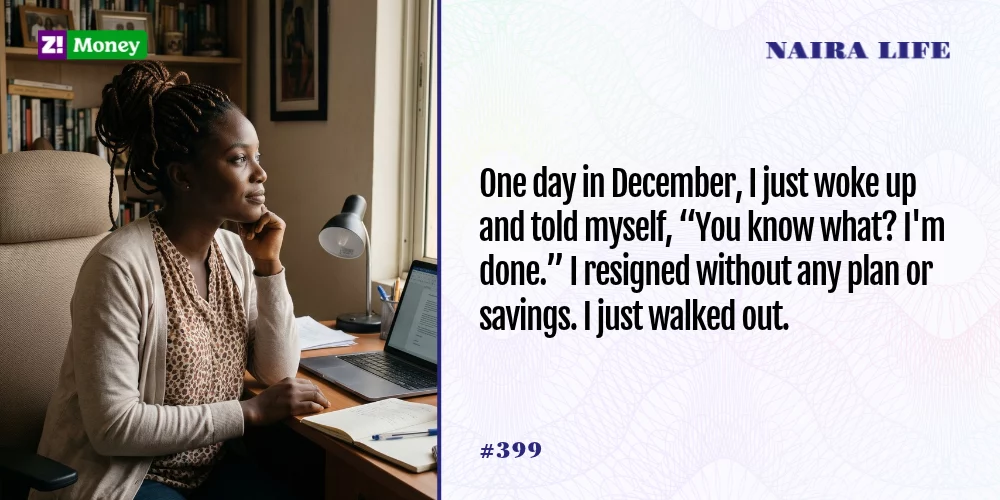
One day in December, I just woke up and told myself, “You know what? I’m done.” I resigned without any plan or savings. I just walked out.
I couldn’t do it anymore. Also, December marks the end of the financial year, and we were already hearing that targets for January 2026 would be tripled. I told myself I wasn’t entering a new year with that kind of pressure, so I just walked out.