World
Monuments without a country: Indonesia’s empty gesture to Palestine

Madrid played host this week to a strange piece of theater. Ministers gathered to talk about rebuilding Palestinian culture — its cinema, its archives, its museums — at a conference bearing the bloodless title “International Conference on the Reconstruction of Cultural Sector in Palestine.”
Indonesia’s culture minister, Fadli Zon, came home with pledges: a Palestinian museum wing at Taman Mini in Jakarta, a cultural center in Jerusalem, a slate of literary translations into Bahasa Indonesia. All very warm. All very photogenic.
And all, frankly, beside the point while the thing that actually matters goes conveniently unmentioned.
Culture is not a museum piece. It is not embroidery under glass, waiting patiently for a foreign minister to admire it on a conference sideline. It is what a people build while they are living.
Minister Zon says he wants Indonesians to know Palestine “not only through conflict, but through civilization, art, tradition.” That line should embarrass him. It treats the extermination of a people as an unfortunate distraction from the real cultural content — when the extermination is the story, and everything else being lovingly cataloged is what’s being erased alongside the bodies.
Look closely at what Jakarta actually offered. A wing in an amusement park, for “the Palestinian struggle” — struggle rendered as diorama, struggle you can walk past on the way to the food court.
Co-produced films. Translated poems. A memorandum of understanding, and now a memorandum to follow the memorandum.
None of it reopens a single university flattened in Gaza. None of it hands a filmmaker in Ramallah a permit to cross into his own capital. None of it feeds a single child.
This is not solidarity. It is a government finding the cheapest, safest, most exportable way to look like it cares while asking nothing of itself.
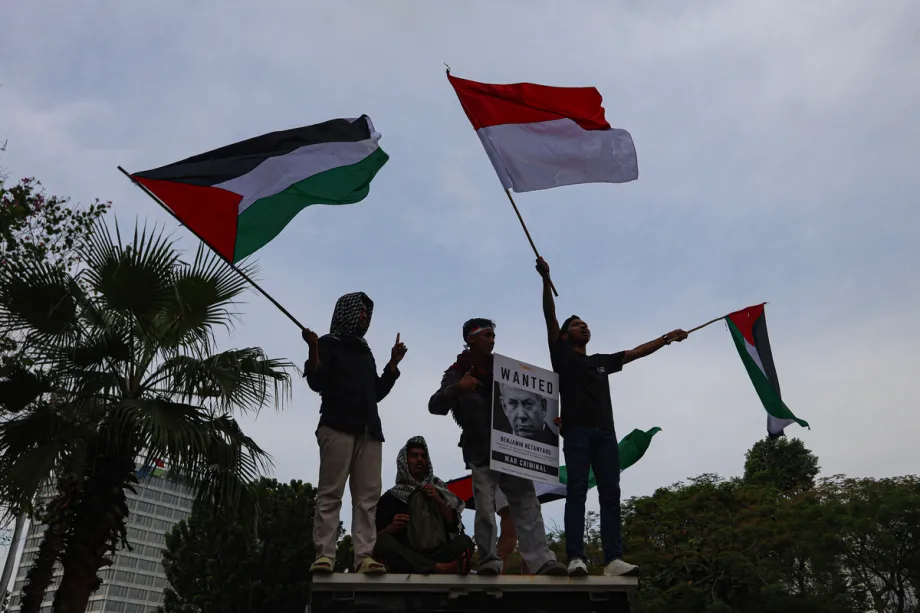
And Indonesia knows better. This is not a naive country stumbling into this issue for the first time. It has refused to open an embassy in Israel since independence. It votes for Palestinian statehood at the UN reflexively, ritually, as it has since Bandung in 1955.
Its diplomats can read the same reports everyone else can — the ones documenting mass starvation used as a weapon, hospitals reduced to rubble with patients still inside, entire extended families erased in single airstrikes, a death toll that keeps being revised upward because the counting itself keeps getting interrupted by more killing.
Knowing all of this and responding with a museum wing is not an oversight. It is a decision. It is choosing the version of solidarity that costs nothing — no sanctions, no severed trade ties, no real diplomatic confrontation, no risk to a single Indonesian export contract — over the version that might actually matter to someone standing in the rubble.
You cannot preserve a house’s furniture while letting the house itself be condemned, bulldozed, and built over by someone else’s settlers. Sooner or later someone has to ask what all that carefully archived furniture is even for, if there is no home left standing to put it in — if the people meant to inherit it are being killed faster than their poems can be translated.
If Indonesia’s decades of rhetoric mean anything at all, the honest conclusion is not a two-state compromise that has been dead in practice for years and exists mainly to give powerful bystanders an excuse to keep doing nothing while the map keeps shrinking.