Viral
Messi Becomes First Player To Score In Seven Consecutive World Cup Matches

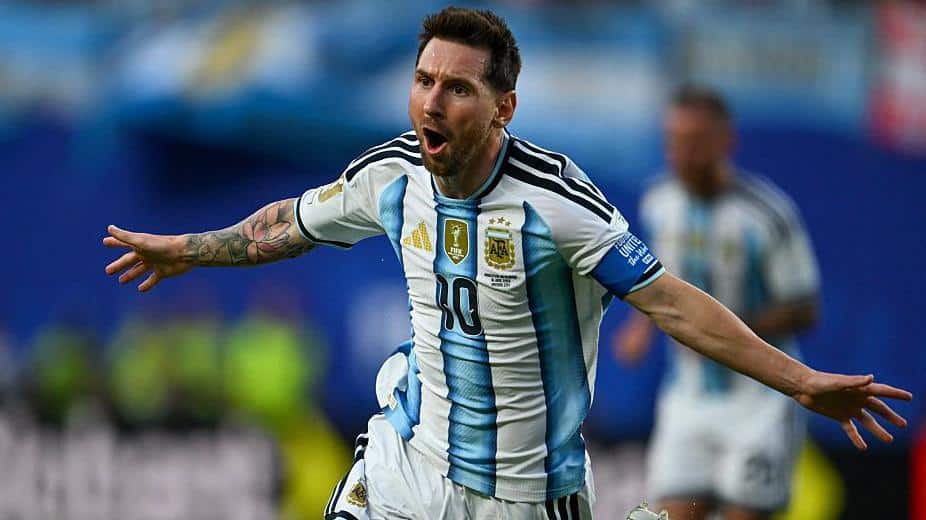
Argentine captain Lionel Messi etched his name deeper into football history on Saturday after becoming the first player ever to score in seven consecutive FIFA World Cup matches, breaking a long-standing record previously shared by Just Fontaine and Jairzinho.
The milestone came during Argentina’s 3-1 victory over Jordan in Dallas at the 2026 FIFA World Cup. Introduced as a second-half substitute, Messi put the result beyond doubt in the 80th minute with a brilliantly curled free-kick from approximately 25 metres, sending the ball past the goalkeeper and into the net.
The goal extended an extraordinary scoring streak that began during Argentina’s triumphant 2022 FIFA World Cup campaign in Qatar.
Messi first found the net in Argentina’s 2-1 Round of 16 victory over Australia before scoring again against the Netherlands in the quarter-finals and Croatia in the semi-finals. He then delivered a memorable performance in the final against France, scoring twice as Argentina lifted the World Cup trophy after a dramatic penalty shootout.
The 39-year-old has carried that remarkable form into the 2026 tournament. He opened his campaign with a hat-trick against Algeria before adding two more goals in Argentina’s second group-stage match against Austria. His strike against Jordan now makes it seven consecutive World Cup matches with at least one goal.
The latest effort also saw Messi extend his record as the highest World Cup goalscorer in Argentina’s history, taking his overall tally in the competition to 19 goals.
Before Messi’s achievement, the record for scoring in consecutive World Cup matches was jointly held by French legend Just Fontaine, who scored in six straight games during the 1958 tournament, and Brazilian great Jairzinho, who matched the feat at the 1970 FIFA World Cup.
Messi’s latest landmark further cements his legacy as one of the greatest players in football history, with the Argentine icon continuing to rewrite the record books even after leading his country to World Cup glory four years earlier.