World
Malaysian MPs seek clarity over Lynas-Pentagon rare earths deal

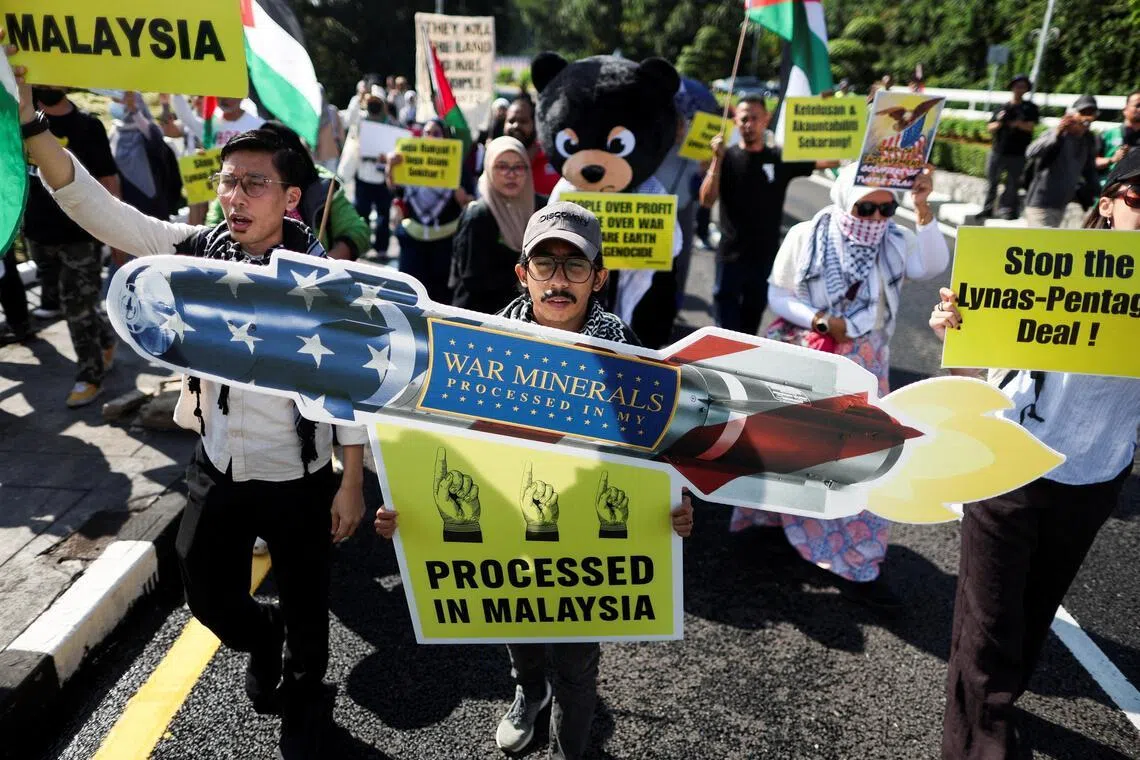
KUALA LUMPUR – Malaysian lawmakers have called on Putrajaya to declare its stance on concerns over the country’s rare earth operations being linked to the United States defence industry’s supply chain.
This came after Australian miner Lynas, which operates a rare earth processing plant in Pahang, signed a binding letter of intent with the Pentagon in March for a proposed four-year supply deal worth US$96 million (S$124 million).
Under the proposed agreement, the Pentagon will purchase light and heavy rare earth oxide products from Lynas to support US national security and supply-chain resilience. Such materials are essential for modern manufacturing and used in military systems.
The issue has thrust Malaysia into the geopolitical spotlight, with its lawmakers questioning whether rare earths processed in the country could become part of the US military supply chain, potentially complicating Putrajaya’s carefully balanced foreign policy and longstanding support for the Palestinian cause.
On July 17, a Malaysian parliamentary committee pressed the government to publicly clarify its position by the end of July.
The committee, which held a hearing on the matter on July 16, also recommended that Putrajaya develop a clearer foreign investment policy for strategic minerals to safeguard Malaysia’s interests, sovereignty and international reputation.
“The meeting was held to examine and assess the impact of the supply agreement, which is seen as potentially damaging Malaysia’s reputation as a staunch supporter of Palestine, founded on the principles of humanity and universal justice,” said the Select Committee on International Relations and International Trade.
Subang Member of Parliament Wong Chen, who chairs the select committee, declined to comment when contacted by The Straits Times. Lynas did not immediately respond to a call and e-mail seeking comment.
Besides lawmakers and Lynas interim chief executive Pol Le Roux, the committee heard from environmental and civil society groups including the Malaysian Consultative Council of Islamic Organisations, Sahabat Alam Malaysia and Greenpeace Malaysia. Representatives of the Malaysian chapter of the pro-Palestinian Boycott, Divestment and Sanctions (BDS) movement also attended.
Greenpeace Malaysia representative Adam Azlan said it is opposed to the Lynas-Pentagon deal as rare earths minerals processed in Malaysia should not contribute to any form of conflict, alleged atrocities as well as violations of international humanitarian and human rights law.
“We need Malaysia to ensure due diligence under international law and standards for companies operating within our jurisdiction – that they do not contribute to rights violations,” Adam told ST.
“We need the government to have stronger oversight, transparency and accountability in our supply chains. All this to safeguard Malaysia’s sovereignty.”
Washington has provided continuous military assistance and weapons shipments to Israel since the outbreak of the war with Hamas on Oct 7, 2023. The death toll in Gaza officially surpassed 70,000 in mid-2026, according to the Hamas-run health ministry, whose figures are widely cited by the United Nations but disputed by Israel.
Rare earths thrust Malaysia into geopolitical spotlight
The debate also underscores Malaysia’s growing strategic importance in the global race for rare earths. With an estimated 16.1 million tonnes of non-radioactive rare earth resources, the country is becoming an increasingly important player in competition between major powers for these critical minerals.
These minerals are used in technologies ranging from smartphones to radar systems and precision-guided weapons. Their specialised magnetic, optical and heat-resistant properties are also essential to advanced manufacturing, energy infrastructure and weapons systems.
The 100ha Lynas Advanced Materials Plant in Malaysia’s Gebeng industrial hub, near the coastal city of Kuantan, is the world’s largest rare earth processing plant outside China.
It mainly processes rare earth minerals imported from Lynas’ Mount Weld mine in Western Australia, including neodymium-praseodymium, which is used in high-strength magnets. In 2026, the plant also began producing separated dysprosium, a heavy rare earth critical for electric vehicles, wind turbines and defence applications.
Washington treats rare earths as a national security issue, considering them essential to advanced manufacturing while viewing its dependence on foreign processing, particularly in China, as a strategic vulnerability.
In October 2025, it signed an agreement with Putrajaya to promote US investment and cooperation in rare earth exploration, extraction, refining, manufacturing and recycling. Malaysia also committed to facilitating the development of its rare earth sector with US companies and not restricting exports of critical minerals or rare earth magnets to the US.
Members of the Select Committee on International Relations and International Trade with Lynas interim CEO Pol Le Roux (seated, third from right) in the Malaysian Parliament on July 16.
PHOTO: COURTESY OF PARLIAMENT OF MALAYSIA
While China has yet to make a major confirmed investment in Malaysia’s rare earth sector, it remains an important player through downstream processing, technical expertise and discussions on future cooperation.
The issue has attracted concern from across Malaysia’s political divide.
Opposition Parti Islam SeMalaysia (PAS) was among the earliest political voices to raise concerns, calling for the Malaysian government to explain the proposed agreement in a statement on March 19.
Selangor PAS Youth chief Mohamed Sukri Omar said Malaysians deserved to know whether the country was indirectly contributing strategic materials to the military supply chains of major powers.
“The government needs to explain whether there is a policy or control mechanism to ensure that strategic resources processed in Malaysia are not channelled to the military industry of any major power involved in international conflicts,” he said.
Sukri reminded Putrajaya that rare earth resources are a strategic national asset, not just an ordinary economic commodity, and need to be managed with responsibility, transparency and long-term strategic considerations.
“Malaysia cannot be seen as a country that indirectly contributes to the strengthening of the military industry involved in conflicts and the suffering of civilians in various regions of the world.”
Sign up for our weekly Asian Insider Malaysia Edition newsletter to make sense of the big stories in Malaysia.