World
Losing ground to nemesis Eisenkot, a desperate Netanyahu plumbs new depths

This Editor’s Note was sent out earlier Wednesday in ToI’s weekly update email to members of the Times of Israel Community. To receive these Editor’s Notes as they’re released, join the ToI Community here.
The Knesset only dispersed last week, the election campaign has barely started, and already Prime Minister Benjamin Netanyahu has sunk to another low.
On Tuesday, his office produced, and he posted, a campaign video showing his main rival, Gadi Eisenkot, in a sunlit meadow, running past a handsome young man in a T-shirt emblazoned “Israeli unity” into the embrace of the Arab Ra’am party leader Mansour Abbas. The unsubtle message: Eisenkot will do anything to win power, including forsaking a unified Jewish Israel and joining forces with Israel’s internal enemies.
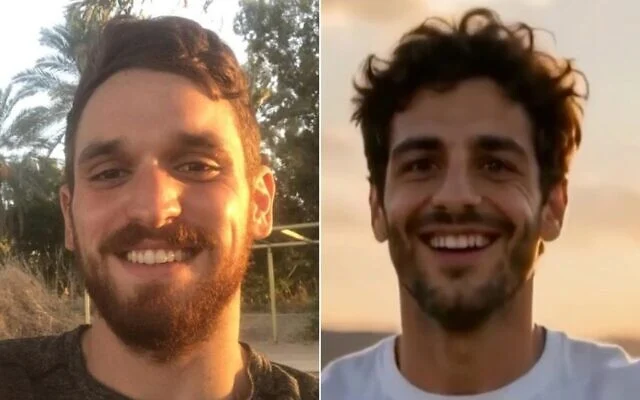
But that calumny wasn’t the worst thing about the ad. This was an AI-generated clip. The prime minister and his campaign team could have chosen any nonexistent young man or woman for Eisenkot to ignore in his faked rush to join forces with the Arabs. But they generated, in their fake heavenly flower-filled field, a fake bearded man in his mid-20s who looks like Eisenkot’s own son Gal — an IDF reservist who was killed at age 25 while fighting in Gaza in December 2023. In other words, Netanyahu had his purportedly dastardly rival ignoring a beyond-the-grave Israel-unifying plea from his own fallen son.
Eisenkot’s campaign responded with a compilation of (genuine) clips showing how Netanyahu and his colleagues tried and failed to woo Abbas into their own coalition — inevitably giving the original toxic ad more resonance. And Netanyahu’s under-indictment top adviser Jonatan Urich then issued a follow-up ad, this time putting the “Israeli unity” T-shirt on an AI-generated woman.
גדי, זה לא ישר pic.twitter.com/awy47dINmq
— Benjamin Netanyahu – בנימין נתניהו (@netanyahu) July 20, 2026
Needless to say, no apology has been forthcoming from Netanyahu for the despicable original ad.
Needless to say, even me writing about it here will generate further viewing. I’ll pay that price to make the following points:
Netanyahu wants to fight the October 27, 2026, election on the ostensible unsuitability of anyone but him to lead Israel. In fact, he has, tragically for this country, proved himself to be just about the last person who should run Israel. Having held power almost uninterrupted since 2009, and encouraged Qatar to help fund Hamas’s growing strength in Gaza, he failed to thwart the October 7, 2023, Hamas invasion and massacre. He refused to take responsibility for that failure by stepping down. And he has steadfastly blocked the establishment of an essential state commission of inquiry into the failures surrounding that invasion, the better to ensure that nothing like it will happen again, because he knows such an inquiry would recommend his immediate departure from public office.
Worse, through almost three years of ongoing multifront war, he has survived in power by indulging the immoral and untenable demand by the leaders of the ultra-Orthodox community for the exemption from military or national service of their young men — who are instead increasingly subsidized by the diminishing community of Orthodox, traditional and secular Israelis who do perform mandatory national service and seemingly endless reserve duty while somehow holding family life and work life together. The final paroxysms of his coalition’s Knesset term last week included the passage of legislation designed to render legal, by force of corrupted executive will, the patently illegal exemption of ultra-Orthodox Jews from national service.
The ultra-Orthodox leaders’ extortion, and Netanyahu’s readiness to be blackmailed, have heightened dreadful divisions in Israeli society — which are now at the fore even as the Jewish people on Wednesday night mark Tisha B’Av, the day on which it is believed both Biblical temples were destroyed by enemy forces profiting from internal Jewish hatreds.
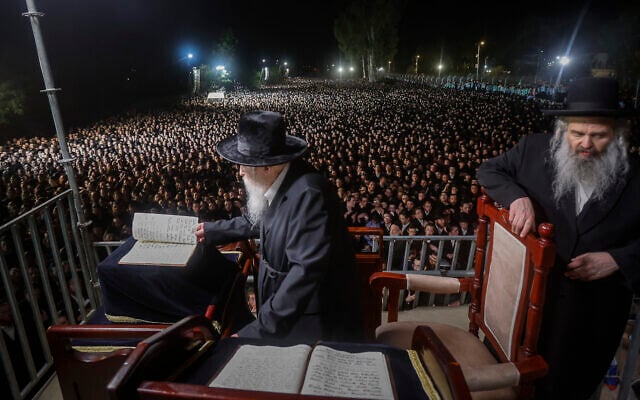
The refusal of the ultra-Orthodox leadership to allow its constituency to share in the responsibility to defend the state is exacerbated by that leadership’s refusal to allow its constituency to gain an adequate education — keeping their youngsters in sectoral schools, again lavishly funded by the Israeli workforce, that do not teach the most basic skills.
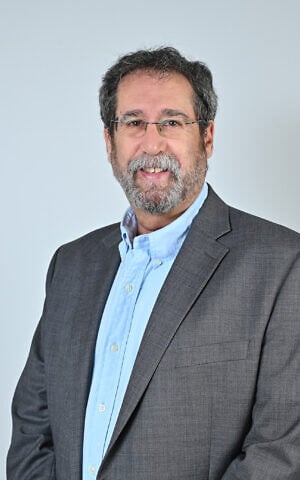
As Prof. Dan Ben-David, the academic economist who heads the Shoresh Institution for Socioeconomic Research, underlined to me this week, the ultra-Orthodox community, at 14% of the populace and growing much faster than any other sector, does not cut itself off from the benefits of modernity and development. “When they get sick, they go to the doctor, not the rabbi,” he noted. “They don’t want to live in tents. They live in homes, designed by architects and engineers.”
But their leadership, terrified of “losing” their constituency, God forbid, to an Orthodox, traditional or secular lifestyle, a working lifestyle, a participatory, responsible lifestyle, has insistently deprived successive young generations of the opportunity to make a choice, and cynically closed them off from the educational tools that could enable them to join a first-world workforce.
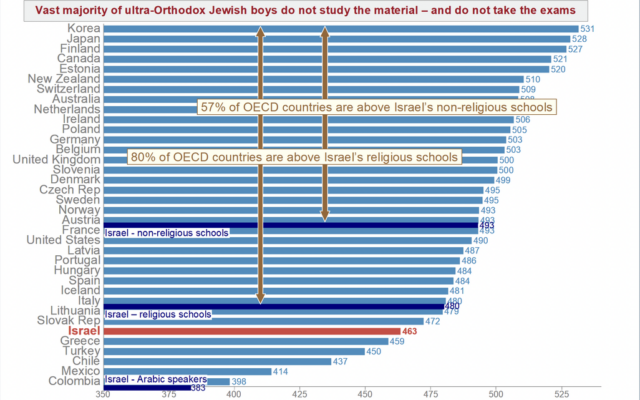
Not only is Israel’s fastest-growing community therefore being strategically stunted, Ben-David pointed out, but so, too, by extension is all of Israel. Nationwide education standards have been gradually collapsing, to the point where Israel, in its school-system entirety, today ranks in surveys below almost the entire developed world. And a country with a third-world education system, as Israel’s is fast-becoming, cannot maintain a first-world economy, a first-world health system… or a first-world army.
This is the cost that Netanyahu has been prepared to have Israel pay for his political survival, most egregiously in the wake of his October 7, 2023, failures: skewing a country in which an ever-greater burden falls on the workforce, in which many of the best and the brightest are increasingly inclined to leave, and those who remain are ever-less capable of sustaining a thriving Israel and an Israel capable of protecting itself against its salivating enemies.

We still have almost 100 days before we go to the polls — almost 100 days, as President Isaac Herzog warned in a plaintive televised address on Tuesday night, with “dangerous violence” already “rearing its head across the country,” and documented “threats to the integrity of the elections.”
“I turn to elected representatives, activists, and all candidates from all parties, and demand that you do not cross red lines!” Herzog implored. “Do not turn rivals into enemies!”
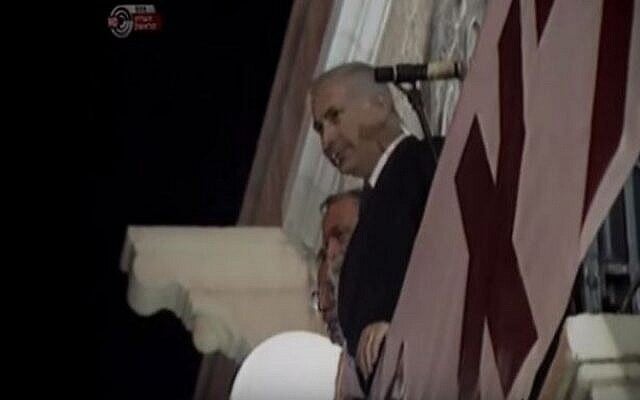
Netanyahu, the opposition leader who stirred up vicious opposition to prime minister Yitzhak Rabin, is manifestly not listening to presidential entreaties and has evidently learned nothing from the sequence of terrible events that played out here 31 years ago. His pet Channel 14 TV station, his social media loyalists, and his thuggish activists spread incessant toxin. And the man who oversaw the Eisenkot attack ad — Israel’s most schemingly divisive politician brazenly and baselessly accusing an opponent of eschewing national unity — no longer even bothers to appear above the fray.
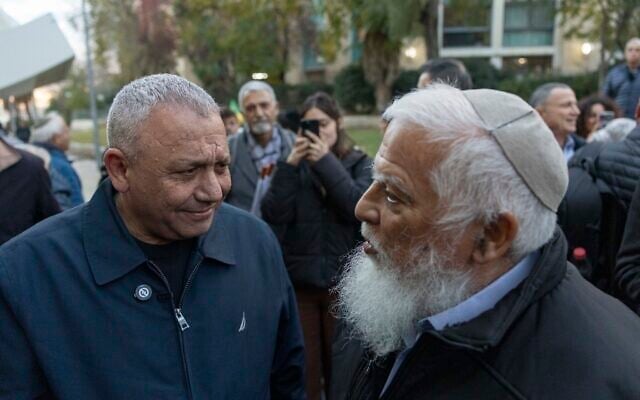
Eisenkot has risen inexorably in the polls, personally preferred as prime minister and his Yashar party neck-and-neck with Likud, because he is perceived as the very opposite of Netanyahu — as a would-be good-faith advancer of Israel’s vital and genuine national interests. Not slick, superficial, or cynical. And not indelibly stained by the worst leadership failure in Israeli history.
It is, dismally, no surprise that the shameless Netanyahu will sink to any depths in a desperate bid to besmirch the bereaved former IDF chief of staff who wants to put this country back together again. Worse is doubtless yet to come. Hopefully, just maybe, enough of the electorate can still see where our vital interests lie and, 97 days from now, Israel’s national direction will start to change for the better.