World
Lebanon’s Faustian bargain: The mirage of the trilateral framework

Can Lebanon extract a genuine, equitable peace from the 26th June Trilateral Framework Agreement (TFA)? The simple answer is yes, but that “yes” comes at a devastating cost. Marketed by Washington as a breakthrough, the framework is fraught with severe imbalances. As Lebanese political figures and civil society groups have already pointed out, the agreement demands sweeping internal concessions under the shadow of occupation, threatening to ignite internal conflict rather than resolve a regional war.
What are Beirut’s realistic chances of normalising ties with Israel while still under occupation? Does Lebanon hold any actual leverage to extract meaningful concessions from an occupying power while it declares war on Hezbollah? The reality is that by signing this text, Beirut is being asked to surrender its only remaining cards for a mirage of stability engineered in Washington.
The framework’s greatest danger lies in what it deliberately leaves out. In a textbook example of diplomatic evasion, the TFA claims to “build upon previous successful agreements,” yet calculatedly erases any mention of UN Security Council Resolution 1701 or the 1949 Armistice Agreement—both should have been referenced in the text. Both, the resolution and the Armistice Agreement, explicitly anchored established borders and mandated unconditional Israeli withdrawal. This is a strategic omission designed to sever the agreement from international law, rendering the TFA legally dubious and structuring it to favour lopsided concessions over legitimate Lebanese sovereignty. Compounding this legal vacuum is another blind spot: the total erasure of Lebanon’s 250,000 Palestinian refugees. By airbrushing this population out, the framework bypasses the demographic realities underpinning the region’s political landscape. Uncoupling the diplomatic process from international law and demographic facts ensures that any future arrangements remain fundamentally unmoored from reality.
For Lebanon, this offers virtually zero guarantees given America’s long-standing, unequivocal bias towards Israel. Washington’s ability to enforce compliance has already proven hollow. On at least three separate occasions since April, President Donald Trump has demanded a ceasefire in Lebanon—a mandate intrinsically linked to the June 17 US-Iran Memorandum of Understanding. Yet Benjamin Netanyahu has consistently defied him. Israeli ministers actively pursue military escalation, thoroughly humiliating Trump’s public boast that “if I tell Netanyahu to do something, he does it.” Entrusting Lebanese sovereignty to an arbiter who cannot command the compliance of its closest regional ally is a fatal diplomatic error, further compounded by the Trump administration’s repeated failure to uphold basic security commitments, even with its NATO allies.
READ: Lebanon says direct damage from Israeli war estimated at $3-4 billion
By conditioning Israeli withdrawal on the neutralisation of Hezbollah, the agreement transforms a highly sensitive, strictly internal Lebanese issue into a collaborative security arrangement with the occupying power.
Historically, Israel has occupied Lebanese land for decades now and ending Israeli occupation should be conditional on anything. Moreover, this shift fundamentally alters the geopolitical stakes: the crisis is no longer an extension of the broader Palestinian cause, but a direct, existential struggle over occupied Lebanese land and villages. Forcing Beirut to collude with Israel to disarm a domestic faction while its own sovereign territory remains under military occupation is a profound strategic error that strips Lebanon of its only actual leverage.
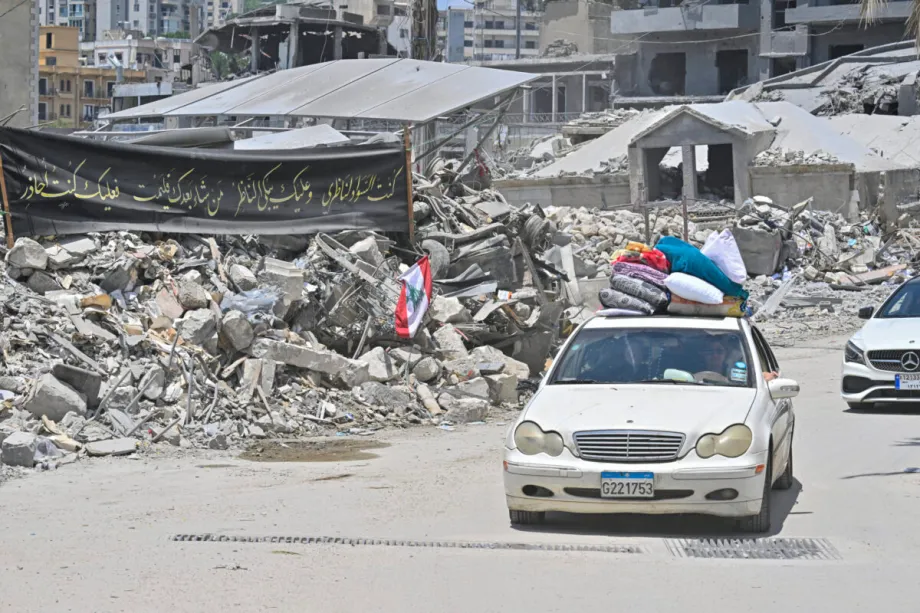
Despite the fact that displaced Lebanese citizens from the south can only return in patches—and only when the occupying force permits movement into their respective villages—this situation represents more than just a surrender of the Lebanese state’s sovereign decision-making on a critical domestic issue. It further legitimizes an occupation that is not only illegal under international law but criminal, given the documented commission of war crimes and crimes against humanity. Ironically, article 13 of the document stipulates that Lebanon, its citizens, and its civil society communities—particularly in the south—have no right to pursue legal action against the occupation, neither while it is ongoing nor after it concludes, should that ever occur—more on this later.
By avoiding a binding, comprehensive withdrawal, the framework leaves the door wide open for de facto annexation and arbitrary security borders. Historical memory warns of the devastating domestic toll of such miscalculations. Just as the ill-fated 1983 May 17 Agreement ignited fierce internal pushback and collapsed under its own weight, this occupation-enabling framework threatens to fracture an already fragile nation. Parliament Speaker Nabih Berri’s warnings of fitnah (sedition) should not be taken lightly.
Perhaps most damningly, the TFA demands one final, punitive concession: a blanket guarantee of impunity. As mentioned above Article 13 deliberately dictates that Lebanon will abandon any legal action against the crimes committed by Israeli invading forces. This amounts to an official erasure of accountability for the targeted killing of journalists, the slaughter of ordinary citizens—including entire families—the total destruction of half a dozen villages, and the violent displacement of nearly two million people. An agreement that not only requires a state to forfeit its sovereign rights but also banning its citizens from suing the occupation in beyond surrender; it is absolving an occupier of its atrocities is not a foundation for peace; it is a document of surrender.
The Lebanese public possesses a stark historical precedent for dismantling inequitable deals with Israel. The prime example remains the ill-fated May 17 Agreement, signed in 1983 under heavy US mediation. That accord profoundly cost the country and severely damaged the presidency of Amine Gemayel, who championed it before domestic and regional pushback forced its formal abrogation. Given this historical memory, pushing an even more dangerous, occupation-enabling framework today risks triggering the exact same violent domestic rupture.
It is worth watching if any agreement between Israeli and Lebanon is put to parliamentary approval that has the potential to further derail the already fractured Lebanon.
READ: Oil, elites, and empty promises: Inside the US-backed coup against the UN in Libya
The views expressed in this article belong to the author and do not necessarily reflect the editorial policy of Middle East Monitor.