World
Khamenei’s funeral makes clear the global order is moving on

The United States turned 250 on July 4. The celebrations were spectacular: 850,000 fireworks launched from ten sites across Washington, military flyovers every hour, a speech from a president who promised it would be the “largest fireworks show in history”. At Mount Rushmore the night before, Donald Trump declared America “the most extraordinary republic ever, ever, ever”.
But anniversaries have a way of exposing what lies beneath the pageantry. And beneath this one, the foundations are crumbling.
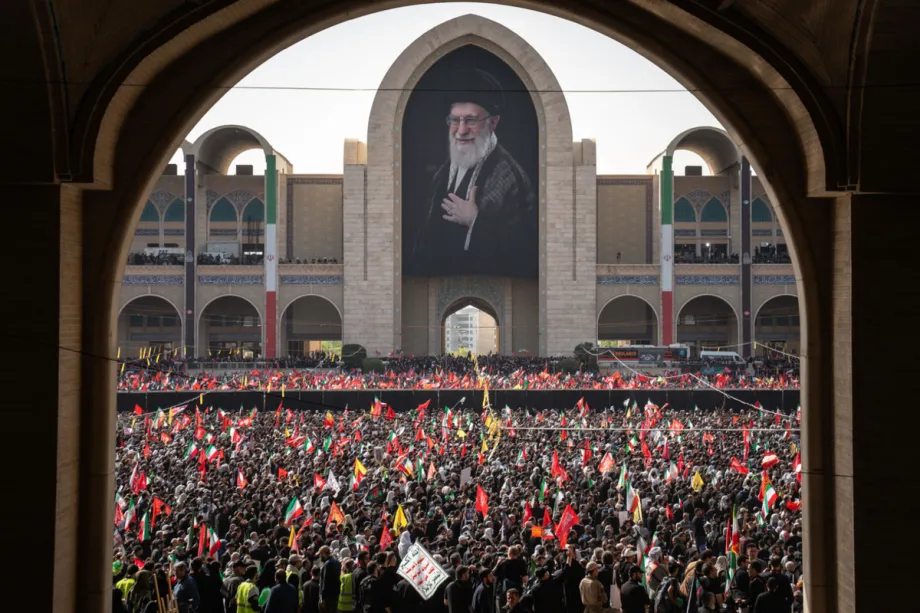
More than 10 million mourners were expected in Tehran. Representatives from over 100 countries attended. And yet, hours earlier, the world learned that Secretary of State Marco Rubio had issued a confidential directive on June 26 instructing all US embassies to warn host governments that attendance would be treated as an ‘unfriendly act’ with consequences for bilateral relations. US ambassadors in several African countries reportedly warned that participation could result in cuts to development assistance. Rubio personally pressed at least five Arab nations.
The result? At least 13 countries—three from Eastern Europe, five from Africa, two Persian Gulf Arab states, two major East Asian powers—withdrew or scaled back their delegations. Some reportedly apologised to Iran through intermediaries, explaining their inability to attend.
The global order, if it accepts this arrogation, ceases to be an order of sovereigns and becomes an imperial death-cult in which the only legitimate mourning is that which the hegemon permits.
And then there was Trump’s other message. Standing at Mount Rushmore—a monument carved into a mountain sacred to the Lakota people, on land stolen through treaty violations—the president warned of a resurgence of “the communist menace” and “newcomers” who embrace ideas “totally opposed to our way of life”. “America will never be a communist country,” he insisted. Communism, he declared, is “like a cancer” that “must be excised”.
This is not the rhetoric of strength. It is the rhetoric of a polity that has exhausted its ideological reserves and now runs on fumes. The mythology of American exceptionalism—the city on a hill, the indispensable nation, the arc of justice—has collapsed under the weight of centuries of violence, hypocrisy, and a global population that no longer buys what Washington is selling.
The numbers are devastating. A Pew Research Centre survey of 42,151 adults across 36 countries found that a median of just 23 per cent have confidence in Trump’s handling of world affairs. Only 35 per cent believe the United States contributes to peace and stability. In Canada, the share viewing the US as a reliable partner crashed from 83 per cent in 2022 to 35 per cent in 2026. In France: 62 per cent to 27 per cent. Germany: 83 per cent to 39 per cent. Britain: 82 per cent to 49 per cent. Australia—Washington’s most steadfast Pacific ally—saw confidence fall from 79 per cent to 37 per cent.
The Lowy Institute’s 2026 poll is even more stark. Trust in the United States to act responsibly in the world has fallen to 31 per cent—the lowest level in the history of the poll, a 25-point drop from just two years ago. Confidence in Trump stands at 21 per cent, the lowest for any US president ever recorded. For the first time, a majority of Australians—51 per cent—now say the relationship with China is more important than the relationship with the United States.
READ: Iranian parliament speaker: We have no peace with US and will not recognise Israel
The gap in trust between the two superpowers has compressed from 53 points in 2022 to just three points today. America is not losing its edge to China because China is winning hearts and minds; America is losing because it has burned its own credibility to ash.
Domestically, the picture is no brighter. An AP-NORC poll found 72 per cent of Americans believe the country is heading in the wrong direction. Only 45 per cent say the US is one of the greatest countries in the world, down from 55 per cent in 2016. PRRI’s 2026 survey found 51 per cent of Americans are extremely or very proud to be American—down from 82 per cent in 2013. Thirty-eight per cent do not believe the United States will exist in another 250 years. Nearly half of Americans—46 per cent—do not even know what the 250th anniversary commemorates. Among Gen Z, that figure rises to 61 per cent.
A nation that cannot remember its own founding mythology is a nation whose mythology has already died.
Ray Dalio, the billionaire investor who has studied the rise and fall of empires for decades, declared in March 2026 that the United States has experienced its ‘Suez moment’. The Suez Crisis of 1956 did not create Britain’s decline; it exposed a loss of power that had already occurred. Within a decade, Harold Macmillan’s ‘winds of change’ speech formalised what Suez had revealed: the British Empire was in managed retreat, not strategic expansion.