World
Keeping his head: Educator detained for dual Israeli-Palestinian flag kippa dons replacement

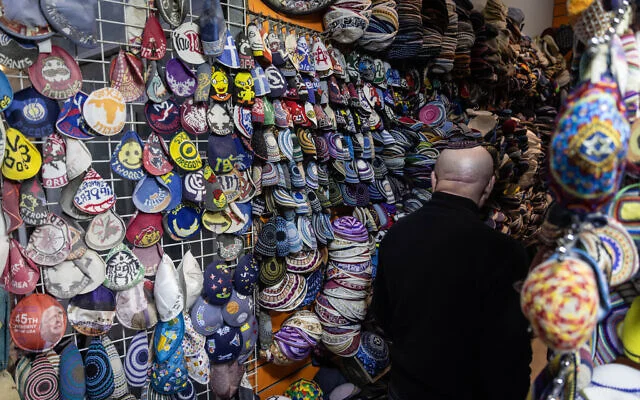
When Alex Sinclair walked into a well-known kippa store in downtown Jerusalem earlier this month to order a new custom-made kippa, he did not know which way the winds would blow.
He’d vowed to get a new kippa identical to the one that was destroyed by the police in a headline-splashing incident in April. Now, some 20 years after he got the first one — and several years after he bought its first replacement after the first was blown away — he wasn’t sure, in the current political climate, what the store owner’s reaction would be.
The 53-year-old writer and educator, who moved to Israel from the UK in 1998, had unwittingly found himself in the spotlight after two Israeli police officers detained him for wearing a unique kippa featuring a Palestinian flag side by side with an Israeli one. The officers released him a few hours later and returned the kippa to him, but only after cutting the Palestinian flag out.
Under National Security Minister Itamar Ben Gvir, the authorities have undertaken a broad crackdown on Palestinian symbols, with police instructed to remove flags, even though they are legal.
After the incident, Sinclair received what he describes as an unexpected and incredible amount of solidarity, even from many who told him they did not like his choice of kippa. He was determined to return to the same shop and find a replacement.
“I went in, and I said to the guy, ‘Hi, do you remember me?’ And he looked at me, and he was like, ‘Not really,’” Sinclair told The Times of Israel over the phone. “I said to him, I once bought from you a kippa with the flag of Israel and Palestine on it. At that point, he remembered.”
Sinclair asked the store owner if he would make another one for him.
“He said ‘Sure,’ and he was very nonchalant, so I asked him if he had heard what had happened to me. He had not,” Sinclair recounted. “I was kind of surprised, but I guess that just shows you that everyone lives in their own little social media and news bubbles.”
The man heard the story and agreed to make the new kippa (actually two, since Sinclair said this time he wants a spare one “just in case of eventualities”), but he asked to keep things quiet as the issue was “sensitive.”
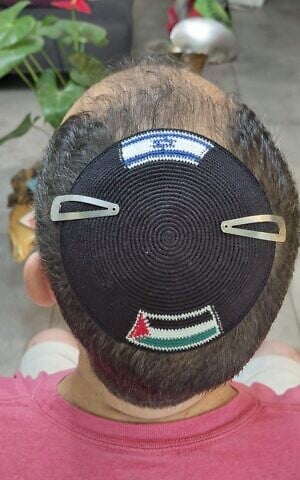
Since his detention, Sinclair has shared his concern and has not publicly disclosed the store’s name, though several people have asked him where they can get the same kippa.
Sinclair started wearing a kippah featuring the two flags for several reasons. Besides showcasing his belief in coexistence, he didn’t want to be easily put in the same box as most kippa-wearing men in Israel.
“Kippas are a very political symbol in Israel,” he said. “If you’re a sociologist or just a regular Israeli who pays attention to this stuff, you can tell a lot about a person from the kind of kippa they wear.”
Knitted kippas in particular are usually associated with the Religious Zionist community (as opposed to, for example, velvet black kippas common among ultra-Orthodox men).
“Obviously, it’s a generalization, and I know that there are exceptions, but if you look at the voting patterns of Israel, typically, men who wear kippas tend to lean right, be pro-settlements, anti-Palestinian statehood, and Orthodox,” he added. “It kind of conveys a certain religious and political approach.”
Sinclair described himself as a “traditional, observant, egalitarian, conservative Jew,” and a liberal Zionist (one of his books is titled “Loving the Real Israel: An Educational Agenda for Liberal Zionism”).
Sinclair acknowledged that for many in Israel, the Palestinian flag is a hard symbol to see, especially after the October 7, 2023, Hamas attack against Israel, which left thousands killed, wounded, and kidnapped.
“[The Palestinian flag] has always been somewhat of a controversial symbol, but I know that it has gotten more controversial and more triggering to people after October 7,” he said. “I’m not naive. I know that for some people, it’s a hard thing to see, and it’s hard for me as well. I’m not immune to those feelings of fear, skepticism, and anger.”
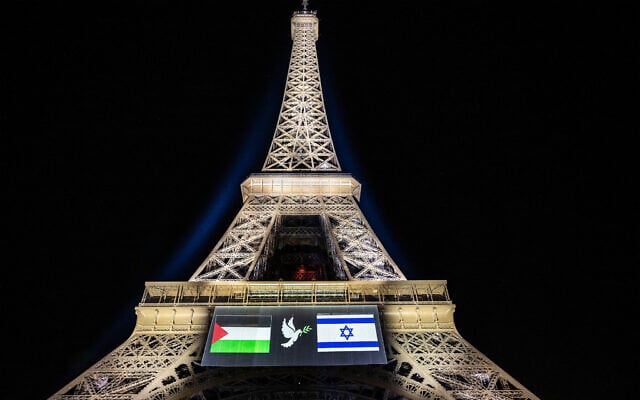
At the same time, Sinclair said that for him, the key is the choice of wearing both flags at the same time.
“I’m very deliberately walking around with the two symbols,” he explained. “I love, and I feel pride about the Israeli flag, which is my flag, and is special to me as an Israeli and as a Zionist. I think that wearing both flags together is the exact opposite of what Hamas wants; it’s everything that Hamas is against: coexistence, Israel, peace, our right to have self-determination as Jews.”
Over the years, Sinclair encountered many reactions to his kippa. The vast majority of people obviously do not pay attention to it, but when someone does, it often sparks an interesting conversation.
Now, the educator is happy he can start wearing his kippa again, and he hopes to have more interesting conversations.
“I feel quite strongly that I don’t want what happened to intimidate me [and prevent me] from continuing to do what I feel is right,” he said.