World
Israeli envoy says Jerusalem views deal with Lebanon as superseding US MOU with Iran

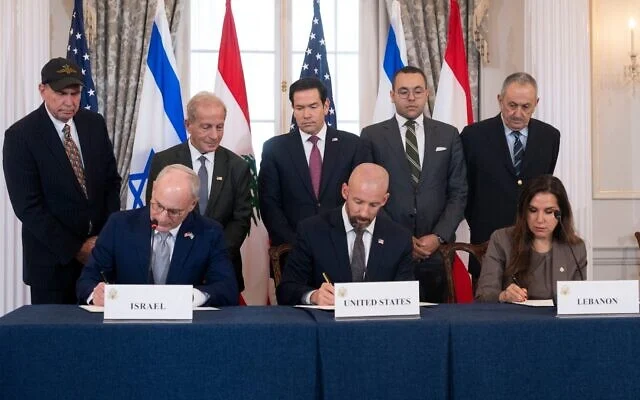
Israeli Ambassador to the United States Yechiel Leiter said Monday that Jerusalem views the framework deal it inked last month with Lebanon as superseding the memorandum of understanding that Washington signed with Iran just over a week earlier.
During an onstage interview hosted by the Council of Foreign Relations in Washington, Leiter also argued that reports of a rift between the US and Israel are overblown, and said the next round of Beirut-Jerusalem talks is slated to begin next week.
“Both Israel and Lebanon clearly see our trilateral agreement superseding the first clause of the MOU. Whether or not the United States does, you’ll have to ask an administration spokesman,” Leiter said.
While the US brokered the talks between Jerusalem and Beirut that led to the framework deal in which the sides agreed to prevent Iran from influencing developments in Lebanon, the MOU that US President Donald Trump went on to sign with Iran appeared to undermine the Israel-Lebanon channel by specifically extending the US-Iran ceasefire to include Lebanon and call for an end to military operations in the country.
Leiter said he recognizes that Iran, along with Pakistani and Qatari mediators, believes the MOU should override the Israel-Lebanon framework deal. However, he argued that the MOU is merely a document aimed at reopening the Strait of Hormuz after Iran closed the channel in response to US and Israeli strikes. Leiter suggested the MOU “is not a closure of the operation against Iran and its nuclear pursuits.”
The Israeli envoy also argued against the MOU’s envisioned sanctions relief to Iran, insisting that Tehran will use that money “for nefarious purposes.”
Israeli Ambassador to the U.S: Yechiel Leiter
“Lebanon is gonna have to get ahold of itself.. make the choice— that it comes down to the side of accommodationism— those who have threatened the notion of Israel’s existence and that Lebanon can be used as a conduit to fulfill… pic.twitter.com/zVN33tSJI8
— MJTruthUltra (@MJTruthUltra) July 6, 2026
At the same time, the Israeli envoy recognized the limits of Israel’s ability to influence US decision-making: “All we can do is weigh in… We can’t be part of that decision-making process. That’s too big for us. We know our size.”
He said there are some members of the Israeli government who are panicking over the MOU and its meaning for Iran and the region, but said he is “much more sanguine,” and is urging a wait-and-see approach regarding ongoing talks on a final deal that would more holistically address Iran’s nuclear program, missile program and support for proxies.
“Whether that’s in 60 days or 90 days or after the midterms… I’m quite sure that the administration didn’t go to war to go back into a situation where Iran has a pathway to once again try and produce nuclear weapons” by creating a shield via the mass production of ballistic missiles, Leiter added.
While Trump made the destruction of Iran’s missile program an initial war aim, he shifted after signing the MOU last month to arguing that Tehran should be allowed to have some missiles as a means of self-defense against neighbors that also possess them.
For his part, Leiter said he “can’t imagine that any ultimate agreement with Iran would be absent a clause limiting the development of ballistic missiles.” He noted that Trump had also said any deal with Iran would have to address its support for proxies, though that issue, too, went unmentioned in the MOU.
With little apparent progress made in further US-Iran talks, Leiter indicated that the next round of negotiations between Israel and Lebanon will take place next week in Rome.
“Next week, we’re going to be sitting in Rome on the 14th and 15th, bringing teams for each issue,” Leiter said.
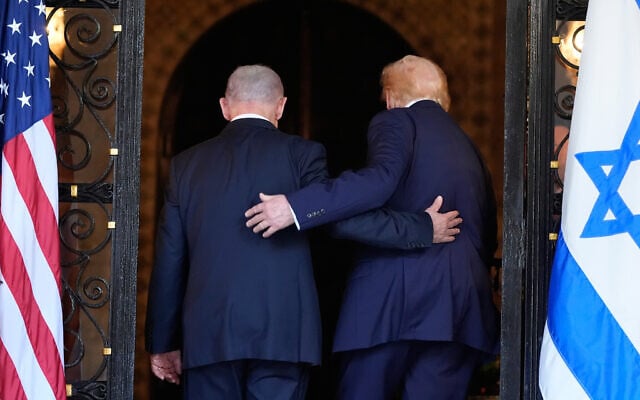
He also revealed that Lebanese President Joseph Aoun will be meeting with Trump at the White House on July 21 — a date that had not yet been publicly confirmed. The US has sought to organize a trilateral meeting between Aoun, Prime Minister Benjamin Netanyahu and Trump, but Beirut has pushed back on the idea so long as Israel maintains forces in southern Lebanon. After a call last week between Trump and Netanyahu, the Prime Minister’s Office said the pair would be meeting soon in the US, with no date confirmed.
Despite a number of highly publicized differences, Leiter insisted Monday that reports of a rupture in ties between Israel and the US are overblown.
“The media loves drama. So, if the president and the prime minister have 100 conversations that are pleasant, and then there are two conversations in which the president is having a bad day or is a little irritable and makes that known — that becomes the tenor of the relationship between the two men,” Leiter lamented.
“The relationship is good and solid. There are differences along the way, and they are legitimate,” he said, using as an example Israel’s opposition to the mulled US sale of F-35 fighter jet parts to Turkey. Leiter explained that Israel has made its position known and that the US has the right to decide how it wants to proceed.
The Israeli ambassador insisted that Israel does not have any territorial ambitions in Lebanon — something leaders in Jerusalem have repeatedly stressed — but will remain there until the Lebanese Armed Forces (LAF) can verifiably prove it has begun disarming Hezbollah.
The Israeli envoy argued that one of the obstacles in the way of that goal is the presence of Hezbollah activists and sympathizers inside LAF units. Accordingly, Israel has submitted a proposal to have the US vet existing LAF units to weed out such Hezbollah sympathizers.
While Trump suggested during a May Oval Office meeting that Israel be the one to vet and train Lebanese soldiers, US Secretary of State Marco Rubio “came to the rescue and said, ‘Well Mr. President, they hate Hezbollah, but they’re not ready to love the Israelis yet.”
Pressed for additional details on this plan to vet LAF units, Leiter admitted that it is still in the works. However, he asserted that some LAF units are not “saturated” with Hezbollah operatives and therefore can already begin operating against the terror group.
Leiter said Israel is prepared to strengthen the current, anti-Hezbollah Lebanese government by providing intelligence on anyone seeking to harm its leaders. He added that Jerusalem is also prepared to lobby Washington to increase its financial assistance to the LAF if the latter proves that it is willing to take on Hezbollah.
Israeli Ambassador Yechei Leiter criticizes U.S. media: “If we were guilty of the things that we’re accused of my son would be alive today…Because we don’t strike bomb population centers from above and we don’t starve population centers and we don’t commit genocide.” pic.twitter.com/Ml6tFJqPwJ
— CSPAN (@cspan) July 6, 2026
Leiter also pushed back against claims that it was a mistake for Israel to kill Iran’s Supreme Leader Ali Khamenei, even though it has led to the elevation of more hardline IRGC officials. He argued that it is too early to say who will fill the leadership vacuum in Tehran, and that in some previous cases, such voids have been filled by individuals willing to make peace.
The ambassador also dismissed US Vice President JD Vance’s recent claim that Trump is the only world leader left who is still sympathetic toward Israel, pointing to strong Israeli ties with India, the United Arab Emirates, Azerbaijan, Somaliand and Armenia, highlighting Israel’s recent recognition of the Armenian genocide. That decision, however, received a somewhat chilly response in Armenia, amid accusations that it was only made in order to snub Turkey.
While arguing that Vance was incorrect in describing Israel as diplomatically isolated, Leiter clarified that he has never detected “a scintilla of antipathy toward Israel” from dozens of meetings with Vance.