World
Israel, Lebanon agree to renew truce, create ‘pilot’ zones where Hezbollah is banned

BEIRUT, Lebanon — Israel and Lebanon agreed on Wednesday to renew their fragile ceasefire and create a number of “pilot” security zones inside Lebanon from which Hezbollah terrorists would be banned.
In a joint statement released after a fourth round of US-mediated talks at the State Department, the two sides said the ceasefire “is contingent on a complete cessation of Hezbollah fire and the evacuation of all Hezbollah operatives” from areas south of the Litani River. It was not immediately clear how the security zones would be established, but the agreement calls for the Lebanese army to take full control of those areas.
“These steps will enable progress towards a comprehensive peace and security agreement,” the statement says. “All countries reaffirmed that the future of the relationship between Israel and Lebanon must be decided by the two sovereign governments. They rejected any attempt, by any state or non-state actor, to hold Lebanon’s future hostage.”
The latter is a reference to Iran, which supports Hezbollah and has insisted that Israeli attacks on Lebanon be halted as part of a tentative agreement with the US to end the conflict with Iran. Hezbollah is not part of the Israel-Lebanon talks.
The two countries do not have ties and have been in a state of war since 1948. Israel and the US want to see Hezbollah disarmed, an objective shared by the Lebanese government but rejected by the Iran-backed terror group.
The fresh announcement suggested that Trump’s declaration on Monday that Washington had brokered a fresh truce between Israel and Hezbollah, after the one reached in April unraveled, did not extend beyond halting Israel’s planned operations in Beirut, as strikes continued in southern Lebanon, while the Iran-backed terror group continued launching projectiles at Israel.
Israeli leaders had threatened that the Israel Defense Forces would target Beirut’s southern suburbs, a Hezbollah stronghold, if the Iran-backed terror group targets Israeli communities.
The new announcement also appears to attempt to separate efforts to reach a deal to end the conflict with Lebanon and the war with Iran. Tehran has insisted on tying the two, as it seeks to protect its Hezbollah proxy and continue influencing events in Lebanon. While the US and Israel have pushed back against such linkage, Washington’s effort on Monday to secure another Lebanon truce announcement just hours after Tehran threatened to abandon talks appeared to undercut those efforts.
Washington’s push for a new ceasefire came as the previous ceasefire brokered on April 16 had largely evaporated, with Hezbollah keeping up its relentless rocket and drone attacks and the Israel Defense Forces pushing ahead with an expanded ground operation and widening airstrikes.
Before the announcement, IDF Chief of Staff Lt. Gen. Eyal Zamir said that in Lebanon, “there is no ceasefire for our forces,” during a visit to the Haifa Naval Base on Wednesday.
“We are working to maximize the freedom of action that has been granted to us and will seize every opportunity to remove threats to the citizens of Israel and to our forces,” he said, in remarks provided by the IDF.
Zamir also said that the Israeli Navy is becoming “an additional long-range strategic arm” of the military.
“Upon assuming my position, I directed the strengthening of the Navy as an additional long-range strategic arm of the IDF. We are now accelerating the implementation of the operational concept,” he said.
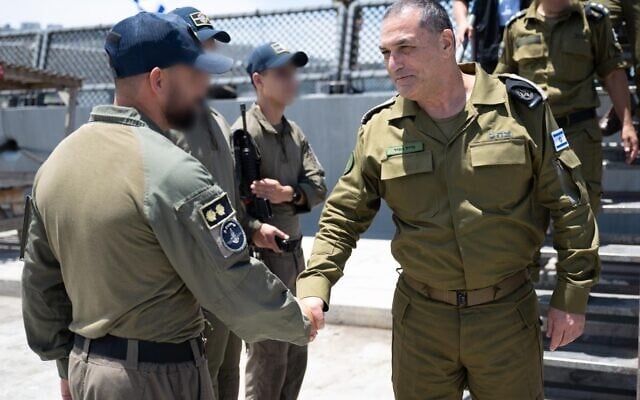
Zamir said the Navy has been operating “across all combat fronts, in challenging maritime arenas near and far, and in operations that cannot yet be disclosed to the public.”
“The IDF, across all its branches, is prepared to immediately return to combat against the Iranian terror regime. The Navy plays a decisive role in our ability to once again strike the terror regime with force, as we have done in the past,” he added.
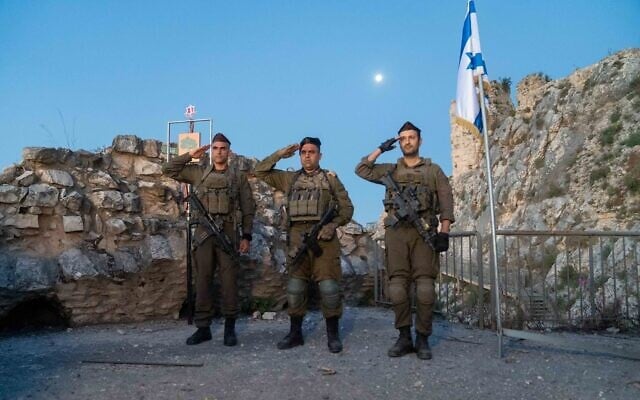
Meanwhile, Col. Ayub Kayuf took charge of the IDF’s Golani Brigade from Col. Adi Gonen, during a handover ceremony held this morning at the Beaufort Castle in southern Lebanon.
Kayuf previously commanded the Israeli Air Force’s elite Shaldag Unit, the Menashe Regional Brigade in the West Bank, and the Operations Department in the Operations Directorate.
Golani troops captured the strategic Beaufort Castle earlier this week, as the military appeared to be expanding its operations in southern Lebanon due to the incessant Hezbollah attacks.
Hezbollah, meanwhile, published a video showing a first-person view (FPV) drone with a night-vision camera flying around the castle, ostensibly on Monday. However, no Israeli troops are visible in the footage.
The latest round of fighting between Israel and Hezbollah began on March 2, when Hezbollah fired rockets into northern Israel two days after the US and Israel attacked its main backer, Iran. Since then, 26 IDF soldiers and one Defense Ministry civilian contractor have been killed in southern Lebanon, 14 of them since a ceasefire was introduced on April 16. Two civilians were also killed by Hezbollah rockets, and an Israeli civilian was mistakenly killed in the north by Israeli artillery shelling.
In Lebanon, the Israeli military has said that it has killed over 2,500 Hezbollah operatives, including hundreds of members of the terror group’s elite Radwan Force, since early March.
Since March 2, Hezbollah has fired some 5,500 rockets at IDF troops operating in the south of the country, as well as around 2,500 at Israel, according to the military. There were at least 75 rocket impact sites in Israel.
In addition, Hezbollah launched around 300 drones, of which 25 struck Israel, according to the IDF.
The IDF believes Hezbollah still possesses thousands of short-range rockets, along with hundreds of longer-range projectiles. The IDF has said that Hezbollah is launching most of its attacks from deeper within southern Lebanon, north of the Litani River, and not from areas close to the border.