Breaking
Iran Shuts Strait of Hormuz, Blames US, Israel-Lebanon Conflict

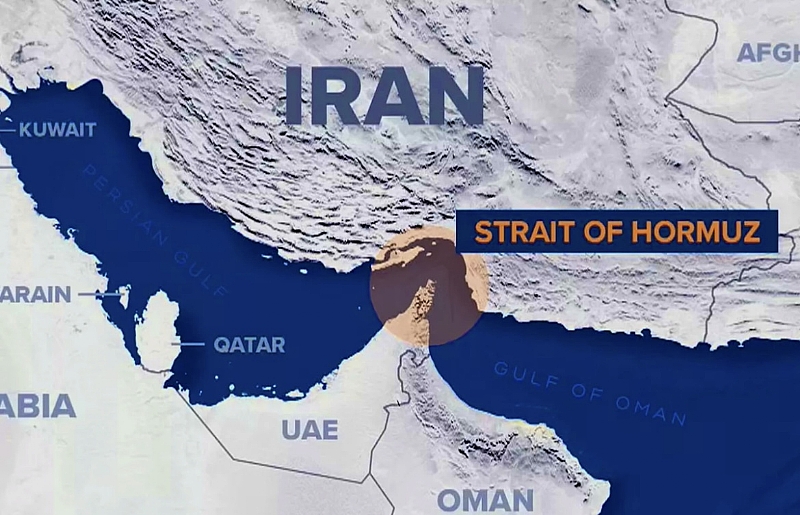
Iran has re-closed the Strait of Hormuz, a strategic maritime passage, citing Israel’s refusal to withdraw its forces from southern Lebanon and the continued presence of US forces in the region.
In a statement broadcast over maritime radio channels on Friday, Iran’s Islamic Revolutionary Guard Corps (IRGC) accused the United States of violating the memorandum of understanding (MoU) signed on Wednesday by US President Donald Trump and Iranian President Masoud Pezeshkian.
According to the IRGC, key conditions of the agreement included Israel’s withdrawal from Lebanon, the complete lifting of the naval blockade, and the withdrawal of American forces from the Persian Gulf and surrounding areas.
“Since Israel’s withdrawal from Lebanon, the complete lifting of the naval blockade, and the withdrawal of American terrorist forces from the Persian Gulf and the region are among the main conditions of the agreement between Iran and the United States, the Strait of Hormuz will remain closed until these conditions are met,” the statement said.
It further warned that all ships should avoid the strategic waterway for safety reasons, adding that any vessel ignoring the directive could be targeted.
Traffic data from the Strait of Hormuz on the morning of June 19 showed commercial shipping activity in the area, despite heightened tensions.
The US Central Command said on Thursday it had formally lifted its two-month blockade on Iranian ports.
However, it remained unclear what the IRGC meant by saying the embargo had not been “completely” removed.
Shortly after the IRGC announcement, a US official claimed that Israel and Hezbollah had reached a ceasefire agreement. This came despite comments by Israeli Prime Minister Benjamin Netanyahu, who insisted that Israeli forces would continue operations against militants.
“We will restore security and prosperity to northern towns,” Netanyahu said.
“That requires maintaining the security zone in southern Lebanon.”
The Israel Defense Forces also released an updated map showing an expanded military presence more than six miles into Lebanese territory, including areas north of the Litani River.
The MoU signed on Wednesday committed the United States and Iran, along with their allies, to respect Lebanon’s sovereignty and territorial integrity while working to end hostilities.
Simcha Brodsky, president of open-source intelligence group OSINT613, said Iran appeared to be exploiting ambiguities in the agreement and the phased timeline for lifting the US blockade.
“What we’re seeing is a direct result of the wording in the US-Iran MoU. The deal lifts the US blockade in phases, fully within 30 days, so the US is still in the middle of that process by design,” Brodsky said.
He added that Iran was using that gap to justify keeping the strait closed, arguing that the blockade had not yet been fully lifted.
“Iran has now linked the Israel-Lebanon conflict to that justification, effectively halting the agreement and drawing Israel into a deal it neither approved nor negotiated,” he said.
The IRGC’s announcement came just hours after the first round of US-Iran nuclear talks, scheduled for Friday in Switzerland under the MoU framework, was postponed.
The United States has yet to provide an official explanation for the postponement.