World
Iran says it’s in ‘full-scale war’ with US as mediators said to proffer 10-day truce

Iranian President Masoud Pezeshkian said Monday that his country was in a “full-scale war” with the United States and that Tehran should accept the repercussions of the conflict, even as mediators reportedly proposed a 10-day truce to deescalate the fighting.
“The reality is that today the Islamic Republic of Iran is engaged in a full-scale war,” Pezeshkian said, adding that “we must be realistic and accept the natural consequences of this resistance,” according to a statement.
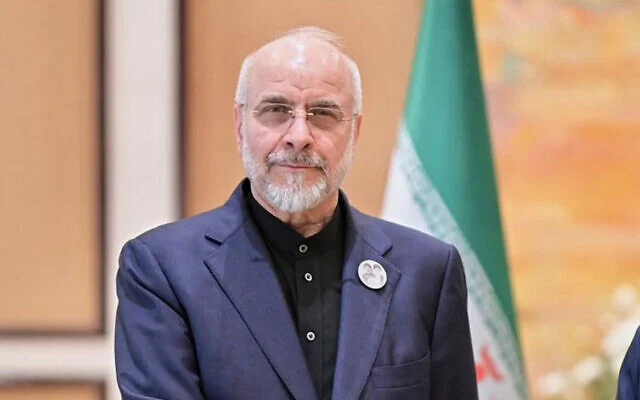
Iran’s top negotiator Mohammad Bagher Ghalibaf doubled down on the sentiment, claiming that US military steps proved that Washington is not interested in ending the recent escalation with Tehran.
“Americans keep bringing new military equipment to the region and claim they want to stop the war,” said Ghalibaf on X. “They’ve bet on our intelligence being as low as their own IQ.”
“We’ve reached the stage of mastery in recognizing these American games, and on that basis, we’ve prepared ourselves,” he continued. “Actions must confirm claims, not contradict them.”
Israel’s security cabinet was set to meet on Monday in light of the conflict, according to Hebrew media reports. A US official likewise told the Washington Post on Monday that the US was making plans for a potential expansion of military operations against Iran, while noting that Washington was limited by low munitions stockpiles.
“The US is planning for a wider war,” the official said, adding that the US was sending more military aircraft to the Middle East, seemingly confirming Ghalibaf’s remarks.
According to the outlet, the Pentagon will be hamstrung by its insufficient stockpiles of air defense and long-range missiles. It will also be limited in its ability to bring more troops into the fight because of battle damage incurred during earlier combat against Iran.
“We do not have enough to safely sustain operations, and I don’t think the White House is aware of that,” the official warned.
Diplomatic efforts continue
Meanwhile, another Iranian official said that diplomatic exchanges with the United States via mediators were ongoing despite the threats of wider war.
“We have been informed by mediators, we have received messages — without going into details — but the main point is that the diplomatic apparatus has been active in recent days and ideas have been conveyed to us by certain mediators,” Iranian foreign ministry spokesman Esmaeil Baghaei said at a press conference in Tehran attended by AFP.

“I reject the duality of either war or diplomacy. Diplomacy is a tool through which we pursue our national interests, just like war,” Baghaei said.
A senior Iranian official told Reuters that mediators passed Iran a proposal to de-escalate the war with the US that would include a 10-day ceasefire, during which the sides would find ways to revive the interim deal they reached last month.
The memorandum of understanding signed last month included a 60-day ceasefire pausing the war that broke out with US-Israeli strikes targeting the Iranian regime in late February. It also mandated the reopening of the Strait of Hormuz and included a timeframe for a final deal to permanently end the conflict and reach an agreement on Iran’s nuclear program.
Israel had no part in negotiating the MOU, and Israeli officials are deeply opposed to the deal’s terms, which resolved none of Israel’s key war goals — notably, eliminating Iran’s nuclear and ballistic missile programs and creating the conditions for the collapse of the regime.
Iran maintains grip on Hormuz
Also on Monday, Baghaei said Iran would not allow the Strait of Hormuz, a key point of contention in the negotiations between Tehran and Washington and a key pathway for the global energy supply, to be used by its foes to threaten the country’s security.
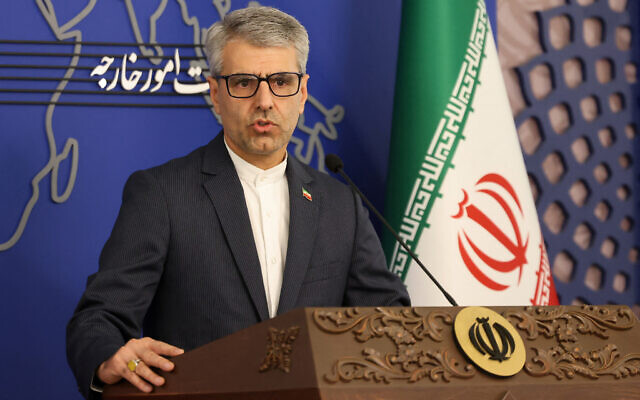
“We must not allow this waterway to be misused again to threaten Iran’s security and national interests,” Baghaei said, adding that the country is “determined to take the necessary measures” to safeguard its sovereignty.
Ships traveling through the vital waterway have come under Iranian attack in recent days.
A vessel operated by Greek shipping firm Dynacom caught fire after it was struck by an unknown projectile eight nautical miles northwest of Oman’s Kumzar overlooking the Strait of Hormuz, maritime security officials said on Monday.
It was the latest in a string of attacks on oil and gas tankers since the United States and Iran re-escalated strikes across the Middle East on July 7 over control of the key conduit.
The cause of the fire was unknown and the crew status was unconfirmed, British maritime risk management group Vanguard said in a statement, adding that regional maritime authorities were investigating.
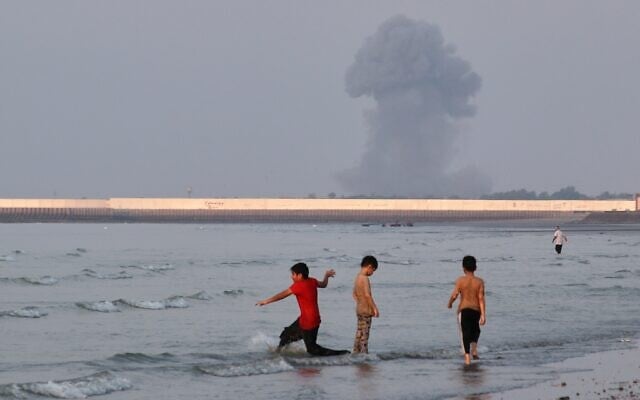
The United Kingdom Maritime Trade Operations agency said the crew safely abandoned the vessel.
Iran’s Revolutionary Guards force also said two oil tankers “exploded” and were immobilized after attempting to take what it called an unsafe southern route through the Strait of Hormuz. On Sunday, the Guards also pointed to two ships involved in an “accident” in the same area.
It was unclear if the two incidents were related.
Separately, Bahrain’s civil aviation body claimed that Iran had targeted its air navigation systems with drones on Monday, though traffic remained unaffected.
During the afternoon, Kuwait’s military said the Gulf country faced another Iranian missile and drone attack.
Iran has launched a series of attacks on Kuwait in the last 24 hours, saying it’s targeting US assets.
In neighboring Bahrain, air raid sirens also sounded, according to the island kingdom’s interior ministry.
Meanwhile, Iran’s Fars news agency reported that explosions were heard in Shiraz, in the southwest of the country.
Report reveals undisclosed US casualties
As tensions continued to escalate, it was revealed that the Pentagon did not disclose that dozens of US soldiers were injured and several helicopters were damaged in Iranian strikes last week, The New York Times reported, citing several anonymous US officials.
Seeming to justify the secrecy, a US military official questioned the Times over why the Pentagon would publish information that could help Iran refine its attacks.
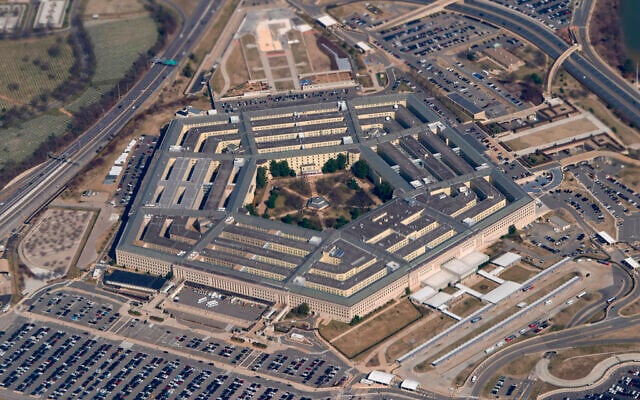
Another US military official said that US Central Command is not required to publish casualty information, especially if the wounded quickly return to duty.
The Trump administration on Monday identified two soldiers killed in action the week prior as part of the US war with Iran, bringing the total number of US servicepeople killed in the renewed fighting to three.
The Defense Department said in a statement that 1st Lt. Tyler James Feehan, 25, of Ewa Beach, Hawaii, and Pvt. Isabella Gonzales, 19, of Carrollton, Texas, were killed in Jordan, where they were supporting a US mission against the Islamic State. It was unclear how they were killed.
The US military announced on Sunday that a servicemember was killed on Saturday in northern Iraq, where the US has military bases, “during a controlled detonation” of a downed Iranian attack drone.
The US military has said the total number of deaths in the war with Iran is 17.