World
Iran said to tell Hezbollah, allies to prepare for wider conflict, which could rope in Israel

Iran has reportedly told its regional allies, including Hezbollah, to prepare for the possibility of a broader conflict amid military escalations with the United States, raising the prospect of Israel becoming directly involved in the fighting.
Leaders of the Iran-backed regional “Axis of Resistance” told allies that the current period of waiting is nearing an end and that preparations for military scenarios have become a priority, Lebanon’s Nidaa Al Watan newspaper reported on Friday, citing information obtained from meetings held in Tehran on the sidelines of the recent funeral of former Iranian supreme leader Ali Khamenei, who was killed when the US and Israel launched the war with Iran at the end of February.
Friday’s report came as fighting between the US and Iran has renewed a month after the signing of a preliminary deal that aimed to end the conflict.
So far, Israel has not been involved in the latest escalation, and Tehran has not directly targeted the Jewish state. But that could change if Hezbollah, Iran’s Lebanese terror proxy, gets involved and resumes its attacks on Israeli territory.
Hezbollah was reportedly instructed to be fully prepared for any escalation, with Iranian officials warning that any future conflict could be broader and more severe than previous fighting.
Nidaa Al Watan also reported that Tehran still views Hezbollah as its most important regional asset following setbacks suffered by Iranian terror proxies in recent months. The terror group joined the wider regional conflict on March 2 by attacking Israel, and has objected to US-led diplomacy between Jerusalem and Beirut to solve the countries’ disputes.
In response to the Hezbollah attacks, Israel hit Hezbollah with heavy airstrikes and took control of a buffer zone in southern Lebanon, meant to distance Hezbollah from the border. Israel also decimated Hezbollah’s leadership in a previous round of fighting in 2024.
Another Iran-backed terror group, the Houthis in Yemen, has also previously attacked Israel.
US strikes Iranian infrastructure; Iran fires at region
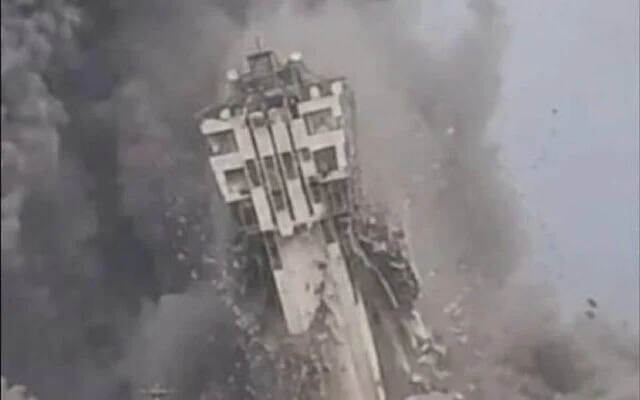
The US has struck Iran for six consecutive nights and has expanded its airstrike campaign by increasingly hitting bridges, part of US President Donald Trump’s threats to start striking infrastructure to pressure Tehran to ease its chokehold on the Strait of Hormuz, the vital waterway for the global energy supply. Iran launched new missile attacks against US-allied nations in the Middle East and warned that its attacks would escalate.
Iranian state media reported Friday that overnight US strikes on infrastructure in southern and western Iran killed eight people, up from the earlier seven reported, and wounded 20 others.
“Some infrastructure in several provinces of the country came under US military attack,” the IRNA news agency said, reporting that six bridges in the southern province of Hormozgan were targeted.
Iran’s energy ministry called on citizens to reduce electricity use after the power grid came under strain following strikes on energy infrastructure in the south.
In response to the US strikes, Iran’s Islamic Revolutionary Guard Corps said it struck US military aircraft stationed in Jordan with ballistic missiles and drones. Iran has fired on several Middle Eastern countries with a US troop presence in response to the American attacks.
In a statement, the IRGC claimed to have destroyed “several US refueling aircraft and fighter jets” and caused “serious damage to many more.” It also called on Jordanians to target “the interests of the aggressive and anti-Islamic Americans” in their country.
There was no immediate comment from Jordan or the US military regarding the IRGC’s claims.

Earlier on Friday, Jordan said it intercepted three Iranian missiles targeting its territory, with no reports of injuries or damage.
The IRGC also said it targeted US radar systems and military aircraft in Qatar to “punish the aggressor.”
The commander of the IRGC’s Aerospace Force vowed that Tehran would not halt its attacks in the region until the US stopped striking Iran’s southern coastline and the Strait of Hormuz.
In a social media post, Majid Mousavi said, “Tehran and the south are one and indivisible as Iran”, adding that “effective and targeted strikes from across Iran against the enemy will continue” until attacks on “the southern coastline and the Strait of Hormuz” cease.
Additionally, Kuwait said that a power and water plant had been damaged by an Iranian attack.
“One of the power and water distillation plants was the target of an attack as part of the Iranian aggression… resulting in a fire, damage and the impairment of several production units,” the Electricity Ministry said in a statement, urging users “to ration their electricity consumption during this exceptional period.”
The country’s army also said that an Iranian drone attack wounded several military personnel in the Gulf state.
The army’s chief of staff “visited several wounded members of the Kuwaiti land forces, who were injured after enemy drones targeted several army facilities and camps this morning, as part of the criminal Iranian aggression,” the army said in a social media post.
سعادة #رئيس_الأركان العامة للجيش يطمئن على صحة عدد من المصابين من منتسبي القوات المسلحة
قام سعادة رئيس الأركان العامة للجيش الفريق الركن خالد درج سعد الشريعان، وسعادة #نائب_رئيس_الأركان العامة للجيش اللواء الركن الطيار صباح جابر الأحمد الصباح، بزيارة عدد من المصابين من منتسبي… pic.twitter.com/U6Zk0ZpXfU
— KUWAIT ARMY – الجيش الكويتي (@KuwaitArmyGHQ) July 17, 2026
Meanwhile, strikes in Iraq’s Kurdistan region killed eight members of an Iranian Kurdish armed opposition group, the exiled party said, blaming the attack on Iran.
Idriss Kohlwazi from the Komala party told AFP that “the Iranian regime attacked with drones and rockets a camp” belonging to the party near the city of Sulaimaniyah in the early morning, resulting in the “martyrdom of eight of our members and wounding others.”
Earlier on Friday, Kurdish forces said they downed eight drones over Erbil, with no damage or casualties reported.
Trump has returned in recent days to his threats to target Iranian power stations and bridges to try to compel Iran to loosen its hold on the strait, through which about a fifth of all oil and natural gas traded once passed in peacetime. The US also reimposed a naval blockade on Iranian ports to halt its shipments of crude oil.
Week-to-week cargo shipments through the strait dropped by almost a quarter at the beginning of the month, according to maritime data firm Lloyd’s List Intelligence, according to data from before the recent surge in violence.
Given the risks, some oil shippers are transiting the strait with their location devices turned off, but many are just staying put, Lloyd’s said Thursday. A growing amount of the region’s energy is being shipped through pipelines, but not nearly enough to offset the decline in shipping through the strait.