World
Iran fires warning shots at 2 ships in Strait of Hormuz as clashes with US intensify

Iran shot at two ships attempting to cross the Strait of Hormuz, and American airstrikes reportedly killed two people in southwestern Iran, as continued clashes cast doubt on diplomatic efforts to bring a complete end to the war.
US President Donald Trump, meanwhile, declared a resumption of the American blockade on Iranian ports, vowing to keep the strait open, and said Washington would be “reimbursed” for doing so.
The ongoing clashes around the Strait of Hormuz again underlined that the waterway, which once saw a fifth of the world’s traded crude oil and natural gas pass through it, remains the key issue in negotiations.
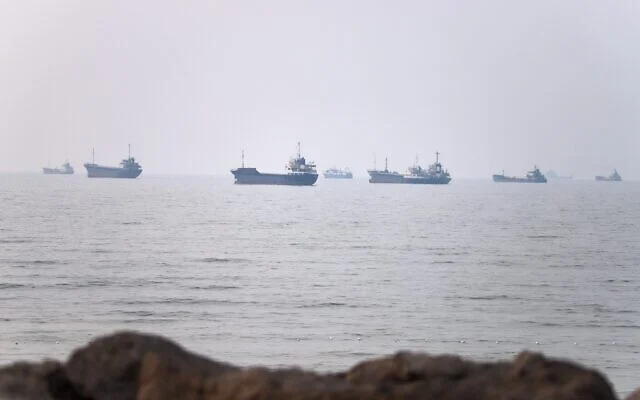
Shipping through the narrow mouth of the Persian Gulf has been disrupted since the start of the war as Iran has maintained a chokehold on it by attacking commercial vessels around it, intimidating shippers.
Iranian state TV reported that the Iranian Revolutionary Guard Corps fired “warning shots” at two ships attempting to cross the strait, as Tehran and Washington continue to battle for control of the strategic waterway. Such attacks on ships in the strait had prompted the US to launch fresh strikes on Iran in recent days, igniting the ongoing clashes.
“This morning, two ships that were attempting to cross the Strait of Hormuz illegally were targeted and stopped by warning shots fired by the navy of the Revolutionary Guards,” said a correspondent on national television based near the strait.
Iran and the US are nearly halfway through the 60-day interim deal period that was supposed to set up talks for a permanent end to the war. Instead, it has devolved into a series of attacks over the strait and its future, worrying world leaders that the war could fully resume.
In an interview on Sunday, US President Donald Trump claimed Iran “agreed to a deal” on Saturday before striking a Cyprus-flagged ship in the Strait of Hormuz.
An Indian crew member is still missing from the attack, and a search operation is underway to find him, Cyprus’s Deputy Ministry of Shipping said on Monday.
The US claimed earlier Monday that the strait was open, while the IRGC sharply rejected the American statement.
On Monday, Trump declared on his Truth Social platform that the US was reinstating its blockade of Iranian ports, and said his country would be managing the Strait of Hormuz going forward, taking twenty percent of the profits in the process.
“The Hormuz Strait is OPEN, and will remain OPEN, with or without Iran,” Trump wrote, countering Tehran’s repeated statements to the contrary.
“We are reinstating the THE IRANIAN BLOCKADE, so named because it is only stopping Iran’s ships or customers from entering or leaving. All other countries will have fair and open use of the Strait,” the president wrote.
“The USA. will be, from this point forward, known as “THE GUARDIAN OF THE HORMUZ STRAIT,” but as such, and as a matter of FAIRNESS, will be reimbursed, at the rate of 20% on all cargo shipped, for any and all costs necessary to do the job of providing safety and security to this very volatile section of the World,” Trump said.
“The process and formation will begin immediately,” he added.
It was unclear who would be paying the US for this effort, or whether it would even be possible to execute it.

In Iran, authorities reported attacks in Hormozgan, Khuzestan and Markazi provinces and said at least two people were killed, according to state-run IRNA news agency. Semiofficial Iranian media also reported strikes in the eastern Sistan and Baluchestan province, which is on the coast of the Gulf of Oman.
US airstrikes also injured three people, the Iranian Fars and Tasnim news agencies reported, citing a Khuzestan province official, who mentioned strikes in “three different locations” on the outskirts of the city of Abadan.
Additionally, Iran’s Mehr news agency reported explosions of an unknown origin near Bandar Abbas and the island of Qemsh, adding that the blasts “appear to be coming from the West Coast of Bandar Abbas.”
The US military said it struck Iranian air defense systems, coastal radar sites, missile and drone capabilities and small boats on Sunday, using aircraft, naval vessels and drones.
Iran’s IRGC said it had targeted US military facilities in Bahrain and Kuwait, destroyed radar systems in Oman, and hit fuel tanks and ammunition depots at Prince Hassan Air Base in Jordan in response to US strikes.
Bahrain said its air defense systems intercepted and destroyed several Iranian missile and drone attacks early on Monday.
Its military accused Iran of targeting civilians with its latest attacks on the kingdom.
“Iran continues its systematic hostile approach through its heinous attacks with missiles and drones that target civilians in the Kingdom of Bahrain,” the general command of Bahrain’s military said in a statement, adding that air defenses “intercepted and destroyed a number of Iranian aerial attacks.”
Jordan said it shot down four Iranian missiles without suffering any damage.
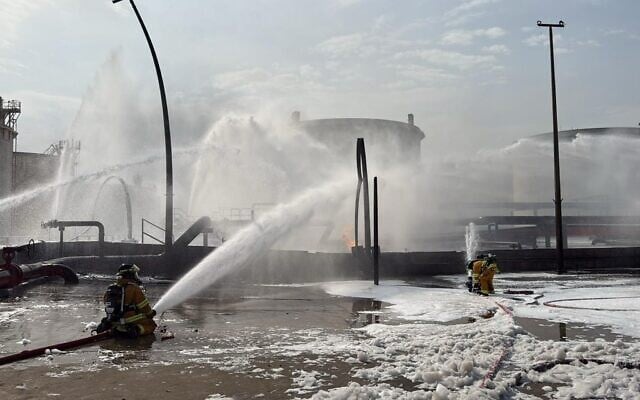
The IRGC accused the US of jeopardizing global oil and gas supplies by interfering in the strategic Strait of Hormuz. IRGC spokesman Hossein Mohebi said Washington had “seriously endangered the security of the world’s oil and gas supply and must be held accountable,” adding in a post on X that Tehran “will continue to exercise sovereignty over and management of the Strait of Hormuz.”
Despite the escalation in violence, Israel still remained on the sidelines of the fighting as of Monday evening, without joining the US strikes in Iran or becoming a target for Tehran’s retaliatory bombing. Israel had no part in negotiating the Iran-US memorandum of understanding, which sought to reopen the strait and launch talks as part of a deal that now appears shakier than ever.
“A return to full-scale hostilities would have catastrophic consequences,” United Nations Secretary-General António Guterres said in a statement on Monday.
The foreign ministers of Germany, France and Britain condemned Iran’s attacks on commercial shipping in the strait and on countries in the region.
“We condemn Iran’s heinous attacks on merchant shipping in the Strait of Hormuz and on countries in the region, including Qatar, Kuwait, Oman and Jordan,” they said in a joint statement.
The group, which is known as the E-3, called for the restoration of the ceasefire and the resumption of negotiations between the warring parties.
Iran says US pressure hindering efforts for joint Hormuz control with Oman
In a briefing on Monday, Iranian Foreign Ministry spokesperson Esmaeil Baghaei said Iran is trying to agree a joint mechanism with Oman for the Strait of Hormuz, but US pressure on Oman has hindered efforts.
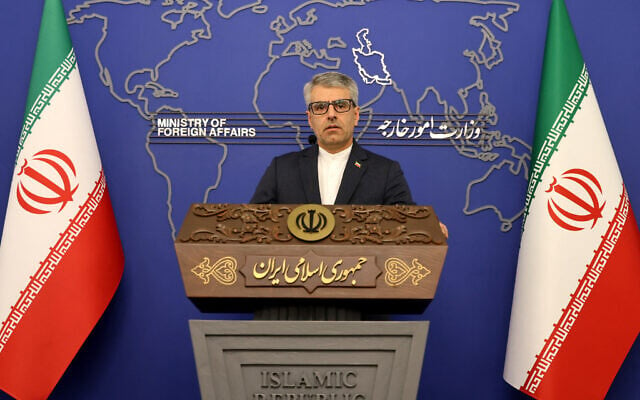
Baghaei also said Tehran was continuing talks with mediators from Qatar, Pakistan and Oman in an effort to prevent any further escalation in the war.
“The role of the mediators is to continue their efforts to prevent an escalation of tensions,” Baghaei said.
“Each time that the other party has failed to meet its obligations, we did not uphold ours… We will continue to act in this manner,” Baghaei said, referring to the memorandum of understanding.
Trump suggested last week that the interim deal in the war was “over.” But mediators, including Pakistan, Qatar, and Egypt, have continued efforts to reach a final agreement to end the war.
A regional official involved in mediation, speaking on condition of anonymity to discuss talks, said efforts to shore up the ceasefire continued Sunday. Pakistan said its foreign minister spoke by phone with Iran’s top diplomat and urged “de-escalation” on both sides.
Iran’s new supreme leader, Ayatollah Mojtaba Khamenei, unseen since the war began, on Saturday vowed in his first statement since the funeral of his father, Ayatollah Ali Khamenei, that Iranians would avenge his killing.