World
Iran begins days-long funeral for Supreme Leader Ayatollah Ali Khamenei

Hundreds of thousands of mourners have begun a days-long funeral for Iran’s Supreme Leader Ayatollah Ali Khamenei, beating their chests in sorrow before the glass case containing his flag-draped coffin in Tehran.
They also called for revenge against Israel and the United States.
The funeral for Mr Khamenei, who ruled Iran for decades before he was killed at age 86 in a February 28 airstrike in the opening moments of the Iran war, could provide a boost for the country’s theocracy and its new supreme leader, his son Ayatollah Mojtaba Khamenei.
That is important as Iran tries to leverage its hold on the Strait of Hormuz in negotiations with the US over a permanent end to the war and as concern lingers that Israel could attack again.
The funeral was delayed as the war raged, and talks appear to be on hold until it is over.
During the ceremony, Iran’s top negotiator warned France and the UK over their comments about potentially launching joint patrols in the waterway, the narrow mouth of the Persian Gulf through which a fifth of all oil and natural gas once passed in peacetime.
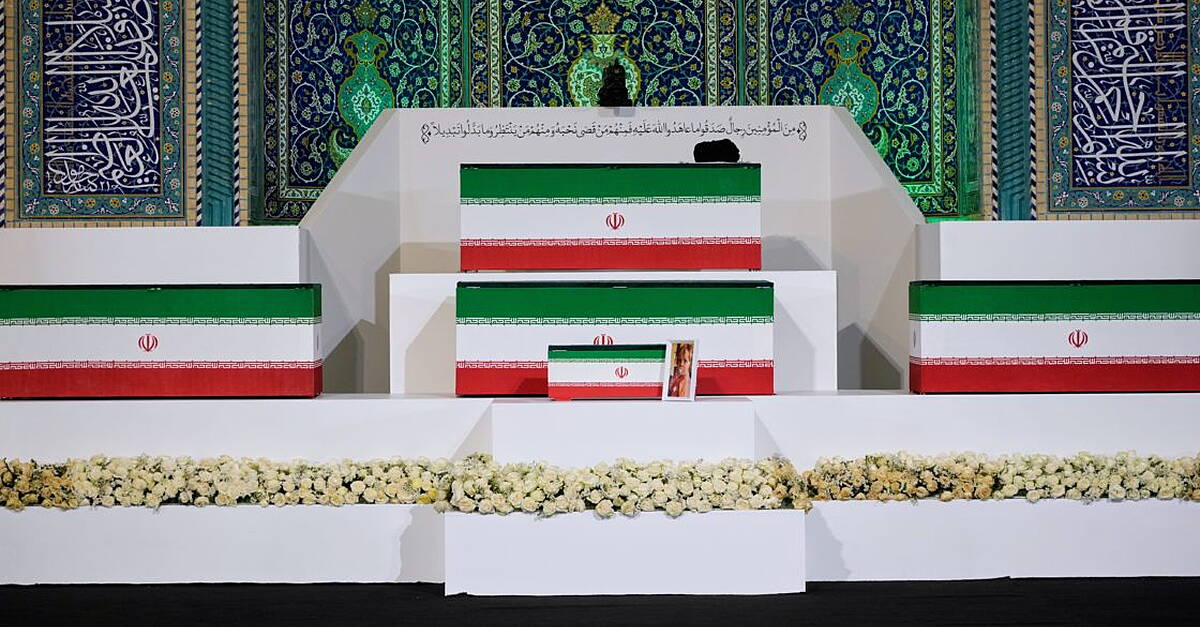
Mourners wept at the sight of Mr Khamenei’s coffin alongside those of his family members also killed in the airstrike, with some chanting: “Our word is one. Revenge. Revenge.”
Some carried banners and flags. Billboards across the city bore Mr Khamenei’s image. Crowds of men rhythmically beat their chests in mourning, a common practice at Shia funerals.

“Imam Khamenei was our heart, our father, our everything,” mourner Masoumeh Mohammadi said.
“I still can’t believe they martyred him. We will not rest until we avenge his death.”
An outdoor stage at the Grand Mosalla resembled the stage where Mr Khamenei once gave his speeches at a husseiniyah at his compound in central Tehran.
There was a chair like the one he once sat in while giving his sermons, complete with a microphone on a stand and a table next to it.
Above it hung an image of the late Supreme Leader Ayatollah Ruhollah Khomeini, who died in 1989.
Mr Khomeini’s funeral saw chaotic scenes as millions thronged his mourning ceremony and trip to the cemetery. Mr Khamenei’s death was only the second time Iran has lost a supreme leader since the 1979 Islamic Revolution.
On Saturday, volunteers sprayed cooling water on crowds in the summer heat. Men and women congregated separately inside the Grand Mosalla after being checked by metal detectors and body searches.
Police with assault rifles stood guard on surrounding streets. Many people stayed outside in the street, lounging under the shade of trees because the city had shut down.
The caskets of his dead family members sat beneath Mr Khamenei’s, which had his black turban atop it, identifying him as a direct descendant of the Prophet Mohammed.

The dead included the wife of Mojtaba Khamenei, whose possible appearance at the funeral remained unclear. He reportedly was wounded in the attack that killed his father and has not been seen publicly since the war began.
“We attended the funeral to show that we are all committed to defend our country and religion,” said one mourner, Ali Kazemi.
As sunset approached, the streams of people continued.
“Authorities advised not to rush to the sites,” said a later visitor, Mohammad Barati.
Mourners had also been advised not to stay too long, to allow others to come.
Iran chose July 4, the 250th anniversary of the creation of the US, to begin the funeral.
While authorities did not acknowledge the timing, crowds at the ceremony in Tehran chanted: “Death to America.”
The refrain has been common in Iran since the 1979 Islamic Revolution and US Embassy takeover and hostage crisis. They also cried: “Death to Israel.”

As the ceremony went on, Iran’s chief negotiator Kazem Gharibabadi criticised a joint statement overnight from British Prime Minister Sir Keir Starmer and French President Emmanuel Macron which suggested their armed forces stood ready to patrol the Strait of Hormuz.
Iran has suggested it wants to charge vessels passing through the strait, upending decades of it being widely considered an international waterway.
“The security of Hormuz lies with the coastal states — the crisis-makers will be held accountable for the consequences of their adventurism,” Mr Gharibabadi wrote on X.
“This is a serious warning.”
Mr Khamenei’s body will be transported to cities in Iran and neighbouring Iraq.
Authorities have shut down streets, airspace and daily life for the mourning, which will end on Thursday as he is buried at the Imam Reza shrine in Mashhad, Mr Khamenei’s place of birth.
Authorities offered no immediate attendance count for the event on Saturday. Other cities across Iran also held mourning ceremonies.
On Sunday, a prayer for the dead is planned at the Grand Mosalla. On Monday, Mr Khamenei’s body and those of his family will be taken through the streets of Tehran, which likely will draw large crowds.
“I am here to say goodbye to my beloved leader Ali Khamenei,” said a weeping Hananeh Mousavi, 27, who attended alongside her mother.
“I never expected to see such a day. I wish I had died before this tragedy.”