Politics
INEC Vows Action After Lecturers Declare Support for APC

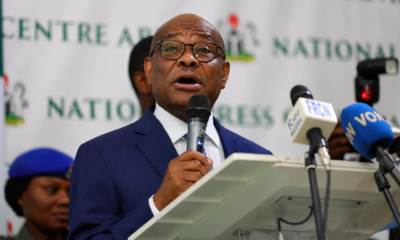
The Independent National Electoral Commission (INEC) is set to examine concerns over the political activities of university lecturers who could be recruited to perform sensitive duties during the 2027 general elections.
The move follows the declaration of support for President Bola Tinubu’s re-election by more than 600 senior academics from public universities across Northern Nigeria.
INEC’s Director of Voter Education and Publicity, Mrs Victoria Ita-Messi, said the Commission would look into reports concerning lecturers accused of openly taking partisan positions and determine whether further action was required.
“Engaging lecturers is a Commission policy,” Ita-Messi said.
She explained that although the involvement of lecturers in election duties remained part of INEC’s established policy, allegations concerning individual officials would not simply be ignored.
According to her, the Commission would examine the reports, establish the facts surrounding the allegations and take appropriate decisions based on its findings. She added that any decision reached would be made public.
The issue emerged after a political gathering in Kaduna at which senior academics declared support for Tinubu’s bid to remain in office after the 2027 presidential election.
The academics were brought together at the Umaru Musa Yar’Adua Centre by Ibrahim Masari, Special Adviser to the President on Political Matters. The meeting focused on the performance of the Tinubu administration and the country’s political direction ahead of the next general election.
At the end of the engagement, the academics said they had considered developments in the economy, security, education, infrastructure and other sectors before announcing their support for Tinubu.
“We resolved to express our support for the re-election of President Bola Ahmed Tinubu, GCFR, in the 2027 presidential election,” they said.
They nevertheless cautioned that their decision should not be interpreted as unconditional backing for every government policy.
“Our support should not be interpreted as a blank check,” the academics stated, while calling for stronger measures to address insecurity, unemployment, food prices and transportation costs.
The endorsement has now raised questions because university lecturers are regularly considered for important electoral assignments, including the positions of Returning and Collation Officers.
Opposition politicians have therefore questioned whether academics who publicly support a particular candidate can maintain the appearance of neutrality if appointed to duties involving the collation, declaration or transmission of election results.
Former Vice-President Atiku Abubakar was among those who warned against deploying lecturers with openly partisan positions as electoral officials.
Peter Obi also raised similar concerns through his media office. His spokesman, Idris Zekeri, said it was troubling that academics who could later be entrusted with electoral responsibilities were publicly declaring support for political candidates.
The African Democratic Congress (ADC) separately asked INEC to make its criteria for selecting Returning and Collation Officers more transparent.
The party acknowledged that university lecturers, like other citizens, have the constitutional right to support political parties and candidates. However, it argued that academics who had publicly endorsed candidates should not be placed in electoral positions where their neutrality could become a subject of dispute.
The ADC also urged INEC to release the names of proposed Returning and Collation Officers ahead of elections so that political parties and members of the public could raise concerns where they believe there may be conflicts of interest.
The party said public confidence in an election depends not only on voters and candidates but also on the neutrality of officials responsible for administering and declaring results.
The development has also prompted ASUU to clarify that the Kaduna endorsement was not an endorsement by the union.
President of the Academic Staff Union of Universities, Prof Chris Piwuna, said individual academics were entitled to participate in politics but stressed that ASUU itself remained politically neutral.
“We will never take such positions, going by our constitution. They cannot mention ASUU. Nobody can mention ASUU in that context because we’re apolitical,” Piwuna said.
He added that lecturers could belong to political parties or support candidates in their personal capacities without making such activities the position of the union.
“Our members can belong to any political party that they want. They can do whatever they want to do under the law. We have never, and we will never endorse any political party candidate. Nobody should drag us into such things,” he said.
Piwuna further rejected attempts to associate ASUU with political activities undertaken by individual lecturers or university administrators.
“It is misleading because ASUU has not sent anybody outside to participate in the electoral duties or serve as electoral officers,” he said.
The Kaduna meeting itself was presented as an assessment of the Tinubu administration, with the academics acknowledging that some of the Federal Government’s economic policies had imposed hardship on Nigerians through increased living and transportation costs and inflation.
At the same time, they said they had observed progress in areas including education financing, agriculture, infrastructure, business support, investment and the digital economy.
The academics also called for more investment in education, healthcare, roads, electricity and agriculture, alongside a broader strategy for tackling insecurity.