World
IDF says strike killed Hezbollah operative who emerged from tunnel in south Lebanon

A Hezbollah operative who emerged from the terror group’s underground facility at the Ali Taher ridge in southern Lebanon was killed in an airstrike, the Israel Defense Forces said on Thursday.
The military said troops of the Egoz Commando Unit spotted a Hezbollah operative emerging from one of the tunnel shafts on the ridge, which is located inside the IDF’s south Lebanon security zone.
“The terrorist posed an immediate threat to our forces,” the IDF said, adding that the Israeli Air Force struck “and eliminated the terrorist to remove the threat.”
The IDF said it continues to operate at the Ali Taher ridge, beneath which Hezbollah has a massive underground complex, where some 30 operatives are holed up. The military said it will “not allow Hezbollah terrorists to exit the underground tunnel network or move in the area of the ridge.”
Also on Thursday, the IDF said sirens that sounded in the Lebanon border communities of Yiron and Avivim were false alarms.
The alerts were triggered by a “false identification.”
צה”ל חיסל מחבל חיזבאללה לאחר שיצא מתשתית הטרור התת-קרקעית ברכס עלי טהאר
כוחות יחידת אגוז הפועלים בפיקוד אוגדה 36 זיהו מוקדם יותר היום, מחבל מארגון הטרור חיזבאללה שיצא מאחד הפירים של התשתית התת-קרקעית הנמצאת ברכס עלי טהאר, במרחב הביטחוני בו פועלים כוחות צה”ל.
המחבל היווה איום… pic.twitter.com/MAefrYhUu0
— צבא ההגנה לישראל (@idfonline) July 2, 2026
Hezbollah dragged Lebanon into the war in March by attacking Israel in support of Iran, resulting in the destruction of large parts of southern Lebanon and the disruption of the lives of those living in northern Israel. US-sponsored efforts to halt fighting between the two sides have reduced hostilities, but have yet to achieve peace or bring the war to a definite end.
Last week, Israel and Lebanon signed a framework agreement committing Lebanon to restoring sovereignty over its territory through the “verified disarmament of non-state armed groups,” which would in turn enable a progressive Israeli withdrawal. The state of Lebanon, along with Israel and the US, signed the agreement, but Hezbollah and its allies are opposed to it.
Prime Minister Benjamin Netanyahu, on a visit to the security zone in south Lebanon on Tuesday, reaffirmed that forces would remain there so long as Hezbollah remained a threat.
Lebanese President Joseph Aoun defended negotiations with Jerusalem on Thursday, saying that Beirut has decided to engage in talks “to guarantee Israel’s withdrawal from its territory.”
“We will not yield a single inch of Lebanese territory,” Aoun declared.
Female troops told to leave before PM’s arrival
Meanwhile, Netanyahu’s visit created controversy after it was revealed that a squad of female troops from an artillery unit currently stationed in southern Lebanon was told to leave the building they were stationed in on Tuesday in southern Lebanon shortly before the arrival of Netanyahu and Defense Minister Israel Katz.
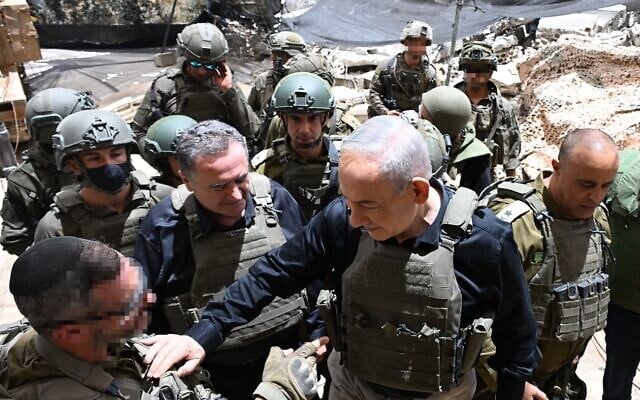
The mother of one of the soldiers told the Kan public broadcaster on Wednesday that the women were told that soldiers from the ultra-Orthodox Hasmonean Brigade would be joining Netanyahu for the visit.
In order to “respect” the Haredi soldiers, the four women were asked to leave the home that they themselves had helped clean and secure for Netanyahu’s visit, the mother told Kan.
For four hours, the girls sat alone in an adjacent house and were not even permitted to go upstairs to avoid a scenario in which the Hasmonean soldiers might “accidentally” see them, the mother said.
The home that was used for the Netanyahu visit wasn’t even in an area where the Hasmonean Brigade was stationed, but organizers of the visit still wanted the troops to take part, as the premier tried to present the unit as a success story, in an apparent effort to blunt criticism of his coalition’s efforts to pass legislation granting blanket conscription exemptions for Haredi yeshiva students.