World
IDF reveals key Hezbollah command tunnel network near south Lebanon’s Beaufort

The Israel Defense Forces on Sunday revealed a major Hezbollah tunnel system near Beaufort Castle in southern Lebanon, which it said was constructed with direct Iranian assistance.
According to the military, the main reason for its raid on the Beaufort Castle area was to capture and demolish the underground site, as well as to prevent the terror group from carrying out rocket attacks on Israel from the area.
“The IDF launched operations in the Beaufort area to achieve operational control over the area, which constitutes a threat to Israeli civilians, and to enable the destruction of the tunnel network,” the military said.
The IDF said the tunnel was “built in a civilian area, in a location that enables operational control over the Galilee panhandle region, only six kilometers (3.7 miles) from Metula, and served as Hezbollah’s center in the area.”
Troops are now working to destroy the “major Hezbollah underground infrastructure site in the Beaufort Ridge area,” IDF Spokesman Brig. Gen. Effie Defrin said in a video statement.
“This is an underground network consisting of several levels excavated deep into the rocky ground. The entire network was built with full funding and planning by the Iranian terror regime over more than a decade,” he said.
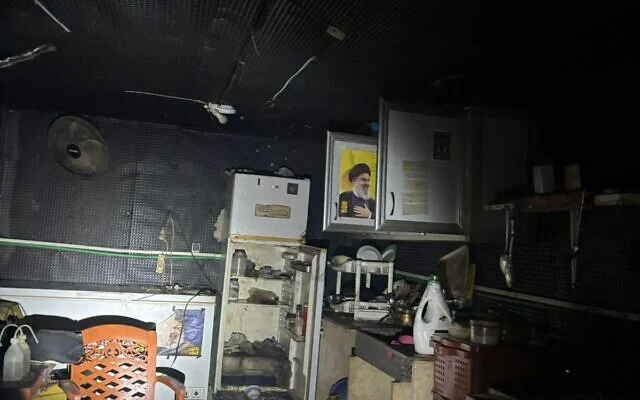
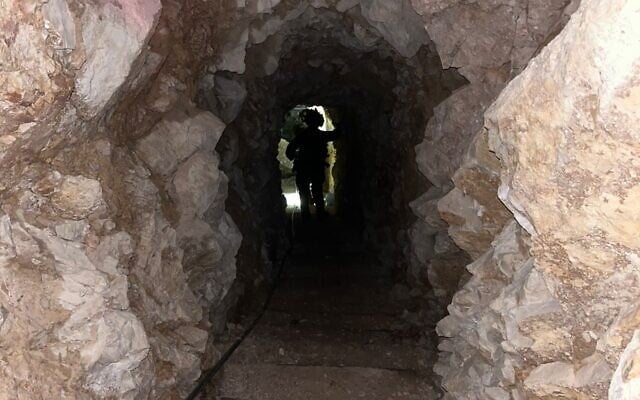
Inside a major Hezbollah tunnel system near Beaufort Castle in southern Lebanon, in footage published by the IDF on June 7, 2026. (Israel Defense Forces)
According to an illustration published by the IDF, the tunnel system is located under the same ridge upon which the castle sits, about a kilometer (0.6 miles) south of the Crusader-built fortress, which Israel captured at the end of May, after having withdrawn from the site in 2000 amid a pullout from southern Lebanon as a whole.
Defrin said the underground site served as a “significant command-and-control center, where hundreds of Hezbollah operatives were stationed.”
The operatives managed the fighting from the site, including during the current war, but fled when the IDF launched its operation, he said.
“We planned the operation for a long time and waited for the appropriate operational opportunity to carry it out. The complex was struck from the air several times, and now, through a ground operation, we are working to destroy it,” Defrin said.
The military said the tunnel featured water and electricity infrastructure, anti-tank and anti-aircraft capabilities, and numerous rooms, including several living quarters, showers, restrooms, an operating room, and kitchens.
Hezbollah also stored weapons at the site, with the IDF reporting that it found a room with anti-tank missiles, a launcher, and other military equipment.
According to the IDF, Hezbollah launched over 400 rockets from the area at northern Israel during the current fighting, as well as drones, shoulder-launched missiles, and anti-tank missiles at troops.
The IDF said that the underground site was constructed “in an area where the Lebanese army operates.”
“As part of efforts to enforce the agreement between Israel and Lebanon, a request was submitted to the Lebanese army to address the site, but Hezbollah clearly prevented it from doing so,” the military added.
The IDF revealed the existence of the tunnels just as the fighting in Lebanon significantly escalated, with a Hezbollah attack on northern Israel drawing an Israeli response in Beirut’s southern suburbs. A few hours later, on Sunday evening, Iran attacked northern Israel, marking its first direct attack on the Jewish state since an April 8 ceasefire agreement.
The IDF has uncovered similar Hezbollah tunnels in the past, including two in April that it said were constructed by the terror group with “direct guidance” from Iran.
Those tunnels were built over a decade, reaching depths of some 25 meters, and were “funded by the Iranian terror regime and as part of Hezbollah’s plan to conquer the Galilee,” according to the military.
The IDF believed the underground sites were intended by Hezbollah for use as a staging ground, where hundreds of terror operatives would arrive when called, gather equipment, and ready themselves to attack Israeli towns. Hezbollah’s invasion plans never materialized.
The latest round of fighting in Lebanon began on March 2, when Hezbollah attacked Israel in response to US-Israeli strikes against the Islamic Republic of Iran, the terror group’s sponsor.
Since then, 30 IDF soldiers and one Defense Ministry civilian contractor have been killed there amid fighting against Hezbollah. Two civilians were also killed by the terror group’s rockets, and an Israeli civilian was mistakenly killed in the north by Israeli artillery shelling.
In Lebanon, the Israeli military has said that it has killed over 2,500 Hezbollah operatives, including hundreds of members of the terror group’s elite Radwan Force, since early March.