World
IDF fires interceptors over Eilat as Iranian missiles target nearby Aqaba in Jordan

Israel launched interceptors on Sunday after fragments from Iranian missiles fired at Jordan’s southern city of Aqaba potentially threatened the nearby city of Eilat, as the escalation in US-Iran fighting showed no signs of abating.
The missiles were intercepted by American air defense systems, according to initial Israel Defense Forces assessments, while the military said it also launched Iron Dome interceptors amid the missile attack to shoot down fragments.
No sirens sounded in Eilat, as the fragments were shot down. Interceptor fragments fell in an open area near the city, without causing any damage or injuries, the IDF said.
The Jordanian military said three Iranian ballistic missiles were intercepted while a fourth hit an open area, according to a statement carried by the official Petra news agency.
There were no reports of injuries in the attack.
Iran launched fresh missile attacks against nations allied with Washington as the US has struck Iran for eight consecutive nights and has expanded its airstrike campaign by increasingly hitting civilian infrastructure. The operations followed US President Donald Trump’s threats to start striking infrastructure to pressure Tehran to ease its chokehold on the Strait of Hormuz, the vital waterway for the global energy supply.
IDF has identified missiles launched from Iran in Jordan’s southern city of Aqaba. Explosions were heard in Eilat from an interception. The IDF warns the public that there may be debris that spills over. pic.twitter.com/DhPKZsqm9x
— Emily Schrader – אמילי שריידר امیلی شریدر (@emilykschrader) July 19, 2026
So far, Israel has not been involved in the latest escalation, and Tehran has not directly targeted the Jewish state.
Echoing similar comments by Prime Minister Benjamin Netanyahu, Defense Minister Israel Katz said Sunday that Israel would respond powerfully to any attack by Iran.
“If Iran fires missiles at Israel, we will attack them with full force,” Katz said during a visit to a rescue service facility. “If the United States changes its policy, which is also something that could happen, we are prepared for both defensive and offensive” action against Tehran, he added.
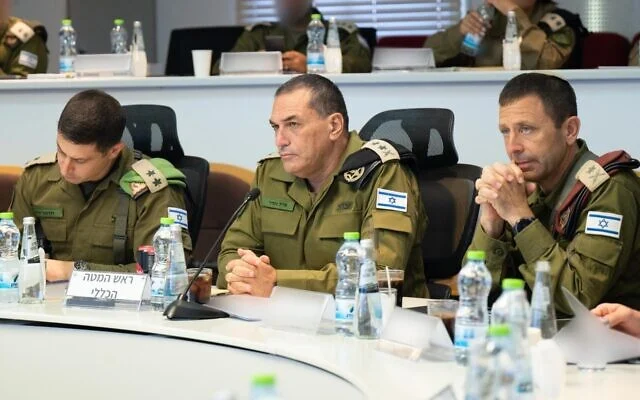
IDF Chief of Staff Lt. Gen. Eyal Zamir said the military is “closely monitoring the developments in Iran and maintaining a high level of readiness.”
“We monitored the launch toward the Aqaba area today, and our air defense array is on alert to protect the citizens of Israel,” Zamir said during a visit to the West Bank today, according to remarks provided by the military.
“We are prepared to immediately resume fighting and will act with great force against anyone who harms us,” he added.
The US said strikes overnight Saturday-Sunday were intended to “punish” the IRGC for a deadly strike that killed two US military personnel in Jordan and left another missing.
Iran’s Atomic Energy Organization on Sunday condemned a US attack on the site of the nuclear power plant under construction in Darkhovin, saying the strike violated international law, Mehr news agency reported. It did not say when the strike occurred.
Construction of the plant in southwestern Iran’s Khuzestan province began in 2022.
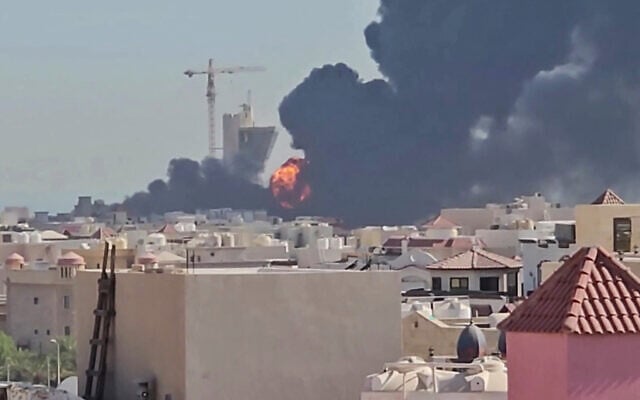
In response to the latest strikes, Iran carried out a drone attack that targeted US military assets and equipment at Kuwait’s Al-Adiri camp and Ali Al Salem Air Base, Iranian state TV reported early on Sunday. Both bases have been targeted as part of Iran’s attacks against US assets and allies in the Gulf since last week.
Kuwait’s Electricity Ministry said a desalination plant had been attacked for the second day running, causing a fire. Kuwait’s armed forces said earlier they had again intercepted Iranian missiles, after a sustained Iranian attack on Saturday.
Bahrain’s air defenses also intercepted an Iranian attack on Sunday, its state TV reported.
In recent days, both sides have taken aim at shipping traffic, with the US saying it is enforcing a naval blockade on Iran and Tehran saying it targets vessels violating its rules on navigating the Strait of Hormuz, which usually handles one-fifth of global oil supply.
The IRGC said on Sunday that four vessels had attempted to transit the strait via an “unsafe route” with US backing after ignoring IRGC warnings. It said two had abandoned the attempt while the other two were involved in an “accident.” It did not elaborate.
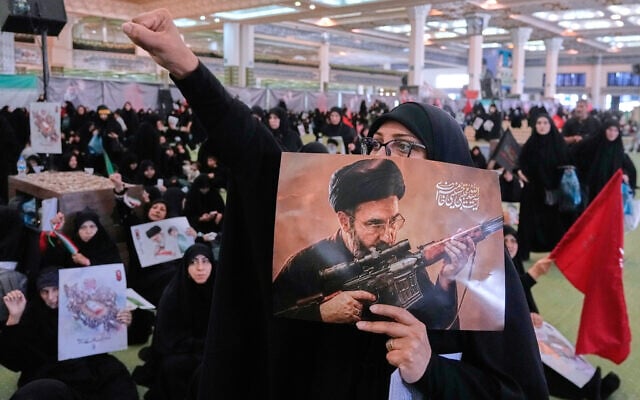
New supreme leader Mojtaba Khamenei reportedly ‘not in Iran’
An Israeli security source cited by the Saudi al-Hadath outlet on Sunday said Iranian leader Mojtaba Khamenei “is not in Iran.”
Khamenei, who was appointed supreme leader shortly after his father was killed in US-Israeli strikes on February 28, which sparked the war, has only communicated via written statements since, and has made no public appearances.
The source told al-Hadath that Khamenei’s messages are written by the new Islamic Revolutionary Guard Corps chief Ahmad Vahidi, and other members of the IRGC.
“Iran’s internal divisions are deep and threaten the existence of the Islamic Revolutionary Guard Corps,” the source was cited as saying.
The Israeli source also said that the US does not want Israel to participate in strikes on Iran, even if Tehran attacks Israel.
Separately, Iran’s Foreign Minister Abbas Araghchi said Sunday that an intelligence breach that allowed Israel to assassinate the senior Khamenei has likely not been patched.
In a Persian-language interview, Araghchi said that he told President Masoud Pezeshkian on the morning of February 28 that “the atmosphere is war.” He said that he then met with Khamenei aide Ali Asghar Mir Hijazi at 9 a.m., shortly after which Israel carried out the deadly attack on a Tehran compound where Khamenei was having a high-level meeting.
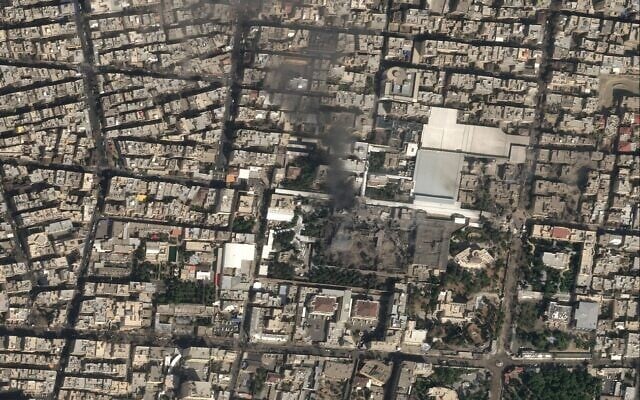
Araghchi said that at the time of the strike, Khamenei was in his office, the advisory Strategic Council for Foreign Relations was holding its weekly meeting, and the Defense Council had also convened.
“Holding simultaneous meetings was not unusual in those days,” said Araghchi, “but the enemy’s knowledge of these meetings was the result of an information breach that probably still exists.”
Araghchi also said that he has yet to meet with Mojtaba Khamenei in person: “Only a handful of people have met him,” he claimed.
The US and Israel together launched a campaign against Iran on February 28 to degrade the regime’s military capabilities, distance threats posed by the country — including its nuclear and ballistic missile programs — and “create the conditions” for the Iranian people to topple the regime, the military and other Israeli leaders have said.
Israel respected the US-Iran ceasefire that began April 8, and the government, while not included in the process of negotiating the US-Iran memorandum of understanding signed last month, did not object to it even though it purported to bind both the US “and its allies.”