Trends
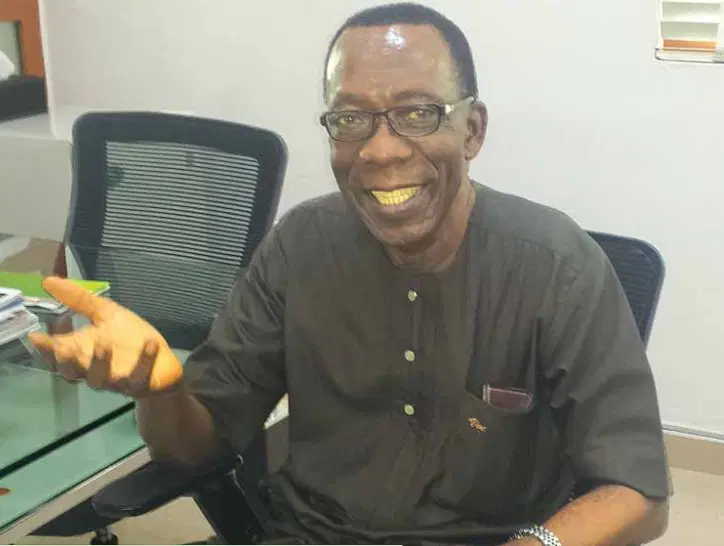
I Walked Away From Power Rather Than Compromise My Integrity —Octogenarian Eburajolo

Few Nigerians have witnessed the country’s economic evolution as closely—or participated in it as actively—as Victor Eburajolo. For more than five decades, the industrial relations expert, corporate executive, manufacturing advocate and public servant occupied a front-row seat as Nigeria journeyed from an agrarian economy to industrial ambition, through the Structural Adjustment Programme, trade liberalisation, the decline of the textile industry and successive waves of economic reforms.
Along the way, he earned a reputation for something increasingly rare in both the corporate and public sectors: an unwavering commitment to integrity.
Now, as he marks his 80th birthday, Eburajolo reflects on a lifetime of leadership, service and conviction. Speaking with the candour of a man who has little left to prove, he recounts challenging the chairman of a multinational company over the meaning of loyalty, explains why he resigned from the Nigeria Social Insurance Trust Fund, NSITF, rather than compromise his principles, and revisits the warnings he issued decades ago that Nigeria’s embrace of structural adjustment and global trade liberalisation, without adequate preparation, would undermine local manufacturing.
In this wide-ranging interview with Vanguard, Eburajolo offers a candid assessment of Nigeria’s economic leadership, industrial policy, labour relations, entrepreneurship and governance.
He speaks passionately about the need to place national interest above personal gain, argues that integrity remains the foundation of effective leadership, and insists that despite decades of missed opportunities, Nigeria’s future remains bright.
More than an account of one man’s remarkable career, this is a conversation about the choices that have shaped Nigeria, the lessons history still offers, and the values that can guide the country towards a more prosperous future.
Throughout the interview, Eburajolo returns to the simple philosophy that has defined every major decision of his life: whatever your hand finds to do, do it as unto God.
As you mark your 80th birthday and look back on more than five decades in industry, corporate leadership, and public service, what moment do you consider the defining moment of your journey, and what values have guided your decisions throughout your career?
One experience captures the values that have guided me throughout my life.
One day after church, as I was walking to my car, eight young men from the congregation approached me. They said: “If you don’t mind, we would like to follow you home. We have some questions for you.” They came to my house, we sat down together, and they asked me a simple question: How did you become so successful in your career and in life?
I smiled and said, “Thank God we have just come from church.” I reminded them of what the Bible says: “Whatever your hand finds to do, do it as unto God.” If you live by that principle, God will direct your path.
That has been the foundation of my life. Everywhere I have worked, I have never looked at my boss as the person who would determine my success. My duty has always been to do my work with excellence and integrity, as though I were working for God. When you embrace that mindset, it gives you the courage to tell the truth, even when it is difficult.
I remember an incident about 12 years ago when I was a director at the Kewalram Chanrai Group. We had been invited to the chairman’s house. During the conversation, he said he expected every director to be loyal to him personally. I was the only Nigerian in the room. All the other directors agreed, but I remained silent.
He noticed my expression and asked:
I replied respectfully, “Sir, with due respect, I don’t believe our loyalty should be to you personally. Our loyalty should be to the organisation. If we are all loyal only to you, and one day you make a decision that could ruin the company, no one will have the courage to challenge you. We would all go down together.”
He paused for a moment, reflected on what I had said, and then responded: “Thank you. You are right.”
Not everyone would have had the confidence to disagree with the owner of the company in that situation. The courage came from my conviction that I was speaking the truth and acting in the best interest of the organisation.
That is also the message I shared with those young men. I told them never to see success as a destination. Success is a continuous journey. The moment you think you have arrived, you begin to fall behind.
Many young people know the story of Kodak. It was once a global leader, but while it was enjoying its success, others were innovating and adapting. Eventually, they overtook Kodak, and the company never fully recovered. That is a reminder that success demands continuous learning, improvement, and the humility to keep growing.
Those principles—faith, integrity, courage, and a commitment to continuous improvement—have guided every important decision I have made throughout my career.
When you look at Nigeria today and compare it with the country in which you began your career, what emotions come to mind—pride, disappointment, hope, or something else?
Nigeria’s greatest challenge, in my view, is that too many people in positions of authority are more concerned with pleasing the Western world than advancing our own national interests. Without realising it, we sometimes end up selling ourselves short.
Take the events surrounding the June 12 election. Many people may not realise that Moshood Abiola spoke openly during his campaign about seeking reparations from countries he believed had historically exploited Africa. Whether one agrees with that position or not, it was a significant part of his message.
I remember reading an article in a British newspaper that focused not on his policies but on his personal life—his wives and children—and questioned whether he was fit to lead Nigeria. My reaction was simple: what relevance did that have to the issues Nigerians were trying to address? Too often, external narratives shape perceptions of our country, and we allow them to do so.
The same pattern has played out in sectors such as the textile industry, where we have too often failed to protect and develop our own economic strengths. In many cases, we know what needs to be done but lack the resolve to do it.