Trends
“I Thought Ghana’s Stronger Currency Would Make Life Easier. I Was Wrong” – Abroad Life

The Nigerian experience is physical, emotional, and sometimes international. No one knows it better than the amazing people on #TheAbroadLife, a series where we detail and explore Nigerian experiences while living abroad.
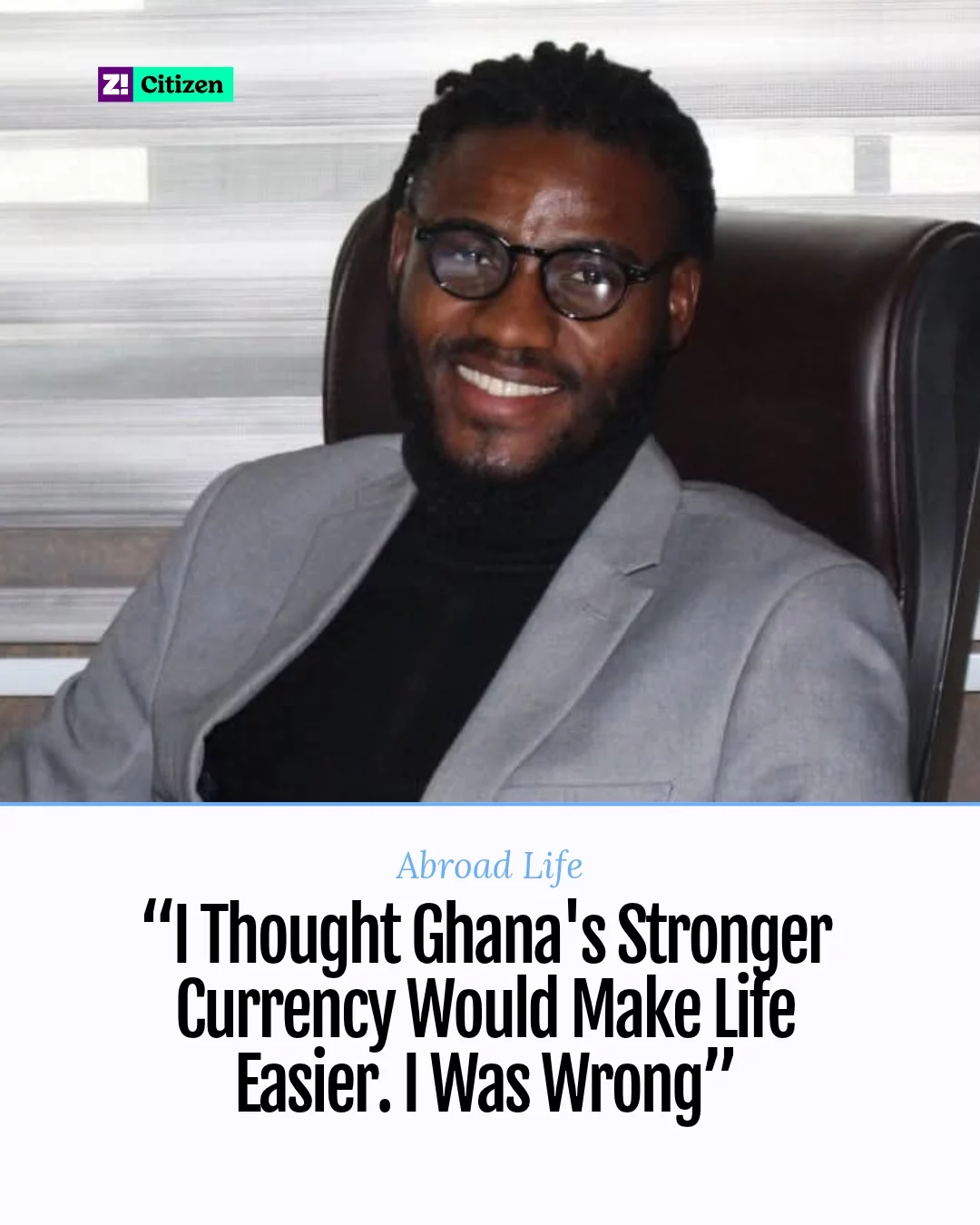
E-Jay (29) has lived in France and Côte d’Ivoire before settling in Ghana. From pretending to like Shatta Wale to avoid trouble to having a traditional marriage with a Ghanaian woman, he tells us about navigating life as a Nigerian in Ghana and the things he misses about home.
I live in Cape Coast, the capital of Ghana’s Central Region. I’m a curious person, so I’ve moved around quite a bit. My first international trip was to France for tourism in November 2024. France felt like a European capital of Africa because of the large number of Africans living there.
After that, I moved to Abidjan, Côte d’Ivoire, where I spent about a year despite being an English speaker. I’m now based in Ghana, where I don’t need a Google Translate app to communicate.
That was April 2025.
Yes. I’ve always wanted to explore beyond Nigeria’s borders. I sometimes identify as a cosmopolitan.
It was okay at a point. Before I left for France, there was a massive layoff at the New York-based tech company I worked for remotely. I thought I was immune because I was the creative director, but when the layoff letters came in, all the Nigerians were laid off.
I had literally sacked people myself before, but this time, I experienced what it felt like to be in their shoes. Then I had to deal with paying half a million naira in rent for a duplex in Osogbo without any income coming in. That became my next headache, and I realised there was nothing much Nigeria has to offer the youth.
For me, Nigeria is facing serious issues as a state. I’m not saying other countries are better overall. We can see the situation facing young people in France and the high unemployment rates in Côte d’Ivoire, Benin, Togo, Ghana and other African countries. These are countries I’ve visited, and they’re not necessarily better off.
But life in Nigeria is unnecessarily very tough. A large percentage of the population can relate to that reality.
Yes, I could say that. I lost the job that was sustaining me and it was hard trying to figure things out.
Then I developed a friendship with a politician’s son in Ghana through my TikTok live. He was willing to help me get settled should I ever decide to relocate to Ghana. So, it naturally became easy to leave Nigeria because I had accommodation sorted out, a friend waiting to welcome me into his family, and a whole community in Ekumfi District Area. But then, I decided to try other countries. It was when they didn’t work out that I decided to move to Ghana.
With what I had left, I wanted to explore Italy and try my luck there. I even worked toward a 10-year passport because the plan was to stay longer in Europe on a work permit visa. Before considering Italy, I was also close to starting a relocation process to the United Arab Emirates (UAE) with a budget of under ₦3 million. Like the Italian offer, it came with a job and accommodation.
Unfortunately, after I dropped the UAE option in favour of Italy, the person handling my documents in Italy relocated to Turkey. I was left stranded in the middle of the process, having wasted a lot of resources. Regardless, I’ve always wanted to explore beyond my home country. France worked out, but honestly, I also wanted to test the waters and see what life was like on the other side.
Ghana was a last resort. There was nothing particularly special about it at first, except that it was close to home, relatively affordable to move to, and its currency was performing better than the naira. So I thought, why not?
The main reason was never about proximity. It was really about my analysis of Ghana’s economic growth and where I saw it going. The business opportunities for Africans and how much my potential success could enable me to invest back in both countries.
My budget for France was just ₦2.6 million. I also had support from friends who helped ensure I had enough money reflected in my bank statements. The process was cumbersome and tiring. I spent just one week in France. In Côte d’Ivoire, I secured a gig with a fashion brand strategist from Switzerland. It felt good to start earning a decent income again.
However, the system there was similar to France’s. I wasn’t used to paying rent, electricity and water bills every month. I was paying about ₦300,000 for a self-contained apartment every 30 days.
I could afford to relax occasionally, and my job gave me opportunities to do so. I was always around models who loved the sound of Nigerian Pidgin English and the little French I managed to speak.
On moving to Ghana, I had managed to save up to ₦1.3 million from my job in Ivory Coast. CFA was three times more than Naira. With accommodation sorted out, and all thanks to the ECOWAS visa-free agreement, I didn’t get to spend as much as I did for France.
My family found out after I had already arrived. They were quite surprised but they were already used to my spontaneous travels even within Nigeria. I’ve visited all four cardinal points of my home country.
Accra is dope. It was the first place I stayed before moving to Cape Coast. I love the clean beaches, especially the free public ones. I also enjoy a particular beer, and I like how drinks have barcodes on their bottle caps. Those impressed me.
The culture shock goes beyond how the food is prepared or how almost every woman I’ve seen makes me turn my head to admire their figure. God is great! But the biggest surprise has been how much Ghanaians actually like Nigerians.
At first, I was worried about how I might be treated, knowing the history behind the Ghana-must-go saga. But I discovered that Ghanaians genuinely like us. Forget the social media banter.
Hmm, I had Ghana jollof rice from two special places. My friend’s family house and a lady I grew fond of. There are levels to this jollof debate. Ghana wins on this one.
Ahh, not at all. I’ve tasted both and I just feel like Ghana jollof is better.
The biggest challenge was finding a job. Ghana’s policies are designed to prioritise Ghanaians, which is understandable. Without a Ghana Card, you can’t easily secure a job.
Before I started building my tech brand, Blackbox Group, I managed to get a job through a friend at a fishing company. I could earn between 100 and 300 cedis a day, which was around ₦10,000 to ₦30,000 at the time. However, currency conversion and reality don’t always align. Eventually, I used what I could earn to bootstrap Blackbox in the blue-collar industry.
It’s a national policy. It’s a common experience for most Nigerians. Nigerians go as far as looking for ways to obtain the national card illegally out of desperation.
I haven’t gotten it. Getting a Ghana Card literally means you’re becoming a citizen. So there are a whole lot of processes involved. But they also offer a similar card known as the non-citizen Ghana Card. I’m in the process of getting that instead. It doesn’t come with all the benefits of having a Ghana Card, but it still gets you some things.
I had a bit of a soft landing in Ghana through the relationship I had built with the politician’s son. So I didn’t really struggle with rent initially, and I settled quite comfortably. However, accommodation can be expensive when converted from cedis to naira, depending on the location.
As it stands, Cedis ranks among the top 10 strongest currencies in Africa when compared to the USD. That’s currency value in theory.
Although the cedi is stronger than the naira against the US dollar, that doesn’t necessarily mean Ghanaians have greater purchasing power. The cost of goods and services in Ghana can still be higher than what Nigerians pay for the same things at home.
Back in Nigeria, I can afford to relock my hair with a stylist for as low as, say, ₦5,000 in Abuja, or less somewhere like Osun. And these are even at salons where you get great services. In Ghana, it was a different experience. Even in the countryside, the lowest charge for dreads relocking begins at 100 Cedis. That’s a bit above ₦10, 000.
Back in Nigeria, I can afford to relock my hair with a stylist for as low as, say, ₦5,000 in Abuja, or less somewhere like Osun. And these are even at salons where you get great services. In Ghana, it was a different experience. Even in the countryside, the lowest charge for dreads relocking begins at 100 Cedis. That’s a bit above ₦10, 000.
Electricity is stable, and some basic social amenities are easily available in Ghana compared to Nigeria. However, they can be quite expensive compared with what you would pay for them in Nigeria.
The advantage of earning in cedis becomes more noticeable when you work remotely and earn an income that doesn’t depend on the realities of the local economy. Otherwise, you have to deal with the cost of living there.
Yes, I have a few gigs , but I also have a personal project that’s running.
I wouldn’t say I have. Although you have to know how to navigate some conversations as a foreigner; otherwise, you will find yourself in trouble.
One is publicly saying you don’t like Shatta Wale or that you prefer Stonebwoy; that can get you into trouble as a Ghanaian, let alone as a Nigerian who takes pride in Nigerian music.
I’ve found myself in situations where I had to admit that I liked Shatta Wale because I could sense the possibility of violence from a mile away. As an independent artist too, I’ve also learnt to understand why Shatta Wale is so loved. Particularly among the Ga people, he makes them believe that nothing is impossible.