Trends
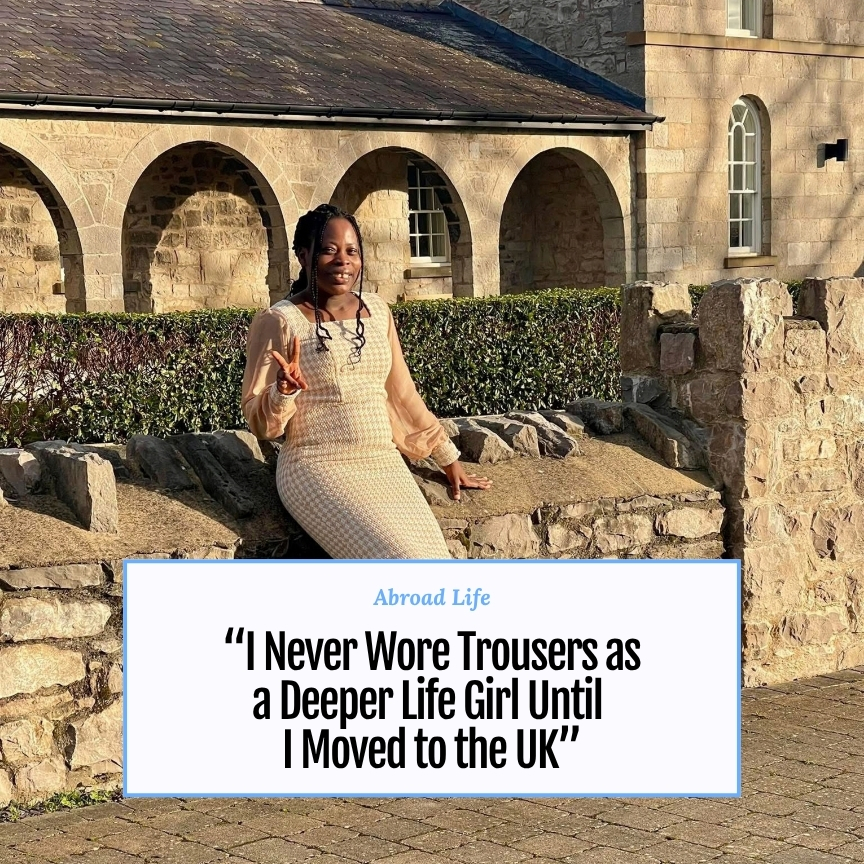
I Never Wore Trousers as a Deeper Life Girl Until I Moved to the UK

The Nigerian experience is physical, emotional, and sometimes international. No one knows it better than the amazing people on #TheAbroadLife, a series where we detail and explore Nigerian experiences while living abroad.
Pelumi (30) moved to the UK in 2021 to study for a master’s degree at the University of Stirling. From adjusting to winter and learning to navigate Scotland to failing her final research module, extending her student visa and eventually graduating a year later, Pelumi says her journey has been one of perseverance, faith and learning to adapt.
I am currently in the United Kingdom (UK), and I left Nigeria in September 2021.
I got a scholarship for my master’s degree in Human Resource Management at the University of Stirling, Scotland.
No, not at all. I didn’t plan to travel out of the country. After I finished my Higher National Diploma (HND), I felt I couldn’t just be comfortable with having only an HND. I wanted academic advancement. At the time, I was trying to do a conversion programme in Nigeria with my HND.
It was my brother who encouraged me to try applying for a master’s in the UK. At first, I was like, “Is it really possible?” He told me to give it a try because I had finished well with my HND.
I applied to so many universities and got about six rejections before the University of Stirling in Scotland gave me admission.
They were very happy. They were really proud of me and happy that I was going for my master’s.
It was a normal feeling to wonder whether I was making the right decision, but I had already prayed about it. I’m someone who takes prayer very seriously and wants to understand what God wants me to do.
Even while applying for the master’s, I prayed that if it was God’s plan for me, everything should work out. When I started getting different rejections, I wasn’t even too bothered. I just thought maybe it wasn’t God’s plan for my life, or maybe it wasn’t my time.
Then, when the time came, things started aligning, and I got the admission.
On the night I was leaving, I was worried because I was only 25 and travelling to a new country alone. I had no friends or siblings going with me. But I knew that if God was taking me there, He would sort everything out for me.
It was a scholarship, but not fully funded. I received a 20% scholarship, while my family funded the rest. I was 25 at the time, had just finished my national service, and wasn’t working; I was not married or anything, so there was no way I could have funded it myself. What makes it interesting is that I applied for my master’s with my HND.
It was possible. Applying for a master’s degree with an HND usually requires having a Distinction or a strong Upper Credit, a good Cumulative Grade Point Average (CPGA), and a strong personal statement. Also, you will be fine as long as you make sure you are applying for a master’s course that is relevant to the course you studied in your HND. These things can make a big difference when your application is being considered.
My story is really a long journey of perseverance. My sister went to Obafemi Awolowo University (OAU), and my brother went to the University of Abuja, while I was the only one who attended a polytechnic. I went to a polytechnic but became the first person in my family to get a master’s degree.
I didn’t initially plan to have an HND. After my National Diploma (ND), I finished with a 4.0 and was the second-best student in my department. I tried to use direct entry to study Public Administration, but I wasn’t given admission.
My mum would always tell me that God had a plan for my life and that I should trust Him. So when I couldn’t get the direct-entry admission, I returned for my HND and made sure I finished well.
I tried again during my HND and still wasn’t given admission. At that point, I decided to stop chasing it and focus on doing well with my HND.
Then I started looking at other options, including conversion programmes. Eventually, I got the opportunity to apply for a master’s in the UK.
So when I eventually graduated, it meant a lot to me because I knew everything I had gone through to get there.
It was a long journey. A very long journey. For me, it was a journey of perseverance and not giving up. Sometimes when I think about everything, I just thank God.
I was happy that I was finally in the UK, but I won’t lie, there were many challenges. There were so many things I needed to adapt to.
The first challenge for me was dressing. I’m a Deeper Life church girl, so I didn’t wear trousers. I had never worn trousers in my life. Then I arrived in the UK during winter.
I remember one day I went out and eventually had to take a taxi back home because I was struggling with the cold. For about six months, I kept thinking, “No, I will stay true to myself.” But eventually, I had to reconsider some things.
Initially, I would wear leggings underneath my gown or skirt. That was how I managed myself for a while. But I knew I couldn’t continue like that. So, when I started wearing trousers, I convinced myself that there was nothing wrong with it. For me, it became a matter of personal conviction. I still believe people should dress modestly and not expose their bodies, but I also believe everything should be done in moderation.
The Big Daily is your weekday shortcut to the biggest news shaping Nigeria. We cut through the noise, connect the dots, and explain why the news actually matters, all in one quick read.
No, they have no problem with it. I still attend Deeper Life church in the UK. I’m married now and have children, but we still attend the church. I didn’t change churches because I moved to the UK.
I think the environment plays a role. The UK is different from Nigeria. I’ve talked about this a lot on Facebook, and people have had plenty to say about it. I also believe it comes down to personal conviction. For instance, you can wear leggings but not trousers, right? But what’s actually the difference between the two?
Also, if you’re a Christian, you have the Holy Spirit, and you should be able to know what is right for you.
I’ve never used attachment before, but I started using it when I got to the UK. People have different opinions about these things, but for me, it’s about personal conviction.
Navigation was another major one. In Nigeria, I didn’t really use Google Maps, but in the UK I had to learn quickly.
The first time I went to work, I went to a completely different place. I was stranded and eventually had to go back home.
Food was another issue. At the time, there weren’t as many African shops as there are now. I was a student and didn’t have much money, so I couldn’t afford to keep shipping food from Nigeria. I had to start eating some Scottish food.
There were a lot of differences. One of the first things I noticed was that almost everything was done online.
There were a lot of differences. One of the first things I noticed was that almost everything was done online.
In Nigeria, some assignments are submitted as hard copies, but in the UK, you submit assignments from your laptop. Tests and quizzes are also done online. Basically, everything is on the laptop.
If you’re someone who doesn’t know how to use a laptop or find your way around one, you could struggle a lot. I didn’t struggle too much, but it was still a bit challenging sometimes.
The biggest challenge came towards the end of my studies when I had to retake my research module. It was the toughest period of my entire life.
In the UK, when you fail a module, you can be asked to resubmit it again one more time. I got 40 at first, and resubmitted again, and I think I got 44. Then I received an email telling me that I had failed the module again and that my points were no longer enough for my master’s degree.
At that point, I had two options. I could retake the course the following year, or I could accept a postgraduate certificate instead. So, if the points for a master’s is 170 and you got 140, they’ll advise you to collect a certificate instead if you don’t want to retake the course.
It was a very difficult decision because it was also going to affect my visa. If I wanted to retake the course, I would need to extend my student visa and undergo the whole process all over again.