
World
High Court rules state comptroller exceeded his authority in several Oct. 7 probes

The High Court of Justice ruled on Monday that State Comptroller Matanyahu Englman cannot complete and publish his examinations of eight key issues relating to the failures that resulted in the October 7, 2023, Hamas invasion and massacre.
The court’s ruling brings an end to an extended legal battle over Englman’s efforts to review the central failings behind the catastrophe, which he insisted was critical due to the lack of any other state-backed inquiry, but which critics said were not part of his remit and could prejudice a future state commission of inquiry.
The court determined that Englman exceeded the authority of the state comptroller in conducting examinations of four issues: Israel’s funneling of Qatari money to Hamas in Gaza prior to the attack; border defense along the Gaza border; the conduct of intelligence agencies and government officials in response to information about a possible Hamas attack; and the response of the government, Shin Bet and IDF to the attack.
The court ruled that the state comptroller’s authority is primarily to review and compare actions of government and state agencies with prevailing norms, not to conduct investigations that aim to uncover the factual reality of an event. The court also found that the state comptroller’s authority does not extend to issues of policy and strategy regarding security and foreign affairs.
The court ruled that four other reports produced by Englman in relation to the October 7 catastrophe cannot be published in their current format, and must be conducted anew since Englman and his office failed to speak to key officials before drawing up the draft reports.
The reports in question reviewed the government’s public diplomacy efforts in the international arena; the treatment of civilians killed on October 7; the permit issued to the Nova music festival by Kibbutz Re’im, where 378 people were murdered, and the security arrangements for it; and defense preparedness for southern cities.
Englman is slated to release a new report Tuesday afternoon that examines the evacuation of wounded to hospitals on October 7, the rehabilitation of those wounded during the war, and the government’s coordination with volunteer organizations throughout the conflict.
The comptroller’s probes were controversial from the get-go, facing claims that they were severely flawed, would taint evidence and the investigative process, and that only a state commission of inquiry could properly investigate the disaster. They also drew scrutiny because Englman was appointed under a government led by Prime Minister Benjamin Netanyahu.
More recently, the state comptroller’s probes into October 7 have come under heavy political scrutiny amid Netanyahu’s refusal to establish a state commission of inquiry into the worst attack in Israel’s history.
The government is instead moving ahead to pass legislation that would create a politically controlled probe of the Hamas attack and aftermath, which the opposition has vowed to boycott and which is opposed by many family members of October 7 victims — some of whom have joined an appeal to the High Court in an effort to force the government to establish a state inquiry.
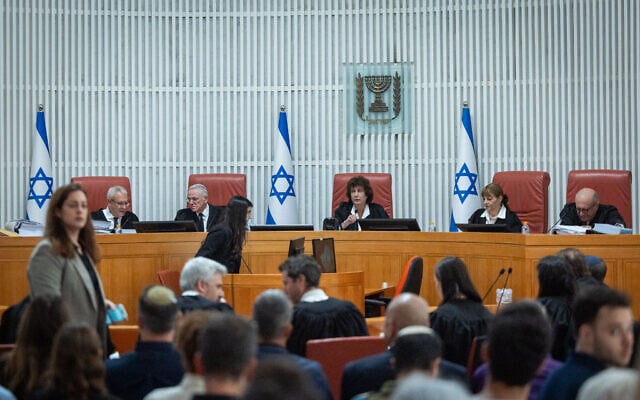
In a heated hearing last month, High Court justices challenged Englman’s conduct in his investigations as well as his authority to carry them out.
The Military Advocate General’s Corps’ Military Defense unit and the Movement for Quality Government in Israel petitioned the High Court in September to halt Englman’s probe into the events of October 7, alleging that there were “substantive flaws” in his information-gathering processes, and arguing more broadly that the ombudsman has neither the remit nor the competence to conduct such inquiry.
The petitions were filed following revelations last August that Englman’s probe had drawn up draft reports on his review of the key issues and found former IDF chief of staff Herzi Halevi responsible for at least some aspects of the catastrophic invasion, without ever having spoken with him.
In December, the High Court issued an interim ruling ordering Englman to freeze his ongoing probes into October 7, and ordering him to justify more broadly his investigation into areas of policy and strategy and his authority to do so.
In a response to the court filed in February, Englman argued that office holders, including political and military officials, have “exposed to the public” only partial details about his review of the failures surrounding October 7.

While Englman has not published his main probe, in February Netanyahu released a 55-page document containing his partially redacted answers to the state comptroller’s October 7 investigation, in which he sought to pin the failure to prevent the onslaught on political rivals and security chiefs while presenting himself in a positive light and deflecting his responsibility for the attack.
Opinion polls have regularly shown a clear majority of Israelis support a state commission of inquiry, Israel’s highest investigative authority. Netanyahu opposes such a body because it is appointed by the judiciary, which he argues would be biased as his government is pushing to curb the courts’ powers.
Responding to the court ruling on Monday, Yair Golan, chairman of The Democrats opposition party, said that the October 7 atrocities “cannot be investigated carelessly or in ways designed to whitewash the truth.”
Golan added that “the October 7 massacre must be investigated by a true state commission of inquiry. The security of the State of Israel is at stake and the bereaved families deserve justice.”
Religious Zionism MK Simcha Rothman — the chairman of the Knesset Constitution, Law and Justice Committee who has been a key architect of the government’s attempts to weaken the judiciary — slammed the court’s ruling.
“When the High Court judges, those who have stolen for themselves the authority to invalidate Basic Laws, say that the state comptroller, who acts by virtue of a Basic Law that does not limit his authority in any way, is acting without authority, another irony gets its wing,” Rothman wrote, adding that Israel is living in “the last days of Pompeii.”