World
Greenland keeps attracting investors it may not even want

NUUK, Greenland – In an elegant glass-walled rooftop dining room overlooking downtown Nuuk, an awkward lunch was unfolding in Donald Trump’s shadow.
The president’s envoy to Greenland, Jeff Landry, had invited executives from some of the biggest local companies to sit down with a US diplomatic delegation. The mood was uneasy, given Trump’s repeated threats to “acquire” the island. But politics wasn’t the point of the gathering. They were there to discuss business ideas that Landry could bring back to the president.
Trump wasn’t the only outsider seeking a stake in Greenland’s future at that moment in late May.
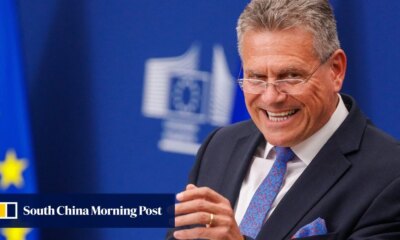
EU Commissioner Jozef Sikela was also in the capital consulting with government ministers, and a French business delegation was paying a visit to Greenland’s state-owned telecom company. The city’s hotels, restaurants and meeting rooms were packed with diplomats and executives who had flown in for a two-day business conference, seeking to get in on the seemingly endless opportunities on offer in minerals, energy, tourism and defence.
The US president’s fixation on the semi-autonomous Danish territory has put it in an uncomfortable, if potentially lucrative, position.
“Everyone is talking about Greenland,” one host declared in their opening remarks at the Future Greenland conference. Putting a positive spin on Trump’s sabre-rattling, local officials and business leaders argued that the newfound attention presented an opportunity for Greenland to attract the capital needed to diversify its economy, lessen its reliance on Danish subsidies and advance toward its long-held goal of independence.
This interest has also stirred old anxieties in a territory where many feel that outsiders have historically reaped the biggest rewards from its wealth. Partly because of Inuit traditions, which view land as a shared resource, and partly because of Greenland’s colonial past, many locals are wary of foreigners looking to play a role in their island’s economic development.
“As a society and as a population, we have been critical and somewhat sceptical of outside investors,” said Peter Christiansen, chief executive officer of Nalik Ventures, the territory’s state-backed investment and business development fund. That means that even if Greenlanders want development, “people are not always that keen on change.”
Trump’s threats to take over Greenland have deepened these concerns. Speaking to reporters on the sidelines of Future Greenland, Prime Minister Jens-Frederik Nielsen said that as Greenlanders “haven’t been treated particularly well politically,” they were inclined to be even more cautious.
That hesitance didn’t escape the attention of international visitors. In private conversations and closed events across Nuuk, company leaders and industry representatives questioned whether Greenland is truly open for business.
As if the challenges posed by the island’s remote geography, harsh weather and limited infrastructure weren’t enough, they pointed to a lengthy list of institutional hurdles: legal uncertainty, abrupt policy shifts as well as stricter new regulations that the government has introduced as it has sought to assert greater control over strategic industries.
As one Danish executive put it to a panel: “We’re talking about all these investments, but do you actually want them?”
Up until Trump put Greenland in the headlines, the vast, sparsely populated island of about 57,000 attracted relatively little attention from international investors, though official data on foreign direct investment isn’t available. That’s not for a lack of potential: Greenland contains vast fossil fuel and rare earth reserves, and its location between the North Atlantic and Arctic makes it interesting to the tourism and defence sectors.
In advance of the Future Greenland conference, the CIP Foundation think tank and industry lobbies unveiled a new investment catalogue identifying more than US$6.2 billion (S$8 billion) worth of potential infrastructure projects, from hydropower plants to data centres, mines and renewable energy developments.
Realising that vision, however, is a long ways away. “The best indicator of whether you have the right investment climate is whether the investments are actually there,” said Christian Keldsen, CEO of the Greenland Business Association.
By that measure, Greenland is still falling short of its potential.
“Things are moving a bit more slowly and with more friction than we would like,” he said.
Earlier in 2026, the state-owned renewable energy developer NunaGreen received just one tender bid for what was to be one of Greenland’s largest-ever infrastructure projects, forcing it to cancel and rethink its procurement process.
Meanwhile, Danish construction giant MT Hojgaard withdrew from the Greenlandic market late in 2025 after taking large losses.
SAS airline also abandoned a route between Denmark and Greenland this summer after just one year, saying that lower-than-expected demand and higher costs made the connection unprofitable.
“Everyone is very captivated by Greenland, but it is very difficult,” said Mads Qvist Frederiksen, executive director of the Arctic Economic Council, which represents companies working in the region.
He travelled to Nuuk alongside 20 business leaders from sectors including energy, construction and maritime who were eager to explore opportunities on the island.
Many left discouraged by an unpredictable regulatory landscape and after learning of high-profile disputes and troubled projects, he said.
The mining sector has been a focal point for these issues. Despite decades of hoping it could transform Greenland’s economy, only two small mines are currently in operation.
An iron ore project in Isua, which aimed to export vast quantities of ore for steel production, collapsed after its developer went bankrupt in 2014, and a subsequent effort to revive it failed. Other high-profile ventures spent decades under development without ever reaching production.
In Kvanefjeld, home to one of the world’s largest undeveloped rare-earth deposits as well as uranium, a project led by the Australian company Energy Transition Minerals spent nearly fifteen years in development. Then, in 2021, uranium became the defining issue of the territory’s parliamentary election.
Residents in a nearby town began protesting the Kvanefjeld plan, and it was effectively killed when lawmakers passed legislation banning uranium mining and exploration.
To the business community, the case became a prominent example of how easily large-scale projects in Greenland can be taken hostage by politics.
Daniel Mamadou-Blanco, managing director of Energy Transition Minerals, said the company was caught off-guard by the decision. While navigating political risk is standard for the mining industry, he said that Greenlandic authorities had made an effort to attract business to Kvanefjeld.
“We invested A$150 million (S$133 million). You invited us. And now at the last minute, you change the rules,” he said. “Had we known, we could have been focusing our efforts somewhere else.”
The case triggered arbitration proceedings against the governments of Greenland and Denmark and has yet to be heard in court.
Naaja Nathanielsen, a former business minister who oversaw the minerals portfolio when the uranium ban was introduced, acknowledged it triggered investor concern but said the restrictions applied only to uranium. The decision, she added, did not signal further bans.
Other regulatory moves have also rattled investors.
In 2025, after years of debate, a new fisheries law took effect that tightened ownership requirements and limited quota rights for individual companies. It was designed to reassert public control over the island’s most valuable natural resource, but drew sharp criticism from one of Greenland’s largest private employers.
Polar Seafood said the reforms effectively stripped away nearly a third of its quota base without compensation and recently warned that it could be forced to close a fish and shrimp processing plant that employs as many as 115 people.
The same year, the government also implemented a new law requiring tourism operators to obtain licences and have at least two-thirds Greenlandic ownership. With the territory preparing for a surge in visitors coinciding with the opening of three international airports, the move has drawn criticism from tourism operators and business groups warning it will deter foreign investment.
Such initiatives are designed to ensure that the island receives a “fair share” of the benefits it generates, said Nathanielsen, who currently serves as one of Greenland’s representatives in the Danish parliament. She pointed to how foreign investors in Iceland’s tourism sector capture most of the profits while local communities see little gain.
“What has generally driven the political motivation in Greenland has been that we should be the ones defining and developing our own resources,” she said.
Yet realising that ambition on its own is no easy task for a territory with a shrinking native population, a shortage of skilled workers and public finances expected to come under increasing strain.
For Greenland, that creates a dilemma. Achieving greater autonomy may require precisely the kinds of foreign investment that many Greenlanders view with suspicion. New mines, tourism projects and infrastructure could help reduce reliance on the roughly US$700 million it receives in annual subsidies from Denmark – about half of the island’s public revenue. Where to draw the line between openness and control, however, is fiercely contested.
At the same time, Greenland is making efforts to be more business-friendly. The government is pursuing corporate tax reforms, establishing a unit to cut bureaucracy and working on a strategy to bolster small and medium-sized companies, according to Prime Minister Nielsen.
New international airports and planned defense and infrastructure investments will also strengthen logistics and transport links. Meanwhile, mining companies such as Amaroq Minerals and Greenland Resources have recently secured fresh funding, indicating that some investors are still willing to commit capital.
“Yes, Greenland is open for business,” even if legislation at times favours local ownership and value creation, Nielsen said. “We need to be able to keep pace with our own development.”
As private investors and businesses weigh the risks of investing in Greenland, foreign governments are moving quickly.
Copenhagen recently unveiled a US$250 million infrastructure package for Greenland, and the European Commission has proposed more than doubling financial support for the territory to over €530 million (S$780.8 million) over seven years. It’s also preparing a major investment package focused on infrastructure, energy, digital connectivity and critical raw materials.
During his visit to the capital, France’s minister delegate for foreign trade, Nicolas Forissier, signed a cooperation agreement covering critical minerals and energy. He said he had been dispatched by President Emmanuel Macron to demonstrate that France’s expressions of support for Greenland were backed by concrete action.
“France is here to help,” he told reporters, adding that Trump’s remarks about Greenland had helped spur his government to engage more with the territory.
This extra funding is welcome. But according to local business leaders, the key to building a more self-sustaining economy is to attract private investment rather than rely on foreign government support.
Sikela, the European commissioner for international partnerships, rejected the notion that Europe was competing with the US for influence in Greenland, though he did grant that Trump’s interest had accelerated some initiatives.
A key goal of his trip, he said, was to discuss setting up a dedicated office that could help Greenland identify and develop EU-funded projects, navigate regulatory requirements and manage the influx of money.
“Business decides where and when to go,” he said, acknowledging that it takes more than political interest to attract investment. “But we can help make the environment more investment-friendly.”
With global interest in Greenland unlikely to fade any time soon, the debate over how to manage it rolls on. But pressure is mounting. Just days after the Future Greenland conference wrapped up, Trump shared a post on Truth Social featuring an AI-generated image of himself peering over the island’s mountainous coastline and colourful seaside homes.
The caption read simply, “Hello, Greenland!” BLOOMBERG