World
'Gotcha' Question On Iran Backfires As Hegseth Clashes With Democrat – WATCH

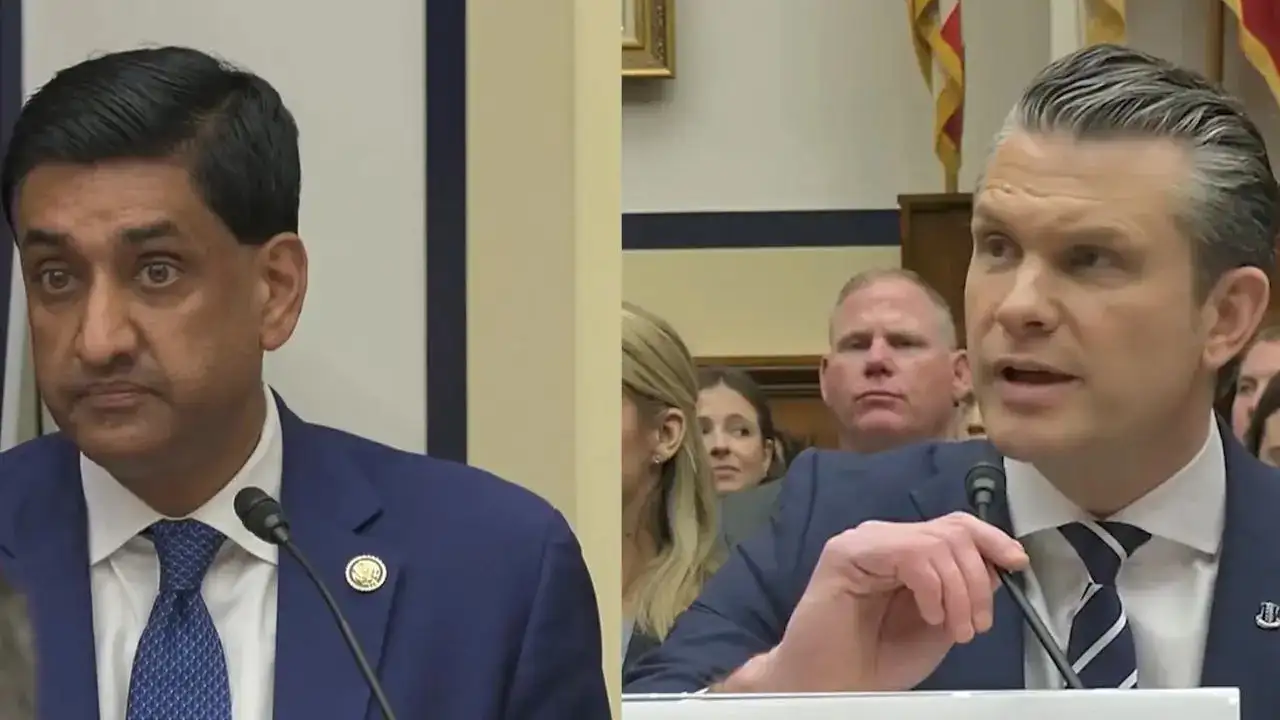
Washington witnessed a heated exchange over the Iran war costs and nuclear threat as US Defense Secretary Pete Hegseth clashed sharply with Democratic Congressman Ro Khanna during a House Armed Services Committee hearing on Wednesday. The confrontation quickly escalated into a debate over the costs of the ongoing conflict and the strategic stakes of preventing Iran from acquiring nuclear weapons.
The tension peaked when Khanna asked Hegseth on the financial toll of the war on American taxpayers. “Do you know how much it cost the taxpayer?” Khanna asked, citing estimates that the overall burden could exceed the $25 billion figure provided earlier by the Pentagon comptroller, with some projections placing the total economic impact at nearly $631 billion, or roughly $5,000 per US household.
Khanna further asked, “Do you know how much it will cost Americans in terms of their increased cost in gas and food over the next year because of Iran?”
Hegseth rejected the question, calling it a “gotcha” attempt to corner him. He pushed back, shifting the focus back to national security. “I would simply ask you what the cost is of an Iranian nuclear bomb,” Hegseth said. He doubled down with a pointed follow-up: “What would you pay to ensure Iran doesn’t get a nuclear bomb?”
The hearing comes amid an escalating and unstable situation in the Middle East following months of confrontation between the US and Iran. The conflict has seen intermittent strikes, economic disruption, and diplomatic breakdowns, although both sides have recently signalled cautious interest in de-escalation. A fragile ceasefire has held in parts of the region, but tensions remain high.
Iran recently offered to reopen the Strait of Hormuz, a critical global oil transit route that Tehran has used as leverage during the conflict. However, US officials have rejected the proposal in its current form, calling it insufficient and conditional on broader security guarantees. Washington has cited concerns over Iran’s continued enrichment activities and lack of compliance with previous agreements.
IRGC Asserts Control?
On the ground in Iran, internal instability has further complicated the picture. Reports suggest a growing power vacuum within the country’s political structure, with the Islamic Revolutionary Guard Corps (IRGC) increasingly asserting control amid infighting among civilian leadership factions.
Analysts say this has made decision-making in Tehran more unpredictable, as the hardliners push for a more confrontational stance against Washington.
War Toll Surges
The human cost of the conflict has also mounted. While precise casualty figures remain contested, both sides have suffered losses in recent months due to airstrikes, missile exchanges, and covert operations. Iranian infrastructure, including military facilities and at least one reported strike on a civilian-linked site, has been damaged in US-aligned operations. On the other side, American forces and allied assets in the region have faced retaliatory strikes, contributing to injuries and fatalities among military personnel.
Recent polling indicates that a majority of Americans disapprove of the administration’s handling of both the cost of living and the Iran conflict, adding pressure on policymakers.As diplomacy stalls and military tensions persist, Washington appears locked in a difficult balancing act.